Recommended resources
The freely available resources this lesson will direct you to.
Hello! Welcome back to our course on real estate investment metrics.
In the last lesson, we introduced the capitalization rate and used it to analyze a property's unlevered return based on its price (Rate = Income / Value). You learned how to calculate it and, crucially, how to interpret what a "good" cap rate means in the context of market risk and asset quality.
Today, we will flip that formula around. Instead of using the price to find the rate, we'll use a known market rate to determine what a property's price should be. This is the income approach to valuation, a fundamental method used by appraisers and investors worldwide to establish a fair market value for income-producing properties. Your goal for this lesson is to learn how to apply this approach (Value = Income / Rate) to make informed offers and identify potentially mispriced assets.
1. The Income Approach to Valuation
The income approach is a real estate appraisal method that estimates the value of a property based on the income it generates. The core principle is that a property's value is directly related to its ability to produce a future income stream. The cap rate provides a simple way to convert that annual income stream (the NOI) into a present value.
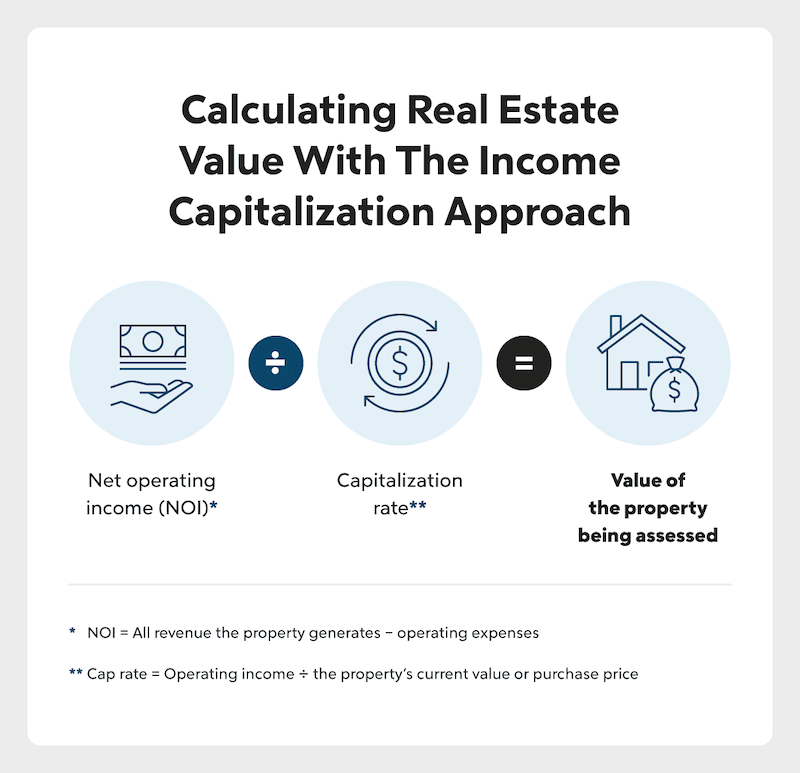
The formula is a simple rearrangement of the one we learned last time:
To effectively apply this, you need two critical inputs: an accurate NOI for the property you're analyzing and a well-justified market cap rate.
Let's start with a formal definition from Investopedia.
Income Approach: What It Is, How It's Calculated, Example
This article provides a clear definition of the income approach, explains how it works, and positions it among other real estate appraisal methods.
Please read the first two main sections: 'What Is the Income Approach?' and 'How the Income Approach Works.' Focus on understanding the core formula and the central idea that you are valuing a property based on the income it generates.
2. Finding the Right "Market Cap Rate"
This is the most crucial—and subjective—part of the income approach. You are not using the target property's own cap rate (which you wouldn't know without a price). Instead, you must determine the prevailing cap rate at which similar properties have recently sold in the same market.
Here's the process:
- Identify Comparables: Find several properties that have recently sold. They should be as similar as possible to your target property in terms of location, property type (e.g., residential multi-family), size, age, condition, and tenant quality.
- Calculate their Cap Rates: For each comparable property, find its sale price and its NOI for the year it was sold. Then, calculate its cap rate at the time of sale:
Cap Rate = NOI / Sale Price. - Determine the Market Cap Rate: Analyze the cap rates of your comparables. You might take a simple average or a weighted average, or you might select the rate from the single most comparable property. This becomes your "market cap rate."
The accuracy of your valuation is entirely dependent on the quality of your comparables and your justification for the chosen market cap rate.
3. A Practical Demonstration
Let's watch a short video that walks through a concrete example. The speaker first calculates a property's NOI, then uses an assumed market cap rate to derive the property's value.
How to Calculate the Net Operating Income (NOI) & Cap Rate for Real Estate Investments
This video segment demonstrates exactly how to apply the income approach. It connects the concepts of NOI and market cap rate to produce a tangible valuation.
Watch the clip from 07:32 to 09:11. Notice how the speaker takes the property's NOI (which he calculated earlier) and divides it by an assumed market cap rate (6% in this case) to arrive at a valuation. This is the core application of the method.
As the video shows, if the market expects a 6% return (the market cap rate) and a property generates an NOI of $98,568, then the market would value that property at approximately $1.64 million ($98,568 / 0.06). If you could buy it for $900,000, you have found an excellent deal.
Test your understanding!
You are analyzing an apartment building for sale in Valencia with an asking price of €1,200,000. You've done your due diligence and calculated its current Net Operating Income (NOI) to be €60,000 per year.
You find three recent, comparable sales in the area:
- Comp 1: Sold for €950,000 with an NOI of €52,250.
- Comp 2: Sold for €1,300,000 with an NOI of €68,900.
- Comp 3: Sold for €1,100,000 with an NOI of €59,400.
- Calculate the cap rate for each comparable property.
- Determine a reasonable average market cap rate.
- Using the income approach, what is the estimated value of the target property?
- Based on your valuation, is the property's asking price attractive?
Show answer
-
Cap Rates of Comparables:
- Comp 1: €52,250 / €950,000 = 5.5%
- Comp 2: €68,900 / €1,300,000 = 5.3%
- Comp 3: €59,400 / €1,100,000 = 5.4%
-
Average Market Cap Rate:
- (5.5% + 5.3% + 5.4%) / 3 = 5.4%
-
Estimated Value of Target Property:
- Value = NOI / Market Cap Rate
- Value = €60,000 / 0.054 = €1,111,111 (approximately)
-
Conclusion: Your estimated value (€1.11M) is less than the asking price (€1.2M). This suggests the property is likely overpriced by about €90,000 based on the current market. This gives you a data-driven basis for negotiation.
4. The Spanish Context: Método de Actualización de Rentas
Your interest is in the Spanish market, so it's important to know the local terminology and regulations. In Spain, the income approach is formally known as the método de actualización de rentas (income capitalization/discounting method).
It's not just an informal investor tool; it's a formal valuation method regulated by Spanish law, specifically Orden ECO/805/2003. This order sets the standards for real estate appraisals for financial purposes, such as obtaining a mortgage. This gives the method official weight.
¿Qué es el método de actualización de rentas?
This article from the Spanish valuation firm Gloval explains the 'método de actualización de rentas,' providing the official regulatory context and terminology.
Please read the full article. Pay special attention to: The name of the governing regulation (Orden ECO/805/2003). The conditions under which this method can be officially applied ('Requisitos'). The calculation steps ('¿Cómo se calcula...?'). Note that it mentions estimating future cash flows and reversion value. This is a preview of the more complex Discounted Cash Flow (DCF) analysis we will cover in Module 5. For now, our simple cap rate formula is a direct application of this principle. The factors influencing the 'tasa de capitalización' (capitalization rate).
This article gives you a glimpse into more advanced valuation, where instead of using a single year's NOI, appraisers project cash flows over many years. For now, think of the cap rate approach as the most direct and widely used application of this principle.
5. Python Implementation: From Comps to Valuation
Now, let's codify this process. We can write a script that takes a list of comparable sales, calculates the market cap rate, and then applies it to a target property's NOI to estimate its value. This automates the exact steps you just performed in the exercise.
# We can reuse the function from our last lesson
def calculate_cap_rate(net_operating_income: float, property_price: float) -> float:
    """Calculates the capitalization rate for a property."""
    if property_price <= 0:
        return 0.0
    return (net_operating_income / property_price) * 100

def estimate_value_from_income(net_operating_income: float, market_cap_rate: float) -> float:
    """
    Estimates a property's value using the income approach.

    Args:
        net_operating_income: The annual NOI of the target property.
        market_cap_rate: The prevailing cap rate for similar properties in the market (as a percentage).

    Returns:
        The estimated market value of the property.
    """
    if market_cap_rate <= 0:
        raise ValueError("Market cap rate must be positive.")

    return net_operating_income / (market_cap_rate / 100)

# --- Example Usage from our exercise ---

# 1. Define the target property
target_property_noi = 60000
target_property_asking_price = 1200000

# 2. Define the comparable sales (a list of dictionaries is a good structure)
comparable_sales = [
    {'sale_price': 950000, 'noi': 52250},
    {'sale_price': 1300000, 'noi': 68900},
    {'sale_price': 1100000, 'noi': 59400}
]

# 3. Calculate the market cap rate from the comparables
comp_cap_rates = [calculate_cap_rate(comp['noi'], comp['sale_price']) for comp in comparable_sales]
market_cap_rate = sum(comp_cap_rates) / len(comp_cap_rates)

print(f"Comparable Cap Rates: {[round(r, 2) for r in comp_cap_rates]}")
print(f"Calculated Average Market Cap Rate: {round(market_cap_rate, 2)}%\n")

# 4. Estimate the value of the target property
estimated_value = estimate_value_from_income(target_property_noi, market_cap_rate)

print(f"Target Property NOI: €{target_property_noi:,.0f}")
print(f"Estimated Value based on a {round(market_cap_rate, 2)}% market cap rate: €{estimated_value:,.0f}")
print(f"Asking Price: €{target_property_asking_price:,.0f}\n")

# 5. Conclude
difference = estimated_value - target_property_asking_price
if difference < 0:
    print(f"The property appears to be overpriced by approximately €{abs(difference):,.0f}.")
else:
    print(f"The property appears to be underpriced by approximately €{difference:,.0f}.")
This script provides a practical and reusable template for performing a quick valuation on any income property, a core task for any serious investor.
Conclusion
In this lesson, you've moved from simply analyzing a deal to actively valuing it. The income approach is an indispensable tool for determining a fair offer price based on a property's income-generating power and prevailing market conditions.
Key Takeaways:
- The income approach estimates a property's value by dividing its Net Operating Income (NOI) by the market cap rate.
- The most critical step is determining an accurate market cap rate by analyzing recent, comparable sales.
- This method allows you to move beyond an asking price and form your own data-driven opinion of a property's worth, which is the foundation of smart negotiating.
- In Spain, this method is formally known as the método de actualización de rentas and is backed by official appraisal regulations.
Preview of the Next Lesson:
The income approach is powerful but requires a full calculation of NOI. What if you need an even faster, "back-of-the-napkin" way to compare properties? In the next lesson, we will introduce the Gross Rent Multiplier (GRM), a simpler valuation metric that uses gross rent instead of NOI. We will explore how to calculate it and when it is (and isn't) an appropriate tool.