Recommended resources
The freely available resources this lesson will direct you to.
Hello! Welcome to the first lesson of our third module, where we pivot from analyzing property performance to determining property value.
In the previous module, we built a comprehensive pre-tax financial model, culminating in an amortization schedule that detailed your debt service and cash flow. All of that analysis was based on a given property price and your specific financing. Now, we're going to strip away the financing to evaluate a property's intrinsic profitability.
This lesson introduces the capitalization rate, or cap rate, one of the most widely used metrics in real estate. Our goal is for you to be able to compute the cap rate and interpret its meaning for property valuation. By removing the complexities of mortgages and leverage, the cap rate allows you to compare different investment opportunities on an equal footing, helping you quickly answer the question: "Is this property a good deal at this price?"
1. What is the Capitalization Rate?
At its core, the cap rate is the rate of return you would expect to earn on a real estate investment property if you were to buy it with all cash. It measures the property's income-generating potential relative to its market value.
In Spain, this is known as the tasa de capitalización. Let's start with a foundational video that explains the concept, how to calculate it, and, most importantly, what it includes and excludes.
How to Analyze Real Estate Rental Properties: Capitalization Rate Explained
To get a solid understanding of what cap rate is and why it's so fundamental, let's watch this excellent explainer from Sage Real Estate.
Watch from 01:00 to 04:50. Pay close attention to two key points: The definition of cap rate as a rate of return on the property's value. The components used to calculate Net Operating Income (NOI) and, critically, what is excluded (specifically, the mortgage payment).
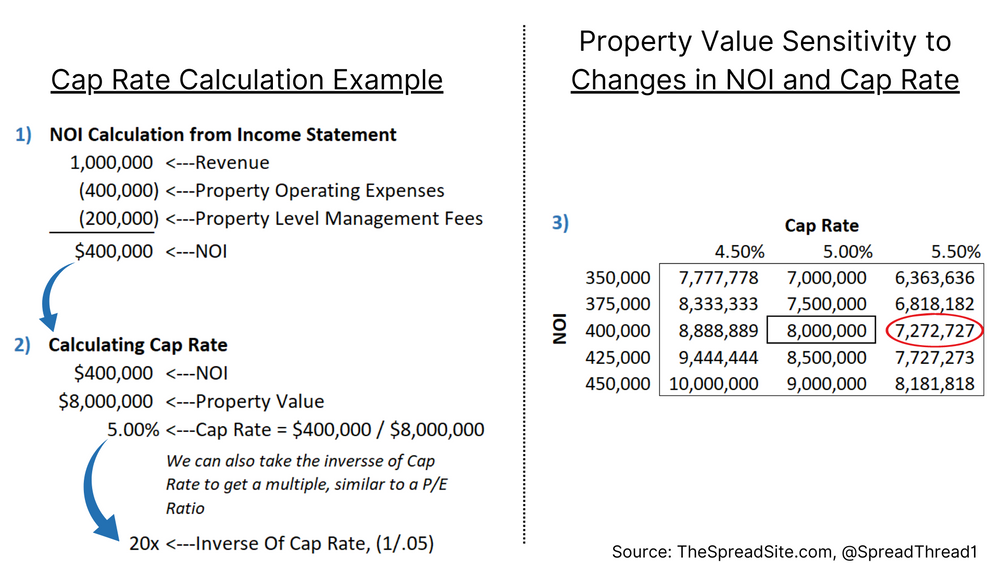
As the video highlighted, the formula for cap rate is simple but powerful:
The two inputs are:
- Net Operating Income (NOI): You'll remember this from Module 1. It's the property's annual income after all operating expenses but before debt service (mortgage payments) and income taxes.
- Property Value: This is typically the purchase price or the current market value of the property.
The single most important concept to grasp is that cap rate is independent of financing. By excluding mortgage payments, it measures the performance of the asset itself, not the deal you structured to buy it. This is what allows for a true "apples-to-apples" comparison between properties.
2. The "IRV" Formula: A Versatile Valuation Tool
The relationship between Income, Rate, and Value can be remembered with the simple "IRV" formula, which you can visualize as a triangle. This is a mental model that will serve you throughout your investment career.
The "IRV" formula can be rearranged to solve for any of its three components:
-
I / V = R(Income / Value = Rate): If you know a property's NOI and its price, you can calculate its cap rate. This is what you do when analyzing a property for sale. -
I / R = V(Income / Rate = Value): If you know a property's NOI and the prevailing cap rate for similar properties in the market, you can estimate its value. This is what you do when determining a fair offer price. This is the foundation of the income approach to valuation, which we will cover in the next lesson. -
V * R = I(Value * Rate = Income): If you know a property's value and the market cap rate, you can determine the NOI it should be generating. This is useful for spotting underperforming assets.
Let's see this in action.
How to Analyze Real Estate Rental Properties: Capitalization Rate Explained
The video you just watched continues by introducing a simple but powerful mnemonic for the IRV formula. This shows how you can use the same three variables to solve for whichever one you're missing.
Watch from 04:50 to 07:14. Focus on how the formula can be rearranged to calculate either the cap rate or the property's value.
Test your understanding!
You are analyzing a commercial property in Spain.
- The listing price is €1,500,000.
- After reviewing the financials, you calculate its Net Operating Income (NOI) to be €90,000 per year.
- Your research indicates that similar properties in this specific neighborhood are trading at a 5.5% cap rate.
- What is the cap rate of the property at its listing price?
- Based on the market cap rate, what would be a fair valuation for this property?
- Is the property likely overpriced, underpriced, or fairly priced?
Show answer
-
Calculate the property's cap rate:
- Rate = Income / Value
- Rate = €90,000 / €1,500,000 = 0.06 or 6.0%.
-
Calculate the property's value based on the market cap rate:
- Value = Income / Rate
- Value = €90,000 / 0.055 = €1,636,364.
-
The property's cap rate (6.0%) is higher than the market cap rate (5.5%). This means that for the same amount of income, the asking price is lower than the market average. Therefore, the property appears to be underpriced (or represents a good deal).
3. What is a "Good" Cap Rate?
The previous exercise leads to the inevitable question: what's a good cap rate? The answer is always: "It depends." A cap rate is a reflection of risk and market sentiment. There is no universally "good" number.
The following resource from a Spanish real estate consultancy provides an excellent overview of the factors that influence cap rates in the local market.
Qué es el Cap Rate: Descubre Cómo Mejorar tu Inversión
This article from Retlife explains why cap rate is so important and what factors drive it up or down, with specific context for Spain.
Please read the sections 'Por qué es importante en inversiones retail' and 'Factores que afectan al cap rate'. Focus on how cap rates are used for comparison and benchmarking, and note the key factors like location, tenant quality, and contract duration that determine whether a cap rate is high or low.
To summarize the key points:
- Higher Cap Rate = Higher Perceived Risk / Lower Price: An older property in a small town with a less reliable tenant will have a higher cap rate. Investors demand a higher return to compensate for the higher risk.
- Lower Cap Rate = Lower Perceived Risk / Higher Price: A new building in a prime location in Madrid, with a long-term lease to a major corporation, will have a lower cap rate. The investment is seen as safer, so investors are willing to pay a premium (accept a lower initial return).
For an investor, the goal is often to find a property with a higher cap rate than the market average for that asset class and location. This implies you are getting a better price for the income generated.
This video demonstrates the powerful inverse relationship between cap rate and value.
How to Analyze Real Estate Rental Properties: Capitalization Rate Explained
Let's revisit the video to see a practical demonstration of how cap rate and property value are inversely related. Understanding this is crucial for negotiation and identifying good deals.
Watch from 07:14 to 12:24. The speaker explains what makes a cap rate 'good' and then shows concrete examples of how lowering the cap rate dramatically increases the property's price, and vice-versa.
4. Implementing Cap Rate in Python
Given your software engineering background, you can see that the cap rate formula is straightforward to implement. It forms a core function in any real estate analysis software. The following article demonstrates a Python class built for this purpose.
Building an Intelligent Real Estate Investment Analyzer ...
This article on dev.to walks through building a 'Real Estate Investment Analyzer' in Python. We'll focus on how this simple but vital metric is implemented in a larger application.
Read the section '3. Financial Calculator Agent' and study the calculate_metrics method within the FinancialCalculator class. Notice how annual_noi is calculated first, and then used to compute the cap_rate.
Here is a simple, reusable Python function you can add to your toolkit.
def calculate_cap_rate(net_operating_income: float, property_price: float) -> float:
    """
    Calculates the capitalization rate for a property.

    Args:
        net_operating_income: The annual net operating income of the property.
        property_price: The market value or purchase price of the property.

    Returns:
        The capitalization rate as a percentage.
    """
    if property_price <= 0:
        raise ValueError("Property price must be positive.")

    cap_rate = (net_operating_income / property_price) * 100
    return round(cap_rate, 2)

# --- Example Usage ---

# Property details from our earlier exercise
noi = 90000
price = 1500000
market_cap_rate = 5.5

# Calculate the property's cap rate
property_cap_rate = calculate_cap_rate(noi, price)
print(f"Property with NOI of €{noi:,.0f} and a price of €{price:,.0f} has a Cap Rate of {property_cap_rate}%.")

# Compare to the market
if property_cap_rate > market_cap_rate:
    print(f"This cap rate is higher than the market average of {market_cap_rate}%, suggesting a potentially attractive price.")
else:
    print(f"This cap rate is not higher than the market average of {market_cap_rate}%, suggesting the price is at or above market value.")
5. Limitations of the Cap Rate
While cap rate is an essential screening tool, it's crucial to understand its limitations. It should never be the only metric you use to make an investment decision.
- It's a Snapshot in Time: It only uses one year of income and ignores future rent growth, changes in expenses, or potential appreciation.
- It Doesn't Account for Financing: While this is a strength for comparison, it doesn't tell you what your actual cash-on-cash return will be after your mortgage.
- It Can Be Manipulated: A seller might under-report expenses to inflate the NOI and make the cap rate appear more attractive. Diligent verification of the numbers is key.
- It's Not Applicable Everywhere: It's useless for properties that don't generate income, like raw land or a fix-and-flip project that you don't plan to rent out.
The video you watched earlier concludes with a good summary of these limitations (from timestamp 15:45).
Conclusion
In this lesson, you've learned to compute and interpret the capitalization rate, a cornerstone of real estate valuation.
Key Takeaways:
- The cap rate is the unlevered annual return on a property, calculated as NOI / Property Value.
- Its primary strength is removing financing from the equation, allowing for direct comparison between different properties.
- The IRV formula (Income / Rate = Value) is a versatile tool for analyzing deals and estimating value.
- A "good" cap rate is relative to the market, location, and risk profile of the asset. For a given income, a higher cap rate means a lower purchase price.
- Cap rate is a powerful initial screening metric but has significant limitations and must be used alongside other forms of analysis.
Preview of the Next Lesson:
Now that you can calculate and interpret cap rates, in our next lesson, we'll focus on the second use case of the IRV formula: using a known market cap rate to determine the value of a property. This is known as the income approach to valuation, a fundamental technique for real estate appraisers and investors.