Recommended resources
The freely available resources this lesson will direct you to.
Hello! Welcome to our next lesson.
In our last session, we investigated how capacitors and inductors combine in series and parallel, and we uncovered the physical reasons why their combination rules differ from those of resistors. We concluded that while resistors, capacitors, and inductors have distinct behaviors, they are all fundamental building blocks of circuits.
So far, our analysis has centered on DC—circuits with constant voltages and currents. Now, we will shift our focus to time-varying signals, which is essential for understanding how most of the world's electrical systems operate. This lesson directly addresses the learning outcome: Describe a sinusoidal signal using amplitude, frequency, period, and phase, and explain what each parameter represents physically.
Your goal of building deep, physical intuition is paramount here. We won't just memorize terms; we'll build a mental model of a sinusoidal wave from the ground up, connecting each descriptive parameter to a tangible, physical meaning. This will provide the foundation for analyzing AC circuits in the upcoming lessons.
1. From Rotation to Oscillation: The Birth of a Sine Wave
The most common and fundamental time-varying signal is the sine wave. You've likely seen it in math class, but its prevalence in electronics stems from a direct physical origin: rotation. The voltage generated by power plant alternators, the motion of a motor, and many other physical phenomena are based on rotation, which naturally produces sinusoidal waveforms.
To build an intuition for this, we'll start with a simple, non-electrical analogy: a Ferris wheel.
Sine Wave | Simple Explanation on a Giant or Ferris Wheel | Trigonometry | Learnability
The video 'Sine Wave | Simple Explanation on a Giant or Ferris Wheel' provides a fantastic visual analogy for how circular motion creates a sine wave. Pay close attention to how tracking the simple vertical up-and-down motion over time reveals the wave's shape.
Watch the segment from 00:33 to 02:52.
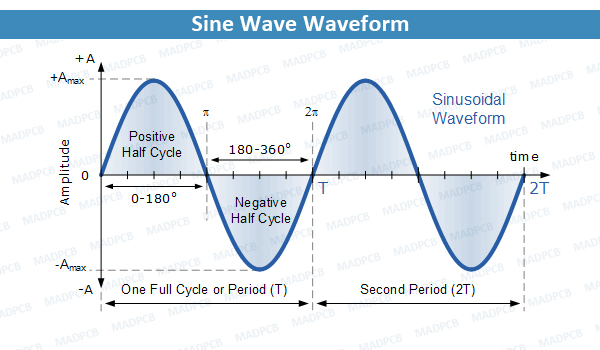
As you saw, if you only look at the vertical movement of the rider, they just go up and down. When you plot that simple vertical motion against time, the iconic sine wave emerges.
This is exactly analogous to how an AC generator works. A coil of wire rotates in a magnetic field. The voltage induced in the coil depends on the angle of the coil relative to the field. As it spins, the voltage rises to a maximum, falls through zero to a minimum, and then rises back to zero, tracing a perfect sine wave, just like the rider's height.
2. The Language of Waves: Amplitude, Period, Frequency, and Phase
To work with sine waves, we need a precise vocabulary to describe their characteristics. We'll explore four key parameters.
Amplitude (A)
The most basic property is "how big" the wave is. This is its amplitude. In our Ferris wheel analogy, the amplitude is determined by the radius of the wheel—a bigger wheel means a greater maximum height.
Sine Wave | Simple Explanation on a Giant or Ferris Wheel | Trigonometry | Learnability
Let's return to the Ferris wheel video to see how the wheel's size affects the waveform.
Watch the short clip from 02:52 to 03:36.
In an electrical circuit, amplitude represents the maximum or peak value of the voltage or current, denoted as or . It is the maximum displacement from the zero-center line.
Period (T) and Frequency (f)
The next characteristic describes "how often" the wave repeats. This can be described in two related ways:
- Period (T): The time it takes to complete one full cycle. In our analogy, this was the 20 minutes it took for the Ferris wheel to make one full rotation. The unit for period is seconds (s).
- Frequency (f): The number of cycles that occur in one second. This is the reciprocal of the period. The unit for frequency is Hertz (Hz), where 1 Hz = 1 cycle per second.
A high-frequency wave has a short period (it oscillates rapidly), while a low-frequency wave has a long period (it oscillates slowly).
Let's see how the speed of the Ferris wheel's rotation affects the wave.
Sine Wave | Simple Explanation on a Giant or Ferris Wheel | Trigonometry | Learnability
This clip from the Ferris wheel video demonstrates the concept of frequency.
Watch from 03:36 to 03:58. Notice how a faster rotation (shorter period) results in a more 'compressed' wave on the time axis.
For a more formal definition, let's watch another short video that clearly defines these terms in an electronics context.
What is a Sine Wave - why it is an important electronic waveform
The video 'What is a Sine Wave' from ElectronicsNotes gives clear, standard definitions for period and frequency.
Watch the segment from 04:33 to 05:43.
To give you a real-world anchor, the standard power line frequency in North America is 60 Hz, meaning the voltage completes 60 full cycles every second. Its period is milliseconds. In Europe and many other parts of the world, the standard is 50 Hz.
Phase ()
Phase is perhaps the most abstract parameter. It describes the wave's starting position or its timing relative to a reference. Think of two identical Ferris wheels side-by-side. If they start at the same time, their sine waves are in-phase. But if one wheel starts a few moments after the other, their waves will be offset from each other. This offset is the phase difference.
Phase is measured in degrees (°) or radians (rad), referencing the angle of the rotating generator.
- A 360° (or radian) phase shift means the wave is shifted by one full cycle, so it looks identical to the original.
- A 180° (or radian) phase shift results in a wave that is perfectly inverted.
- A 90° (or radian) phase shift corresponds to a cosine wave if the original was a sine wave.
When comparing two waves of the same frequency:
- The wave that reaches its peak or zero-crossing first is said to be leading.
- The wave that reaches its peak or zero-crossing later is said to be lagging.
The following reading explains this concept very clearly.
The webpage 'AC phase' from ElectronX Lab provides an excellent explanation of phase shift, including the important concepts of leading and lagging waveforms.
Please read the entire 'AC phase' section. Focus on the diagrams that illustrate different phase shifts (0°, 90°, 180°) and the definitions of 'leading' and 'lagging'.
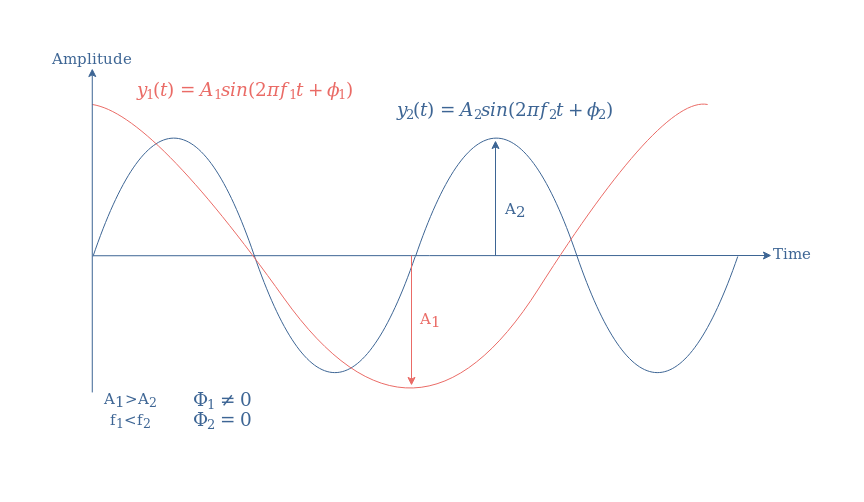
The image below shows two waves with different amplitudes, frequencies, and a non-zero phase shift, illustrating all the concepts we've discussed.
3. The Mathematical Description of a Sine Wave
Now that you have the physical intuition, we can put it all together into a single mathematical expression. This equation is a powerful shorthand that contains all four of our descriptive parameters.
A sinusoidal voltage as a function of time can be written as:
Let's break this down:
- : The instantaneous voltage at any given time .
- : The Amplitude (or peak voltage).
- : The entire argument of the sine function is the phase in radians.
- (phi): The phase angle or phase shift in radians. It determines the value of the wave at .
- (omega): The angular frequency, measured in radians per second. It's related to the frequency in Hertz by the formula: This relationship comes directly from the rotational analogy: one full cycle (corresponding to frequency ) is a rotation of radians. The angular frequency is simply how many radians are swept per second.
To solidify these mathematical concepts, the following text provides a detailed walkthrough.
Sine Wave as a Periodic Sinusoidal Waveform
The webpage 'Sine Wave as a Periodic Sinusoidal Waveform' ties together the geometry of the unit circle with the mathematical formula for a sine wave.
Read the sections 'Angular Velocity of a Sine Wave' and 'Phase Difference of Two Waveforms'. These sections formally define angular velocity (\omega) and show how the phase shift (\phi) is incorporated into the sine wave equation.
Conclusion
In this lesson, we have built a foundational understanding of sinusoidal signals, the bedrock of AC circuit analysis. We moved from an intuitive physical model—a rotating wheel—to a precise technical vocabulary and a compact mathematical representation.
Key Takeaways:
- A sine wave is a periodic signal that arises naturally from rotation.
- It can be fully described by four key parameters:
- Amplitude (A): The peak value or maximum displacement from zero.
- Period (T): The time required to complete one full cycle.
- Frequency (f): The number of cycles per second (), measured in Hertz (Hz).
- Phase (): The timing offset of the wave relative to a reference, measured in degrees or radians.
- The general mathematical expression for a sine wave is , where is the angular frequency.
Preview of the Next Lesson:
Now that we can describe the voltage and current of a sinusoidal signal, the next logical question is: how much power does such a signal deliver? In our next lesson, we will explore the concepts of instantaneous and average power for time-varying signals. This will connect our new understanding of AC waves back to the crucial topic of energy and work in a circuit.