Recommended resources
The freely available resources this lesson will direct you to.
Hello. In the previous lesson, a point away from the chosen focus distance produced a geometric blur circle whose diameter shrank when the aperture was stopped down. That calculation described how much a point blurs; it did not say how much blur you can accept.
This lesson supplies that missing criterion. We will calculate the near and far limits of depth of field, then find the hyperfocal focus setting that places the far limit at infinity. The distinction matters throughout: depth of field is a range defined by a specified tolerance, not a region in which every object is perfectly focused.
Decide what “acceptable” means
Let be the largest permitted diameter of a geometric defocus circle on the image plane. A scene point passes our depth-of-field test if its calculated blur diameter is no greater than . Only points at the chosen focus distance are in exact geometric focus; the others within the range merely pass the test.
There is no universal value of . Suppose an image is enlarged eightfold and you will permit a blur diameter on the final print. The corresponding image-plane criterion is . A larger enlargement, a tighter print criterion, or closer inspection would call for a smaller image-plane value. For a sensor-level assessment, you might instead specify a tolerance relative to pixel pitch—but pixel count alone cannot determine what will look sharp in a particular finished image.
A historical convention for a frame with an approximately diagonal is to choose a circle around , roughly the diagonal divided by 1500. We will use that value for an example, not as a physical constant. Cropping or changing the intended output can invalidate it without changing the lens at all.
Depth of Field Outside the Box - Dick Lyon
Read Dick Lyon’s discussion of how a circle-of-confusion criterion is chosen. It is useful here because it treats the criterion as an imaging decision rather than silently embedding a conventional number in a formula.
In “Choosing the COC Criterion,” start at the paragraph beginning “The idea of choosing the maximum permissible COC” and read the historical criteria, stopping after the examples of typical values for 35 mm photography. Then find “COC and Megapixels” and read the sensor-level alternative, ending after Lyon explains why a higher resolution requirement calls for a tighter criterion. Focus on what each proposed number assumes about the use of the image.
Carry the blur calculation into subject space
We will keep the ideal thin-lens model used previously. Let be focal length, entrance pupil diameter, the nominal f-number, and the subject distance at which the camera is focused. All distances are measured from the thin lens. A candidate scene point is at distance , while the image plane remains fixed at the position appropriate to .
The supplied ray diagram shows this arrangement with different letters. Its is our focused distance , its is our candidate distance , its is our pupil diameter , and its is the actual blur diameter—not our permissible limit .
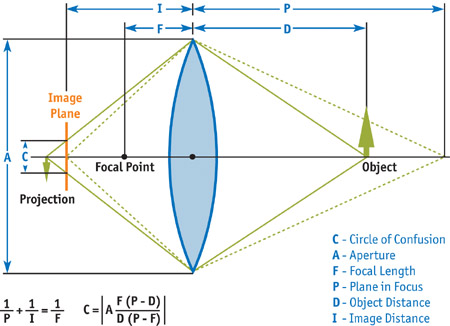
The thin-lens equation gives the image positions for the focused subject and candidate point:
From the similar-triangle result in the previous lesson, the candidate point’s circle diameter at the fixed image plane is
Substitution eliminates the image distances:
This expression is the bridge from image-plane blur to subject-space depth of field. It also explains why the bounds will not generally lie equal distances in front of and behind : the subject distance appears in the denominator.
Lyon develops a complementary construction by projecting the acceptable blur back into subject space. His variables describe an angular blur criterion rather than directly fixing on the image plane.
Depth of Field Outside the Box - Dick Lyon
Return to Dick Lyon’s Depth of Field Outside the Box to see the same near-limit, far-limit, and hyperfocal questions posed using cones in subject space. Compare that construction with the image-plane circle we have just calculated.
In “Finding Depth of Field,” begin at “The problem is set up as shown in Figure 2,” and follow the cone construction through the paragraph interpreting the hyperfocal result, just before “Algebraic Observations.” Inspect Figures 2 and 3 alongside the equations. Lyon’s d is the lens-opening diameter; his e is an angular acceptable-blur criterion. Notice that holding an angular criterion fixed is not quite the same parameterization as holding our image-plane c_0 fixed while changing focus.
Find the near and far limits
A scene point is acceptable when . Define the dimensionless quantity
Our blur test becomes . Solving it separately for a point nearer than and a point farther away gives
and, provided ,
If , the far limit is infinity: even rays from an infinitely distant point meet the stated geometric blur tolerance. When the far limit is finite, the total depth of field is . Quoting the two limits is often more informative than quoting only their difference.
These formulas also show why “one third in front, two thirds behind” is not a general depth-of-field rule. The far bound recedes rapidly as approaches one, while the near bound changes smoothly. Near and far distances measured from the focus plane are therefore not generally symmetric.
The hyperfocal setting
At the boundary , infinity has a blur diameter exactly equal to . Solving for the focus distance defines the hyperfocal distance
Here is a focus setting, not an object distance at which every point beyond it comes into exact focus. If you focus at , the far acceptable limit is infinity. Substituting into the near-limit equation gives in this centered, ideal thin-lens model. The often-quoted “half the hyperfocal distance” result is thus tied to the stated blur criterion and model.
Focusing at infinity does something different. Taking the infinity-focus limit of the blur equation, its near acceptable point is , approximately when is much larger than . Focusing at instead extends the acceptable foreground inward to , at the cost of allowing the distant background to reach the blur limit . It does not make infinity sharper than infinity focus does.
For ordinary subject distances much greater than , the small focal-length corrections can be dropped. With , the useful estimates are
Use the expressions involving when calculating from a specified thin-lens setup, especially if the subject is relatively close.
Put a stated criterion to work
Consider a lens at f/8, focused at , with . Keeping the calculation in millimetres,
Since , the far limit will be finite. Inserting the focus distance gives , and hence
Thus, for this criterion, points from about to pass the geometric blur test. If infinity must also pass it, focusing at approximately moves the near limit to approximately .
Now keep the lens, aperture, and focus setting unchanged, but tighten the permitted circle to . The hyperfocal distance becomes about , and the acceptable range contracts to approximately –. Nothing optical changed between those two calculations; only the standard for acceptable blur changed.
Stopping down is a physical way to shrink the geometric circles. At f/16 with the original criterion and focus setting, the calculated range runs from about to infinity. But recall the previous lesson: at visible wavelengths, f/16 also produces a larger diffraction pattern than f/8. These depth-of-field bounds test geometric defocus alone; they do not guarantee that all detail within the range has equal contrast or that f/16 is the best aperture for the finished image.
What the calculation does—and does not—promise
The method has a reproducible sequence: state and its intended output conditions; specify , , and ; calculate ; then calculate the near and far limits. Alternatively, calculate first to see whether the chosen focus distance reaches infinity. Without the first step, a depth-of-field figure is missing its acceptance criterion.
Our exact expressions are exact only within the adopted geometry: an ideal thin lens, a centered pupil, paraxial rays, and a fixed image plane. Real lenses can move pupil positions, change focal length during focusing, and add aberrational blur. At close focus, lens extension is no longer negligible, so casual distant-focus approximations become particularly unreliable. Most importantly, as you saw previously, diffraction and geometric defocus are not interchangeable definitions of sharpness.
Depth of field is therefore an engineering tolerance calculation, not a map of equally sharp planes. In the next lesson, we will examine aberrations—ways a real lens can produce distinctive blur and distortion even when the geometric focus setting is correct.