Recommended resources
The freely available resources this lesson will direct you to.
Hello! In the previous lessons, you identified a message’s bottom line and distinguished what it is trying to do: inform, request, recommend, decide, or warn. Now you’ll turn that judgment into a one-sentence BLUF—a bottom line up front that tells a particular audience both the main point and why it matters to them.
A sentence can be accurate yet still leave its reader wondering, “What does that mean for me?” This lesson focuses on closing that gap. Allow about 35–40 minutes to watch, read, and follow the revisions below.
Put the outcome before the story
Imagine someone asks for a quick project update during a meeting. You could begin with the delivery problems, the approvals you obtained, and the work still under way. Or you could first say whether the work is on track for the date they care about. Both accounts may be accurate, but only the second lets them use the answer immediately.
Watch the comparison in Jeff Su’s The 1 Tip to Improve Your Communication Skills at Work. The useful distinction is not “short versus long”; it is outcome first versus process first.
The 1 Tip to Improve Your Communication Skills at Work
Watch Jeff Su compare a process-led progress report with a BLUF-led one. The example shows how the first sentence can answer what a busy recipient needs to know.
Watch the two updates. Notice what the director can tell from the opening of the second version: whether the final video will be ready for review, and when. The shipping and scheduling details still have a place, but they are not required to understand that first sentence.
The useful opening in that example does more than say “the project is progressing.” It connects progress to the director’s review date. “For your review by April 1” makes the update relevant to the person receiving it.
That gives you a working definition: a one-sentence BLUF states the message’s main point and connects it to an audience need—something the recipient can now know, plan, decide, or do. The connection need not be dramatic. A review date, a required response, or a change to someone’s schedule may be enough.
The direct approach places essential information first. Read two short passages from 2.1: Examining the Direct Approach in Writing in a Technical Environment. The text discusses a whole message; for now, concentrate on how its opening works.
2.1: Examining the Direct Approach – Writing in a Technical Environment (First Edition)
Read the explanation of the direct approach to see why a reader should be able to grasp the point before reading the background.
Under “The Direct Approach: Like a Pyramid?”, begin with the paragraph starting “When writing a direct message” and continue through the drafting tip. Then find “What are the key characteristics of the direct pattern?” Read its opening paragraph, especially the first-sentence test, stopping before “What are the benefits of the direct pattern?” Focus on what a reader should understand even if they read no further.
The reading offers a useful private prompt: “I want to tell you that…” Complete it before you polish your sentence. “I want to tell you that we had three meetings” may describe your activity. “I want to tell you that the revised plan is ready for approval” is closer to a point your recipient can use.
Make relevance specific to the reader
Once you know the point, ask who will receive it. The same event can matter for different reasons. Suppose a review meeting originally scheduled for Wednesday has moved to Thursday:
- To an attendee: “The review meeting has moved to Thursday, so please update your calendar.”
- To someone preparing slides: “The review meeting has moved to Thursday, giving you an extra day to finalize your slides.”
Both sentences report the same change. The second half of each sentence supplies a different connection to the reader’s work. Neither needs to explain why the meeting moved unless that reason affects what the reader needs to do.
The CDC’s Your Guide to Clear Writing is written for public-health communication, but its questions about audience, objective, and main message apply here. Its guidance allows a main message of one to three sentences; your aim in this lesson is to make one sentence carry the point and its relevance.
Read the CDC guide’s discussion of a communication objective and a main message. It will help you distinguish what you want to say from what the audience needs to take away.
On printed page 5, find the paragraphs labeled “Communication Objective” and “Main Message.” Read from objective to placement, stopping before the advice about making the message stand out visually. Focus on how the audience’s desired takeaway governs what belongs in the opening.
For a professional BLUF, relevance commonly takes one of three forms:
- Consequence: “The revised figures are higher, so the proposed budget will not cover the work.”
- Use: “The draft is ready, so you can begin your review.”
- Response needed: “Please approve the draft by Thursday so the team can proceed with the scheduled release.”
These are not interchangeable endings to attach mechanically. Use the connection the audience actually needs, and only if you can support it. “This is important” does not tell a reader how it matters; an invented consequence is worse.
Draft one sentence, then tighten it
A practical drafting sequence starts before you choose elegant wording. First, identify the recipient’s immediate concern. Next, state the point you established in the earlier lessons. Then connect the two in one sentence.
Suppose you need approval of a report before a scheduled Friday review. Your first thought might be:
“I wanted to let you know that we have been working on the report and have incorporated comments from several people.”
That tells a story about the work, but the recipient still does not know what you need. A more useful BLUF is:
“Please approve the revised report by Thursday so it is ready for Friday’s review.”
The sentence leads with the request. “By Thursday” makes the requested response usable, and “for Friday’s review” explains its relevance. The history of the comments can follow if the reader needs it; it does not have to compete for space in the opening.
A one-sentence BLUF does not always request action. Match the verb and the relevance to the message’s actual purpose:
| If the point is… | A possible one-sentence BLUF |
|---|---|
| An update | “The revised report is ready, so you can begin your review today.” |
| A recommendation | “I recommend delaying the release until testing is complete to reduce the risk of customer disruption.” |
| A settled decision | “We have moved the review to Thursday, so please plan around the new date.” |
| A risk | “The backup has failed, so files changed tonight may not be recoverable.” |
Notice the difference between a consequence and an overclaim. The warning says files may not be recoverable; it does not claim they have already been lost. Likewise, “We have moved the review” is appropriate only if the change is settled. Writing directly does not give you permission to turn a possibility into a fact.
One sentence is a constraint on focus, not an invitation to cram every detail between two full stops. If your draft contains two unrelated updates or several separate requests, decide which point the recipient chiefly needs now. Other information may belong later in the message—or in a separate message.
Learn from a BLUF’s visible parts
The diagram below separates a subject label, an opening BLUF, and background information. Look particularly at where the approval request appears.
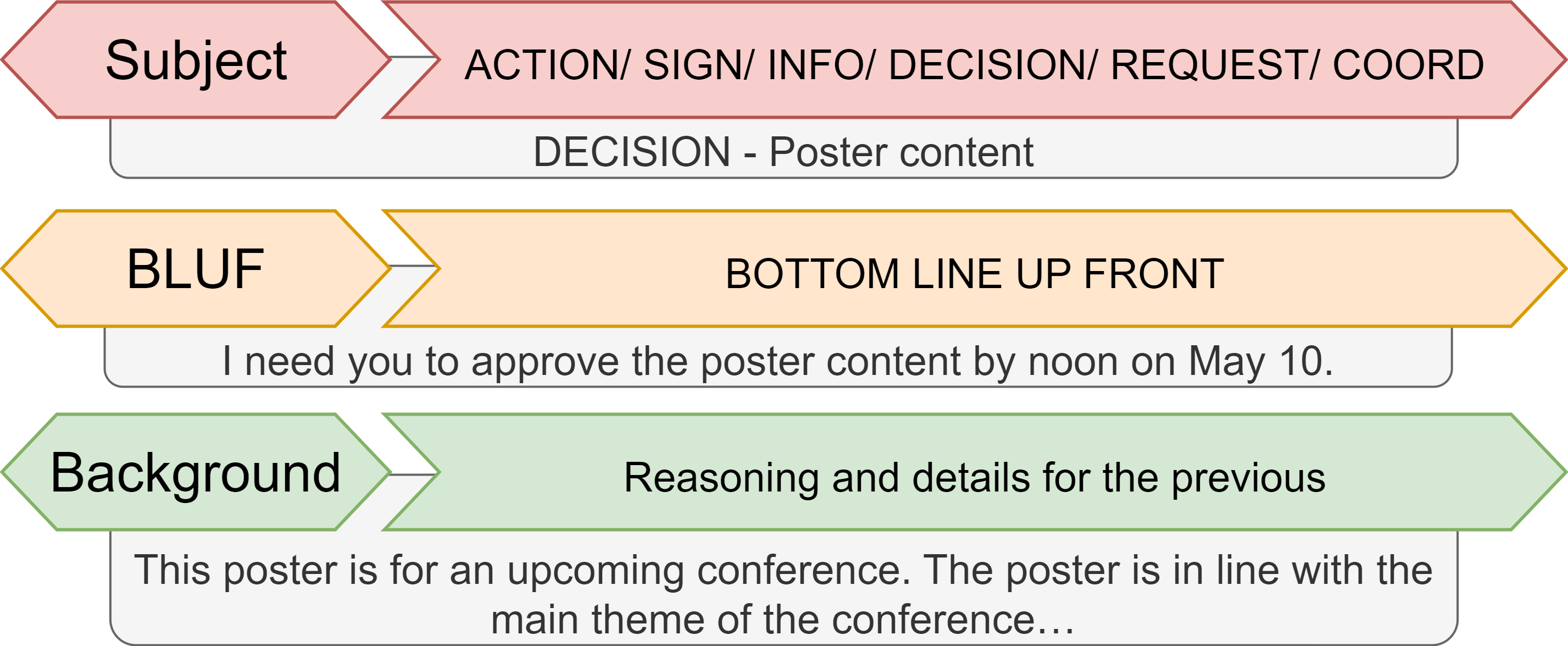
The subject identifies the topic. The BLUF states the request and deadline. The background provides context. That distinction is useful because “Poster content” is not a bottom line, and a description of the conference alone would not tell the recipient what to do.
The pictured sentence already makes the requested action clear. Whether it needs more relevance depends on what the recipient knows. If approval is needed to finalize conference materials, a writer could make that connection explicit:
“Please approve the poster content by noon on May 10 so we can finalize the materials for the upcoming conference.”
The added consequence is useful if it is true. If the sender does not know why noon is the cutoff, they should find out rather than invent a justification. And if the recipient already understands the reason, the diagram’s shorter request may be sufficient. Audience relevance is about giving the reader what they need, not adding a “so” clause to every sentence.
Before leaving a draft, read its first sentence on its own. Can the recipient identify the main point without the background? Can they see why that point concerns them? If either answer is no, revise the sentence before adding more explanation.
Takeaway
A strong one-sentence BLUF combines the main point with its relevance to a particular audience. Lead with the result, request, recommendation, decision, or risk—not the path you took to discover it. Make the connection concrete through a consequence, a use, or a needed response, and keep every claim accurate.
In the next lesson, you’ll decide which supporting facts belong after that sentence so the BLUF is credible and actionable without burying it.