Recommended resources
The freely available resources this lesson will direct you to.
Hello! Last time, you practiced writing a one-sentence BLUF that states the main point and why it matters to its audience. This lesson starts immediately after that sentence: which facts should you add so the reader can trust the point and act on it? Allow about 35–40 minutes for the short video, readings, and examples.
Give the point support, not a history
A BLUF should make sense even if someone reads only the opening sentence. But a reader considering a consequential request may reasonably ask, “What makes you say that?” or “What do you need from me, and when?” Supporting facts answer those questions. They do not document every meeting, test, or conversation that preceded your conclusion.
Watch two portions of How to talk like a consultant using the Pyramid Principle from MissAngieLu. The workplace example makes the distinction between reasons that support a recommendation and activity that merely describes the work.
How to talk like a consultant using the Pyramid Principle
Watch how the speaker moves from a main sentence to selected support, then contrasts two ways of answering a workplace question.
Watch the core idea, beginning with the pyramid description: the speaker distinguishes evidence and useful insights from every step taken to reach them. Then watch the workplace example, from the question about a market study through the improved reply. Notice that the first reply lists people consulted, while the second gives reasons for the recommendation.
The improved reply gives the listener grounds to understand the recommendation. Those reasons would still need evidence if the listener were about to commit substantial resources; a concise answer is not a substitute for substantiation. The lesson is to select support appropriate to the decision at hand.
A useful boundary comes from the “umbrella” explanation in BLUF Writing Format. This PDF was written for intelligence analysis, but its test for whether a detail belongs under a particular point transfers well to everyday professional messages.
Read the passages on the BLUF as an umbrella and on substantiating a claim. Use them to distinguish relevant support from a detail that belongs elsewhere.
On p. 2, under “Bottom Line Up Front (BLUF),” read the umbrella explanation. Start at the sentence defining what the first sentence does and stop after the sentence about the importance of following details. On p. 3, under “Analysis,” begin at the sentence about communicating accurately, briefly, and clearly; read the substantiation passage, stopping before the closing sentence about naming the section. Focus on the connection between an assertion and the facts offered to support it.
The umbrella test is straightforward: Does this detail help explain, substantiate, qualify, or act on the BLUF? If not, it may be important to a different message, but it does not earn space here. A recommendation is a judgment; the supporting facts let the reader assess that judgment rather than simply accept it.
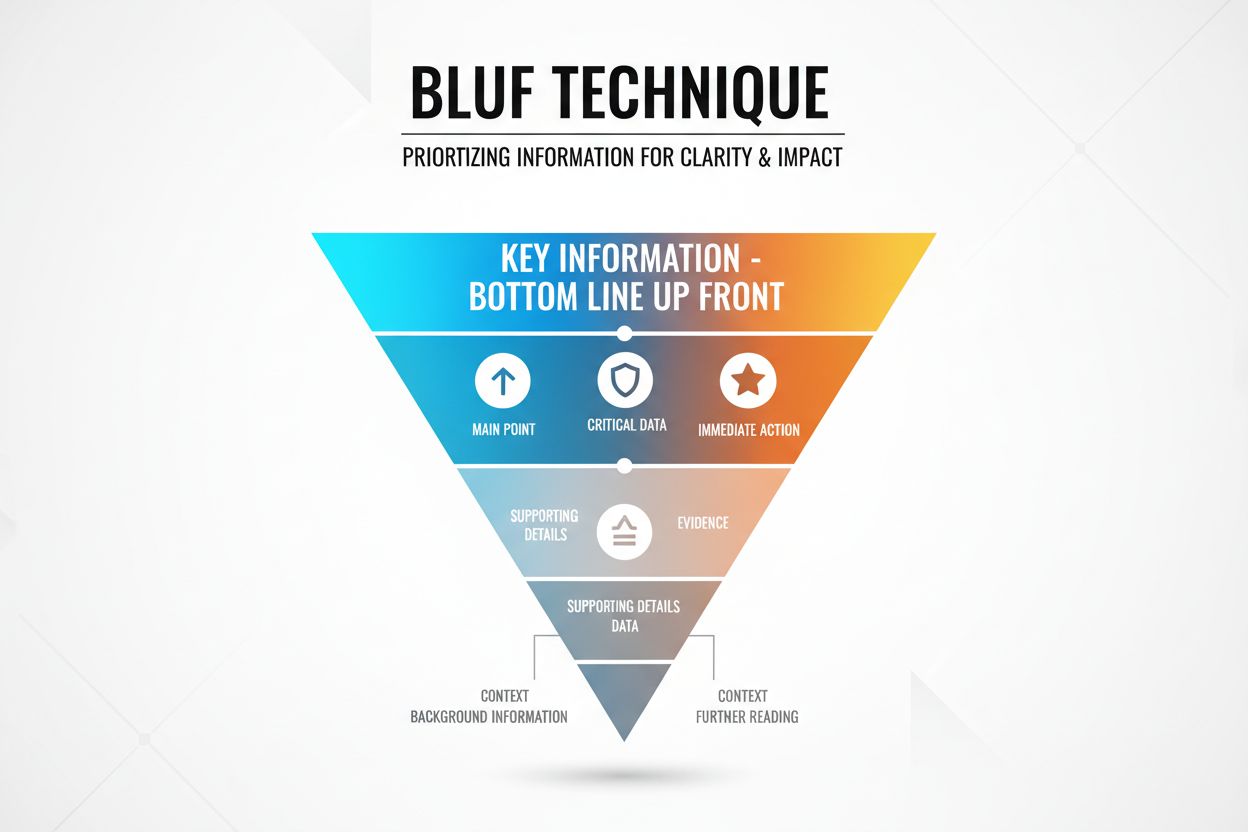
The inverted pyramid below offers another way to see the priority. Its broad top contains the main point, critical information, and immediate action. Less essential detail and background occupy progressively less prominent space. It illustrates priority, not a rule that every figure must fit inside your opening sentence.
Choose facts that change confidence or action
Specificity often helps, provided the specific fact is relevant and accurately described. Read Jeff Gothelf’s Effective Storytelling: Bottom Line Up Front Explained for an example that uses figures to show the scale of a business problem.
Effective Storytelling: Bottom Line Up Front Explained
Read the example and its discussion of specificity. Consider which figures help an audience judge the proposed solution and what further evidence that solution might require.
Under “Bottom line up front,” start with the paragraph introducing the framework and read through the business example, stopping at the paragraph immediately before “Specificity for short attention spans.” Then read the specificity section from its first sentence to its final question, stopping before “Be concise, be precise and nail your next presentation.” Pay attention to what each number measures, not just how striking it sounds.
A figure such as the share of requests concerning one issue helps establish its scale. A cost figure can help an audience judge whether addressing it warrants attention. But the figures do not, by themselves, prove that a proposed tool will solve the problem. Nor should a share of requests be described as a share of staff time unless time has actually been measured. Precise numbers make a message credible only when the measure, scope, and conclusion match.
When selecting facts, give each candidate a job:
- Substantiate the point: What observed result or dependable information supports the claim?
- Show its significance: What scale, consequence, or constraint matters to this audience?
- Enable action: What deadline, condition, or dependency would change what the recipient does?
- Set an honest boundary: What uncertainty must the reader know to avoid mistaking a test result, estimate, or possibility for a confirmed outcome?
You will not need all four kinds of fact in every message. A routine update may need only one decisive result. A recommendation with a deadline may require evidence, a limitation, and the time by which a decision is needed. The test is not “Have I included three facts?” It is “Would removing this fact change the reader’s understanding, confidence, or next step?”
Select from a messy set of notes
Suppose you are asking for a decision about a checkout release scheduled for Friday. You have drafted this BLUF:
Please approve delaying Friday’s checkout release until payment tests pass, so we avoid releasing an unresolved checkout risk.
Your notes contain the following facts:
| Note | Does it belong in this message? |
|---|---|
| Two of ten payment checks failed in Tuesday’s staging test, both using a supported card type. | Yes. This is the observed basis for concern, with enough detail to understand its scope. |
| The test took place before release; it does not show that customers have experienced failed payments. | Yes, briefly. This prevents an exaggerated claim about current customer impact. |
| The team is investigating and plans to rerun the checks Friday morning. | Yes. The reader needs to know how the unresolved condition will be checked. |
| Support needs a postponement decision by 3 p.m. Thursday to update its release notice. | Yes. This makes the approval request actionable. |
| The team held three planning calls about the release. | No. The calls neither establish the payment risk nor change the decision. |
| The checkout screen’s colors were revised twice. | No. This does not bear on payment testing or the requested postponement. |
The selected facts could follow the BLUF like this:
Two of ten payment checks failed in Tuesday’s staging test, both using a supported card type. This is a pre-release result, not evidence that customers have experienced failed payments. The team is investigating and plans to rerun the checks Friday morning. Please decide by 3 p.m. Thursday so support can update its release notice.
Notice what each sentence contributes. The failed checks support the risk. The staging qualification keeps the claim within the evidence. The planned retest explains the condition for proceeding. The deadline tells the reader when their answer becomes useful. The planning calls may have consumed considerable effort, but effort is not evidence that the proposed delay is necessary.
Selection also means noticing what you do not yet know. If investigation shows that the failures affect only an unsupported test condition, the recommendation may change. You should not retain the original claim merely because you have already written a persuasive message.
Stop when the remaining detail no longer helps
Imagine adding five more sentences explaining who ran each check, how long the investigation has taken, and who attended a release meeting. A reader might learn more about the project while becoming less certain of what matters to the decision. Brevity here is not withholding relevant evidence; it is protecting that evidence from competition.
Before sending a BLUF message, scan its supporting facts in light of the audience’s immediate task. If the recipient must approve a delay, include the evidence for delaying and the decision deadline. If the recipient only needs to know that a release date has changed, the test-by-test account may be unnecessary. And if a claim is still uncertain, state the uncertainty rather than filling the gap with a confident-sounding estimate.
You can keep a fuller record elsewhere. A concise message need not contain everything you know; it must contain what the reader needs to assess this point and respond appropriately.
Takeaway
A credible, actionable BLUF has selective support: facts that substantiate its claim, establish relevant significance, identify a necessary action or constraint, or prevent a misleading interpretation. Favor observed results over descriptions of effort, give numbers their proper scope, and omit details that do not change the reader’s confidence or next step.
Next, you’ll arrange the BLUF and its selected support into a message that readers can follow quickly: bottom line, rationale, then detail.