Recommended resources
The freely available resources this lesson will direct you to.
Hello! Last time, you practiced finding the bottom line: the point a recipient most needs to take away. Now you’ll give that point a more precise label. Is the message chiefly informing, requesting, recommending, deciding, or warning?
That distinction matters because two messages about the same situation can call for very different responses. “The deadline is Friday” gives you information. “Please submit your draft by Friday” asks you to act. This lesson focuses on recognizing the sender’s primary purpose, even when a message does several things at once.
Classify the job the message is doing
A message’s topic is what it concerns; its purpose is what the sender is trying to accomplish with the recipient. A message about a project delay might simply report a new date, ask for help, propose a solution, announce a change, or alert people to a risk.
Use these five labels as a working vocabulary:
| Primary purpose | What the recipient chiefly needs to grasp | Example |
|---|---|---|
| Informing | A fact, status, or answer | “The review is complete.” |
| Requesting | Something the sender wants the recipient to provide or do | “Please send your comments by Thursday.” |
| Recommending | A course of action the sender thinks someone should choose | “I recommend a second review before release.” |
| Deciding | A choice that has already been made | “We have approved the revised schedule.” |
| Warning | A risk or potential harm the recipient needs to recognize | “The current schedule leaves no time to correct a failed review.” |
These are purpose labels, not measures of tone or importance. A warning can be calm. A decision can be disappointing. An informative update can be urgent without necessarily warning of harm. To classify accurately, ask: If the recipient takes away only one thing, what does the sender need them to understand or do?
Information, requests, and recommendations
Routine professional messages often share information or ask for information or action. Read the two short parts of Chapter 6: Routine Messages in Strategies for Effective Business Communication. Notice that both examples contain background and follow-up details; the difference lies in what the sender primarily needs from the reader.
Chapter 6: Routine Messages – Strategies for Effective Business Communication
Read the chapter’s examples of providing information and making requests to see how a message’s opening can reveal its purpose.
In Section 6.1, read subsection 6.1.1, “Providing Information,” from the information example through the discussion below its table. Then read subsection 6.1.2, “Requests for Information or Action,” from the request example through the paragraph after its table. Focus on whether the reader is chiefly being given something to know or asked to supply something.
The chapter’s information share may prompt the reader to look into an opportunity, but it primarily provides useful information. Its request example needs the recipient to perform a website update. The sender supplies context and instructions so the requested work can happen; those details do not change the primary purpose.
A recommendation is different from a request because it puts forward a judgment about the best course of action, rather than chiefly asking the recipient to complete a specified task. Compare:
“Please send me the test results by noon.” — Requesting: the sender wants the results.
“I recommend running one more test before release.” — Recommending: the sender wants a proposed course of action considered or adopted.
A recommendation can eventually lead to a request: “I recommend another test. Please approve the extra day.” If the immediate purpose of that message is to obtain approval, requesting may be the better primary label. You can acknowledge the recommendation as a secondary purpose without giving the whole message two primary labels.
This brief video segment contrasts language used to propose an idea with language used to ask someone to do a task.
30 Phrases for the Perfect Business Email
Watch “30 Phrases for the Perfect Business Email” by Maria Sheeran for audible examples of suggestions and requests.
Watch suggestion language and then request language. Listen for the shift from putting forward a proposal to asking another person to perform an action. The phrases are clues, not a substitute for checking what the whole message is trying to achieve.
In practice, wording alone is not decisive. “Could we delay the launch?” might be a genuine request for someone to authorize a delay, or a tactful way to propose one. The surrounding message and the recipient’s role tell you which reading fits.
A proposal is not a decision
The dividing line between recommending and deciding is whether the choice remains open. “We should move the review to Tuesday” proposes a change. “We have moved the review to Tuesday” announces a settled change. Both concern Tuesday, but only the second tells recipients to plan around a decision already made.
The writer need not personally have made the decision. A coordinator who writes “The revised budget has been approved” can be announcing a decision on behalf of the people authorized to make it. What matters for classification is that approval is presented as settled, not awaiting agreement.
Be careful with predictions and hopes. “We expect to approve the budget next week” does not announce an approval. Nor does “I’m confident we’ll choose the Tuesday option.” When the status is uncertain, classify what the message actually establishes rather than promoting a likely outcome into a decision.
Informing and deciding can also overlap: announcing a decision necessarily gives the reader information. Ask what makes the news consequential. “The workshop begins at 2 p.m.” mainly supplies a schedule fact. “We have moved the workshop to 2 p.m.” chiefly communicates a change that has been settled. The second message may require people to adjust their plans because of that decision.
Bad news is not always a warning
A warning draws attention to a risk or potential harm so the recipient can avoid it, reduce it, or prepare. That is narrower than bad news. “Your order will arrive two weeks late” is unwelcome, but it may primarily inform the customer of a delay. “If you use the old delivery date to schedule installation, the installers may arrive before the equipment” warns of a preventable problem.
Read the opening of the negative-messages section and its delayed-order example. As you read, separate the unpleasantness of the news from the purpose of the message.
Chapter 6: Routine Messages – Strategies for Effective Business Communication
Return to Chapter 6 to examine a bad-news message that is not automatically a warning.
In Section 6.3, “Negative Messages,” read the introductory passage from unwelcome news. Then go to subsection 6.3.2, “Indirect Approach to Negative Messages,” and read from the delayed-order example, including Table 6.3.2. Focus on the main news the customer needs to understand; do not assume that a negative tone makes “warning” the right label.
Now consider a message where risk prevention is the central job. The annotated letter below reports compromised account information and describes a potential identity-theft risk. It also recommends protective steps. The example is useful for classification, not as current advice or a source of contact details.
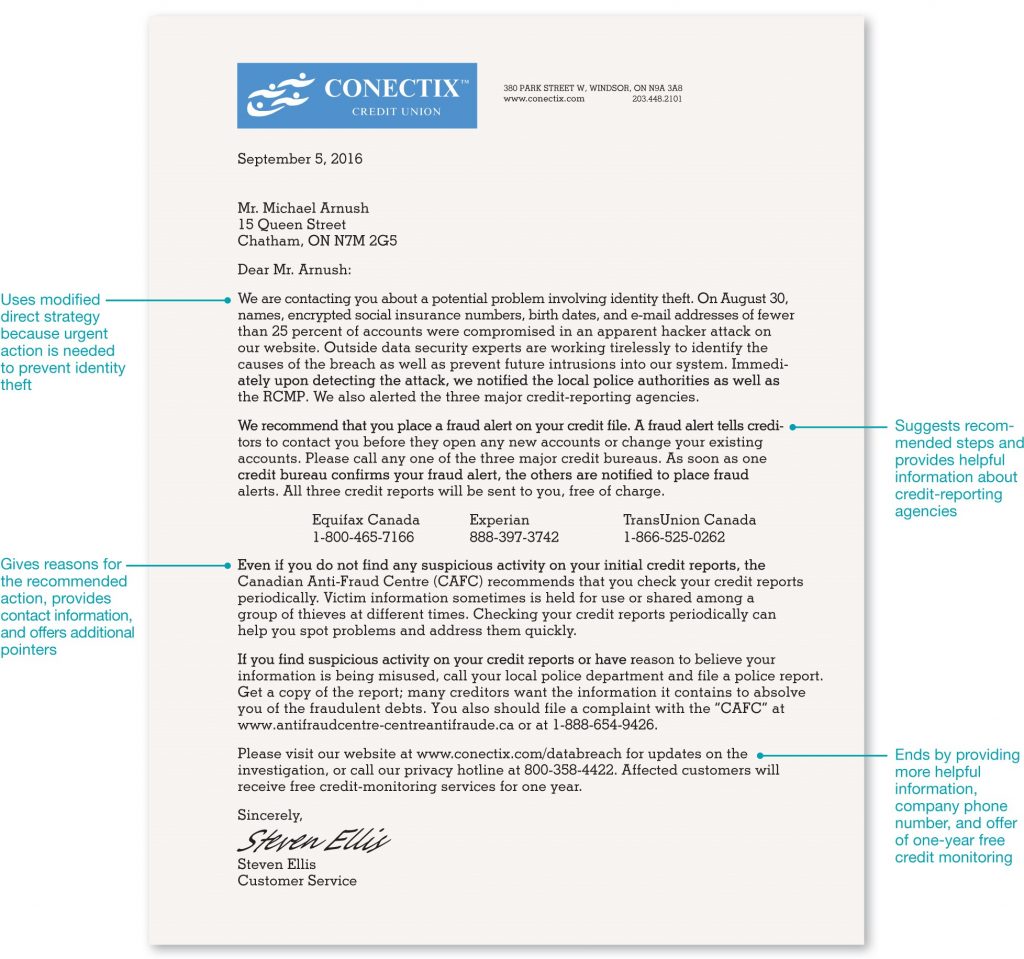
Why classify the letter as warning, rather than recommending? Its suggested steps matter because readers first need to understand a possible harm to them. The recommendations serve that protective purpose. Equally important, the letter does not establish that every recipient has suffered identity theft. A sound classification preserves that distinction between a potential risk and a confirmed outcome.
A warning need not contain an instruction. “The backup has failed, so files changed tonight may not be recoverable” is a warning because it identifies a consequential risk. Conversely, an instruction is not automatically a warning: “Please upload the revised file tonight” is ordinarily a request.
Choose one primary label when purposes overlap
Real messages rarely arrive neatly sorted. A single note might report a problem, propose a solution, and ask for approval. Classify it by identifying the main takeaway or response the sender is seeking, then treat the other elements as supporting or secondary purposes.
Consider three messages about the same untested system change:
- “I recommend postponing the change until testing is complete.” The choice is still open; the primary purpose is recommending.
- “We have postponed the change until testing is complete.” The choice is presented as settled; the primary purpose is deciding.
- “The untested change could interrupt customer access tonight.” The recipient chiefly needs to recognize a possible harm; the primary purpose is warning.
Now suppose the message says, “Please confirm by noon whether your team can complete the test; without it, customer access may be interrupted.” The risk explains the urgency, but the sender’s immediate need is a confirmation. Requesting is a defensible primary label, with warning as a secondary purpose. If the message instead leads with the interruption risk and provides several precautions for everyone affected, warning may be primary.
When a label feels uncertain, use this short sequence:
- Find the bottom line you learned to identify in the previous lesson. Do not classify the topic or the longest paragraph.
- Check its status: Is it a fact being shared, something sought from the recipient, a proposed choice, an established choice, or a risk?
- Check the recipient’s role: Are they meant chiefly to know, respond, consider, adjust to a settled decision, or protect against harm?
- Name a secondary purpose only if needed. If the message itself never makes a main purpose clear, say so rather than forcing certainty.
This is a judgment about the whole message, not a hunt for keywords. “I suggest” often signals recommending and “please” often signals requesting, but either may appear inside a message with a different primary purpose.
Takeaway
The bottom line tells you what matters most; the purpose tells you what job that point is doing. Informing shares something to know. Requesting seeks something from the recipient. Recommending proposes a choice. Deciding announces a settled choice. Warning makes a risk visible. For mixed messages, classify the dominant takeaway and keep any secondary purpose in view.
Next, you’ll use that distinction to write a one-sentence BLUF that states both the main point and why it matters to its audience.