Hello! Welcome back.
In our last lesson, we put the final professional polish on your manuscript using free tools like Grammarly and Hemingway to fix errors and improve readability. Your text is now clean, clear, and carries your unique authorial voice.
Today, we tackle the final, crucial step in the editing module: fact-checking all statistics, technical information, and historical claims in your manuscript. As an author of non-fiction—especially in business, technology, and mentoring—your credibility is your most valuable asset. AI models, for all their power, can "hallucinate" facts, use outdated data, or subtly misrepresent information. This lesson will equip you with the mindset and a free toolkit to verify every claim and ensure your book is a reliable source of information for your readers.
1. The Fact-Checker's Mindset: Three Core Questions
Before we touch any tools, we need to adopt the mental framework of a professional fact-checker. It's a disciplined process of skepticism and verification.
To understand this mindset, let's start with a foundational video from Crash Course that explains how professional fact-checkers approach information.
The Facts about Fact Checking: Crash Course Navigating Digital Information #2
The video 'The Facts about Fact Checking' breaks down the core principles that professionals use to determine the reliability of information. It's the perfect introduction to the 'why' behind the process.
Please watch from the beginning to 07:18. Pay close attention to the three core questions that fact-checkers consistently ask themselves. This framework will be the backbone of our entire process.
As the video explains, the three essential questions are:
- Who is behind this information? (What is their expertise and motivation?)
- What is the evidence for their claims? (Are they citing sources?)
- What do other sources say? (Is there a consensus among reliable, independent sources?)
This is a powerful framework, but AI-generated text presents a unique challenge: there is no single "who" behind the information. The AI synthesizes data from countless, often unidentifiable, sources. So, how do we adapt?
2. Adapting for AI: The Power of Lateral Reading
When dealing with AI content, our primary strategy is called lateral reading. Instead of analyzing the source (the AI), we focus on verifying the claims it makes by looking for external confirmation.
The following resource from Texas A&M University-Corpus Christi's library explains this concept perfectly.
Fact-checking AI with Lateral Reading
The guide 'Fact-checking AI with Lateral Reading' provides a clear, actionable method for verifying AI-generated content. It adapts the classic fact-checking framework for our specific use case.
Please read the sections titled 'Lateral reading: your #1 analysis tool,' 'Lateral reading and AI,' and 'Instructions: tackle an AI fact-check.' Focus on how the core question shifts from 'Who's behind this?' to 'Who can confirm this?' and the four-step process provided.
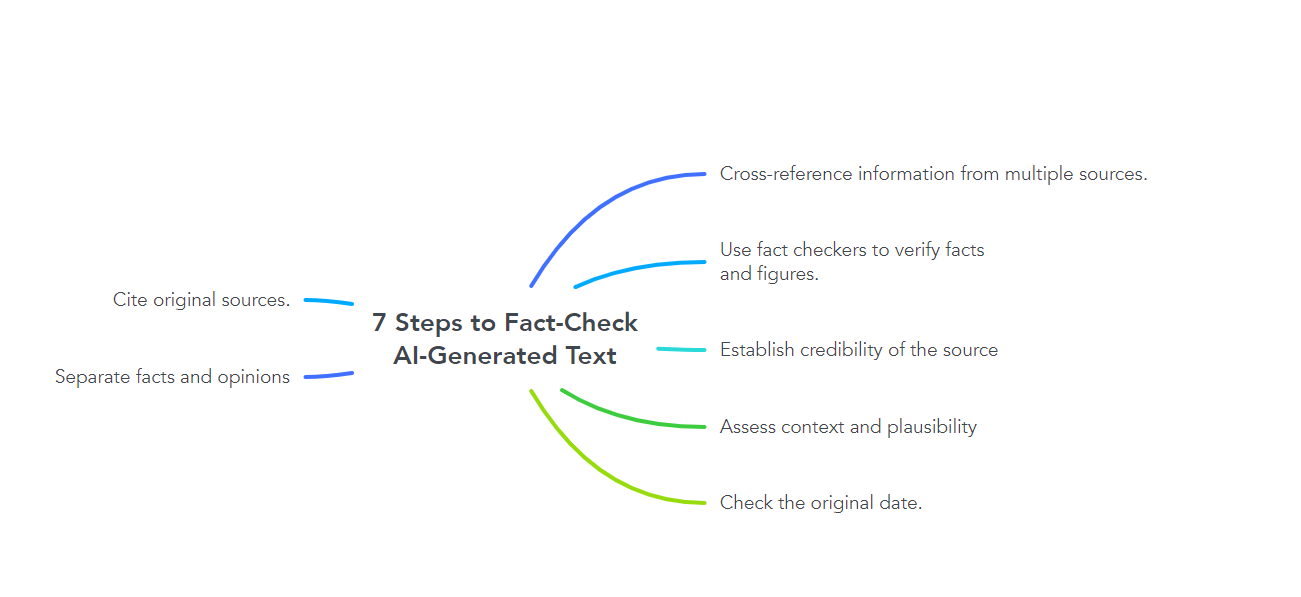
This guide gives us a clear, four-step process for fact-checking any claim from your AI-generated manuscript:
- Fractionation: Break down the text and isolate each specific, searchable claim (e.g., a date, a statistic, a name, a technical specification).
- Lateral Reading: Open new browser tabs and search for these specific claims. This is where you actively seek out other sources.
- Assess Assumptions: Think about what your prompt assumed and what the AI might have inferred. Could a different perspective exist?
- Make a Judgment Call: Based on what you find from multiple, reliable sources, decide if the claim is true, false, or misleading, and correct your manuscript accordingly.
The two images below provide excellent visual summaries of this entire process.

3. Your Free Fact-Checking Toolkit
Now that we have the right mindset and process, let's look at the free tools you can use to perform your lateral reading efficiently.
Tool 1: Perplexity AI (Your Research Assistant)
You're already familiar with Perplexity, but it's time to unlock its full potential as a fact-checking powerhouse. Unlike creative chatbots, Perplexity is designed for accuracy and always cites its sources.
This short video will show you how to use its features to your advantage.
Learn 80% of Perplexity in under 10 minutes!
The video 'Learn 80% of Perplexity in under 10 minutes!' by Jeff Su is a masterclass in using this tool for accurate research. It will show you how to get sourced, reliable answers quickly.
Watch from the beginning to 05:32. Focus on the 'Focus' feature, which lets you target specific sources like academic papers, and how Perplexity provides a summarized answer with direct links to its sources, saving you immense time.
When checking technical details for your IT mentoring books, setting the Focus to "Academic" can instantly pull information from research papers and scholarly articles, providing a high degree of confidence.
Tool 2: Dedicated Fact-Checking Databases (The First Stop)
For claims that might be common myths, political statements, or viral news, your first stop should be a database of articles written by human fact-checkers.
The 6 Best AI Fact Checkers to Verify Truth in a Digital Age
The article 'The 6 Best AI Fact Checkers' reviews several tools, but most are paid. We will focus only on the free, human-powered databases it discusses: Google Fact Check Tools and Snopes.
Please read only section '4. Google Fact Check Tools' and section '6. Snopes'. Understand that these tools are not for analyzing new text; they are search engines for finding claims that have already been investigated by journalists.
- Google Fact Check Tools: Aggregates fact-checks from reputable organizations worldwide.
- Snopes: One of the oldest and most respected fact-checking sites, great for investigating urban legends, internet rumors, and historical claims.
These are excellent for a quick check before you do a deeper dive.
4. A Practical Fact-Checking Workflow
Here is a step-by-step workflow for fact-checking a chapter of your manuscript:
- Read and Highlight: Go through your chapter and highlight every single verifiable claim: statistics, dates, names, historical events, and technical specifications.
- Isolate the Claims: Copy these claims into a separate document or list. This is your fact-checking to-do list.
- Quick Database Check: For any claim that seems like a common myth (e.g., "we only use 10% of our brains"), search for it first on Snopes or the Google Fact Check Tools. This might give you an immediate, well-researched answer.
- Deep Dive with Perplexity: For the remaining claims, especially technical or statistical ones, use Perplexity. Ask it direct questions like, "What was the market share of Android in Q4 2023?" or "Explain the TCP/IP handshake process." Use the "Focus" feature when appropriate and review the cited sources.
- Manual Lateral Reading: If you're still unsure, fall back on a standard search engine (like Google or DuckDuckGo). Search for the claim and look for confirmation from multiple, independent, and credible sources (e.g., established news organizations, university websites, government reports, expert blogs).
- Correct and Document: Update your manuscript with the verified information. It's a great practice for non-fiction authors to save the links to their key sources in a separate file. This can be invaluable if you ever need to defend your work or create a bibliography.
Test your understanding!
Imagine your AI generated the following paragraph for a book on startup history:
"In 1995, Jeff Bezos founded Amazon, originally named 'Relentless.com,' as an online bookstore. Within two years, it went public and was already selling more than just books. Famously, the company's first-ever sale was a science-fiction book by Douglas Adams, processed in a garage that had a server powerful enough to support over 600 simultaneous users, a massive number for the time."
Identify three distinct claims in this paragraph and briefly describe which tool(s) and methods from our workflow you would use to verify each one.
Show answer
Here are three claims and a possible verification workflow:
-
Claim 1: "originally named 'Relentless.com'"
- Method: This sounds like a piece of historical trivia, a perfect candidate for a quick database check.
- Tool: I would start by searching "Amazon original name relentless" on Snopes or a standard Google search. This is a widely-reported fact, so I'd look for confirmation from multiple reputable sources like major news outlets (Forbes, Business Insider) or biographies of Bezos.
-
Claim 2: "the company's first-ever sale was a science-fiction book by Douglas Adams"
- Method: This is a very specific historical detail. It might be in fact-checking databases, but a direct query is better.
- Tool: I would use Perplexity and ask, "What was the first book ever sold on Amazon?" I would then examine the sources Perplexity provides to confirm the details (the book was actually Fluid Concepts and Creative Analogies by Douglas Hofstadter). This demonstrates how AI can generate plausible but incorrect details.
-
Claim 3: "a server powerful enough to support over 600 simultaneous users"
- Method: This is a technical statistic. It requires a more specialized search.
- Tool: This is a great use case for Perplexity with a potential "Academic" focus, or a standard Google search targeting technical histories of the early internet. I'd search for "Amazon server capacity 1995" or "early ecommerce server architecture." It's a very specific number and is likely a fabrication (a "hallucination") by the AI, so I would be highly skeptical and require a primary source (like an interview with an early Amazon engineer) to include it. Without strong evidence, the best course of action would be to remove this specific number.
Conclusion
You've now reached the end of the "Editing and Polishing" module. By mastering fact-checking, you've added the final layer of armor to your manuscript, protecting both your reader's trust and your reputation as an author.
Key Takeaways:
- Always approach AI-generated claims with healthy skepticism. Trust, but verify.
- Use the lateral reading process: isolate a claim, then search for external confirmation from multiple reliable sources.
- Your free toolkit consists of Perplexity AI for deep research, Snopes/Google Fact Check Tools for common claims, and standard search engines for everything else.
- Fact-checking is not just about correcting errors; it's about upholding your credibility and respecting your reader.
Preview of the Next Lesson:
With a fully written, edited, and verified manuscript, you are now ready to move from author/editor to producer. Our next module, "Book Formatting and Production," begins with the essential technical task of creating a digital book. In our next lesson, you will learn how to: "Create a properly structured and navigable ebook in EPUB format using a free tool like Calibre or the Reedsy Book Editor." Congratulations on completing the manuscript creation phase