Recommended resources
The freely available resources this lesson will direct you to.
Hello! Welcome to your second lesson.
In our last session, we classified phase transitions as first-order or continuous by examining the derivatives of the Gibbs free energy. We also caught a glimpse of a more powerful idea: viewing the free energy as a landscape whose shape depends on temperature and some internal system variable, which we informally called an "order parameter".
This lesson is dedicated to formalizing that crucial concept. We will define what an order parameter is, explore how to identify it for various physical systems—from simple magnets to liquids and complex crystal structures—and understand its central role in the modern theory of phase transitions. This concept will be our primary tool for developing the powerful Landau theory in later modules.
What is an Order Parameter?
At its core, an order parameter is a quantity that captures the essence of a phase transition.
Lecture Notes for Quantum Condensed Matter II
Let's start with a clear and concise definition from Prof. Steve Simon's lecture notes.
Please read the two short paragraphs under the heading 'Identify the Order Parameter'. Focus on the key properties: it's typically zero in the disordered phase, non-zero in the ordered phase, and represents a coarse-grained average of microscopic quantities.
As the notes highlight, the order parameter, often denoted by or , is a macroscopic variable that satisfies these key criteria:
- It is zero in the high-temperature (disordered) phase. In this phase, the system typically possesses a higher degree of symmetry.
- It becomes non-zero in the low-temperature (ordered) phase. The appearance of a non-zero order parameter signals that the system has entered a new state with less symmetry.
- For a continuous transition, it grows continuously from zero as the temperature is lowered below the critical temperature . For a first-order transition, it jumps discontinuously to a finite value.
The most profound role of the order parameter is to signal spontaneous symmetry breaking. The fundamental laws governing the system (i.e., the Hamiltonian) may possess certain symmetries, but below the critical temperature, the system's equilibrium state (the ground state) does not. It "spontaneously" chooses a specific configuration that breaks the original symmetry, and the order parameter is what quantifies this choice.
Let's make this concrete with some key examples.
Example 1: The Ferromagnetic Transition
The transition from a paramagnet to a ferromagnet is the canonical example of a phase transition described by an order parameter.
This video provides a nice conceptual walkthrough of how we arrive at an order parameter for the Ising model of a ferromagnet.
Watch the segment from 5:22 to 8:04. Pay attention to how the average magnetization is chosen as the natural candidate to represent the state of the system and how its value distinguishes between the disordered (mixed spin) and ordered (aligned spin) states.
As the video explains for the Ising model:
- System: A lattice of spins .
- Symmetry: In the absence of an external magnetic field (), the Hamiltonian is symmetric under a global spin flip ( for all ). This is a discrete symmetry.
- High-Temperature Phase (): Paramagnet. Thermal fluctuations are dominant. The spins are randomly oriented, and there is no net magnetization. The system's state respects the spin-flip symmetry.
- Low-Temperature Phase (): Ferromagnet. Interactions dominate, causing spins to align. The system spontaneously picks a direction—either mostly up or mostly down—to minimize its energy. This choice breaks the spin-flip symmetry.
- Order Parameter: The average magnetization per site, .
- For , .
- For , .
Example 2: The Liquid-Gas Transition
Identifying the order parameter for the liquid-gas transition is slightly more subtle, as the symmetry being broken is not as immediately obvious as a spin-flip.
- System: A fluid of particles.
- High-Temperature Phase (): Supercritical Fluid. Above the critical point, there's only one fluid phase. The density is uniform throughout the system.
- Low-Temperature Phase (): Coexistence. Below the critical point, a liquid phase with high density and a gas phase with low density can coexist. The system is no longer spatially uniform; it undergoes phase separation.
- Order Parameter: The difference in density between the liquid and gas phases, . An alternative, often used in theoretical models, is the deviation of the density from its value at the critical point, .
At the critical point, the distinction between liquid and gas vanishes, so , and the order parameter becomes zero. The image below shows experimental data for the densities of coexisting liquid and gas phases. The difference between the upper and lower branches of the curve at a given temperature is precisely the order parameter.
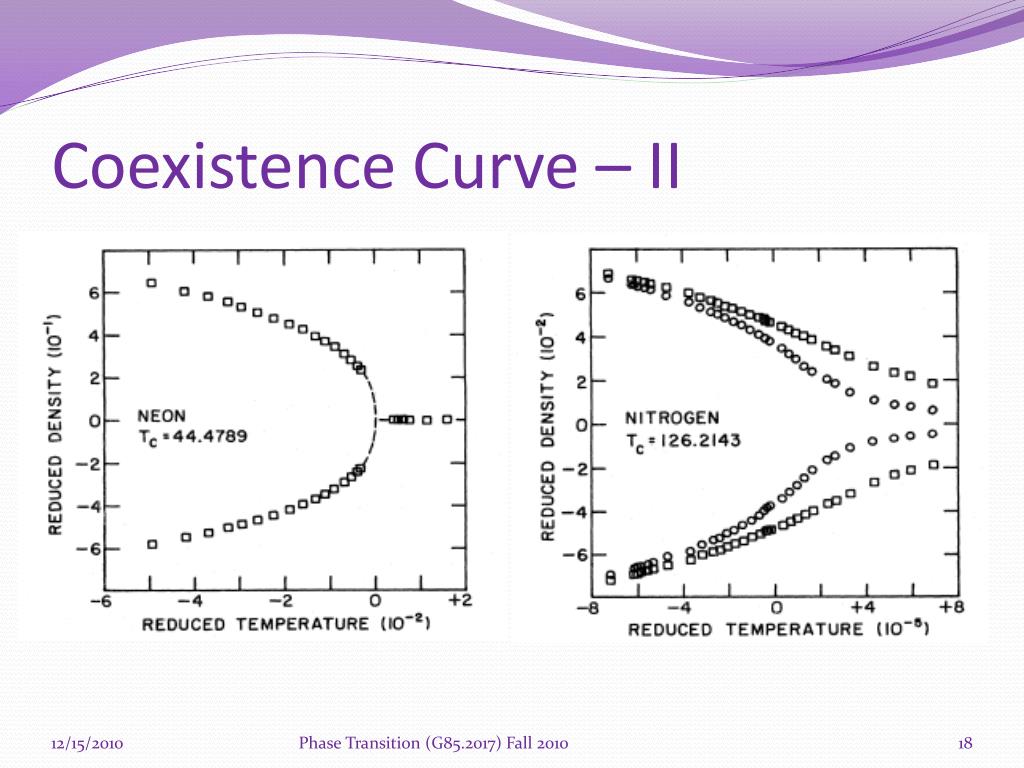
Remarkably, as we will see later in the course, the way this order parameter vanishes near is described by the same mathematical form (the same critical exponent ) as the magnetization in the 3D Ising model. This is a manifestation of universality.
Test your understanding!
Consider the phase transition to superconductivity. Below a critical temperature , a material's electrical resistance drops to exactly zero. In this state, electrons form "Cooper pairs" which can be described by a collective quantum wavefunction, . This wavefunction has both an amplitude and a phase, . In the normal (non-superconducting) state, there are no such pairs.
Based on our definition, what would be a suitable order parameter for the superconducting transition?
Show answer
A suitable order parameter is the complex macroscopic wavefunction that describes the Cooper pairs.
- In the disordered (normal) state for , there are no Cooper pairs, so .
- In the ordered (superconducting) state for , Cooper pairs form, and . The density of superconducting electrons is proportional to .
This is an example of a complex order parameter, which has two components (real and imaginary parts, or amplitude and phase). The spontaneous breaking of a continuous symmetry related to the phase is what leads to the unique properties of superconductors and superfluids.
Beyond Scalars: Vector and Tensor Order Parameters
The order parameter is not limited to being a single real number (a scalar). Its mathematical structure—scalar, vector, or tensor—depends on the symmetry of the Hamiltonian and the nature of the ordered state. Your physics background makes you well-equipped to appreciate these richer examples.
Vector Order Parameter: The Heisenberg Model
The Ising model is a simplification. For many real magnets, the spins are quantum-mechanical vectors that can point in any direction in 3D space. The Heisenberg model captures this:
The dot product makes the Hamiltonian invariant under a global rotation of all spins by the same amount. This is a continuous O(3) rotational symmetry.
Below , the system becomes a ferromagnet by picking one specific direction for the net magnetization to point. This choice breaks the continuous rotational symmetry. The appropriate order parameter is therefore the magnetization vector, .
Tensor Order Parameter: Liquid Crystals & Structural Transitions
Some systems require an even more sophisticated order parameter. A fascinating case is the transition from an isotropic liquid to a nematic liquid crystal, a phase where long, rod-like molecules align along a common axis but their positions remain disordered.
To see why this is complex, let's try to construct an order parameter.
- A naive guess might be a vector representing the average orientation of the rods. But this fails because the rods are physically symmetric upon inversion (). Flipping a rod doesn't change the physical state, but it would flip the sign of our supposed order parameter. We need an order parameter that respects this symmetry.
- A better idea is to build a quantity that is quadratic in the orientation.
This leads to the construction of a tensor order parameter.
Lecture Notes for Quantum Condensed Matter II
Prof. Simon's notes provide an excellent, detailed derivation of the tensor order parameter for a nematic liquid crystal. This is a more advanced example that beautifully illustrates how the choice of order parameter must reflect the underlying physics and symmetries.
Please read Section 3.3.2, 'Nematic and Isotropic Liquid Crystals'. Follow the logic for why a simple vector order parameter is insufficient and how the symmetric, traceless tensor (Q_{ij} = \langle v_i v_j angle - rac{1}{3}\delta_{ij}) is constructed to be zero in the isotropic phase and non-zero in the nematic phase.
This concept of a tensor order parameter is also crucial for describing many structural phase transitions in solids, where a crystal transforms from a high-symmetry lattice to a low-symmetry one. The components of the strain tensor that describe the distortion often serve as the components of the order parameter.

The Unifying Role of the Order Parameter
The true power of the order parameter concept, pioneered by Lev Landau, is that it provides a unified language to describe seemingly disparate phenomena. Whether we are discussing magnetism, boiling, superconductivity, or liquid crystals, we can abstract away the microscopic details and focus on the behavior of the order parameter near the transition.
This is the essence of Landau theory.
Let's conclude by reading the section from Prof. Tong's notes that ties together the concepts of free energy, symmetry, and the order parameter. This perfectly synthesizes what we've learned and sets the stage for the next modules.
Please read Section 5.4, 'Landau Theory', up to (but not including) subsection 5.4.1. This section explicitly defines the order parameter in the context of the free energy, gives several examples, and explains the core idea of expanding the free energy as a power series in the order parameter.
As the notes explain, the free energy is expressed as a power series expansion in the order parameter: . The symmetries of the system dictate which powers of are allowed. For the Ising model, the symmetry forbids odd powers. The entire phase transition is then described by how the coefficients (like ) change with temperature, causing the shape of the free energy landscape to change.
Conclusion
This lesson has formalized one of the most vital concepts in the study of phase transitions.
Key Takeaways:
- An order parameter is a macroscopic quantity that is zero in the disordered (high-symmetry) phase and non-zero in the ordered (low-symmetry) phase.
- The appearance of a non-zero order parameter signifies spontaneous symmetry breaking, where the system's ground state has less symmetry than its governing Hamiltonian.
- The mathematical nature of the order parameter reflects the physics of the system:
- Scalar: Ferromagnetic transition (Ising model), Liquid-gas transition.
- Vector: Ferromagnetic transition (Heisenberg model).
- Complex Scalar: Superconducting/Superfluid transitions.
- Tensor: Nematic liquid crystal transitions, many structural transitions.
- The order parameter is the central variable in Landau theory, where the free energy is expanded as a power series in it, providing a universal framework for describing critical phenomena.
Preview of the Next Lesson:
We have established that the emergence of an order parameter is synonymous with spontaneous symmetry breaking. In the next lesson, we will take a deeper dive into the concept of spontaneous symmetry breaking itself. We will explore its profound consequences, its connection to the type of order parameter, and its fundamental role in dictating the behavior of systems near a phase transition.