Recommended resources
The freely available resources this lesson will direct you to.
Hello! Welcome to the first lesson of our course on the Statistical Mechanics of Phase Transitions. Our ultimate goal is to build a robust theoretical framework for understanding why and how matter undergoes dramatic changes like boiling or becoming magnetic.
In this introductory lesson, we will tackle a fundamental concept: how to classify different types of phase transitions. By the end of our session, you'll be able to classify a phase transition as either first-order or continuous by examining how the system's free energy and its derivatives behave. This classification scheme, known as the Ehrenfest classification, is the bedrock upon which much of the theory of phase transitions is built. We will use the Gibbs free energy, , as our primary tool for this analysis.
Let's begin by establishing what we mean by a "phase" in a technical sense.
What is a Phase Transition?
Intuitively, we think of phases as the familiar states of matter: solid, liquid, and gas. A phase transition is the transformation from one to another. While this is a good starting point, a more precise definition is needed for a rigorous study.
To formalize our understanding, let's read a short introduction from Prof. Matthew Schwartz's lecture notes. It provides a technical definition of a phase and sets the stage for thinking about transitions as points where smoothness breaks down.
Please read Section 1, 'Introduction'. Focus on the technical definition of a phase as a state where properties vary smoothly and how a phase transition represents a non-analyticity or a 'kink' in these properties.
As the notes explain, we can define a phase as a region in the space of thermodynamic variables (like pressure and temperature ) where all thermodynamic properties of the system are analytic functions. A phase transition occurs at the boundary between two such regions, where properties change non-analytically.
A phase diagram is a map of these regions. Let's watch a short video segment that illustrates a typical phase diagram for a simple substance.
Mod-01 Lec-27 Probability distributions (concld.). Phase transitions (Part 1)
This video from NPTEL provides a clear visual introduction to phase diagrams, which will help us picture the concepts we're about to discuss.
Watch the segment from 10:30 to 16:40. Pay attention to the identification of the solid, liquid, and gas phases on the P-T diagram, the lines of coexistence, the triple point, and especially the critical point, where the distinction between liquid and gas vanishes.
The lines on this diagram, called coexistence curves, are where phase transitions happen. The central question for this lesson is: are all these transitions the same? The answer is no, and their differences can be understood by looking at the Gibbs free energy.
The Ehrenfest Classification of Phase Transitions
At a coexistence curve, two different phases (say, phase 1 and phase 2) are in thermodynamic equilibrium. For a system at constant temperature and pressure, equilibrium is achieved when the Gibbs free energy is minimized. This implies that the chemical potential (which is the Gibbs free energy per particle, ) must be the same for both phases:
This equality defines the coexistence curve on the P-T phase diagram. While itself is continuous across the transition (otherwise particles would flow to the phase with lower until only one phase remained), its derivatives may not be. The Ehrenfest classification uses this fact to categorize transitions.
First-Order Transitions
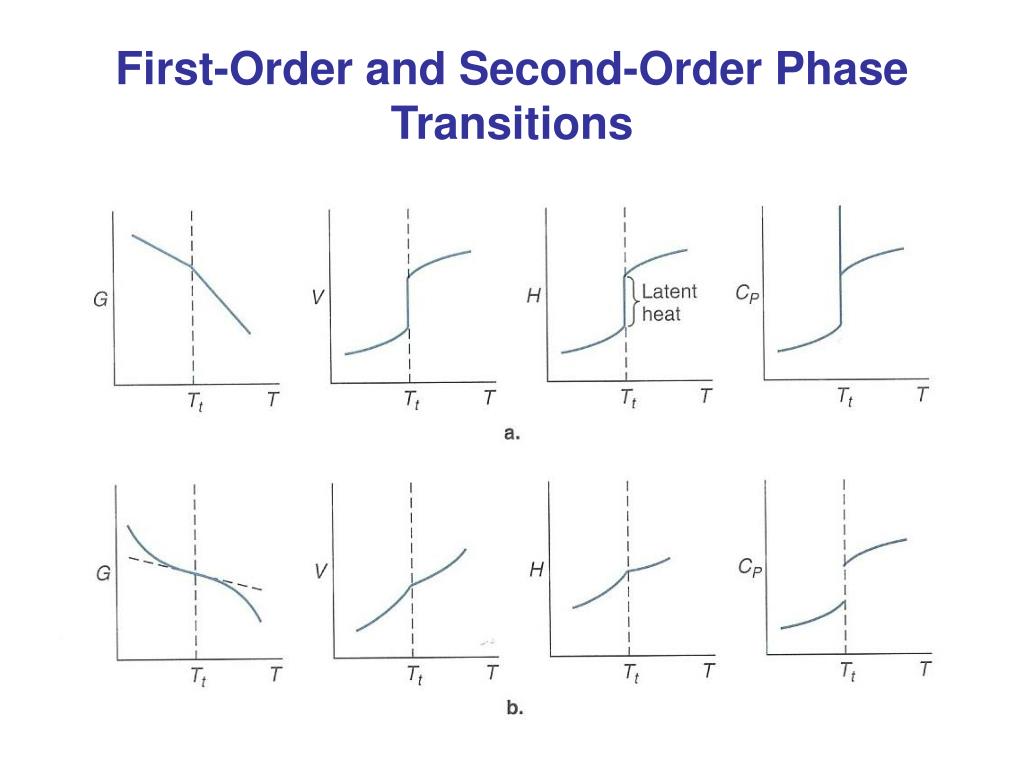
A phase transition is called first-order if at least one of the first derivatives of the Gibbs free energy, , is discontinuous across the phase boundary.
From classical thermodynamics, you'll recall the key relations for these first derivatives:
- Entropy:
- Volume:
A discontinuity in these quantities means that as you cross the phase boundary, the system's entropy and/or volume jump abruptly.
The non-zero change in entropy gives rise to latent heat, , which is the heat absorbed or released during the transition at constant temperature. This is the hallmark of a first-order transition. Everyday examples like boiling water or melting ice are first-order transitions, as they require an input of latent heat to proceed.
Continuous (or Second-Order) Transitions
A phase transition is called continuous (or second-order) if the first derivatives of the Gibbs free energy are continuous across the phase boundary. This means:
- (no latent heat)
So, what changes? The transition is instead signaled by a discontinuity in the second derivatives of . Let's look at the physical quantities related to these second derivatives:
- Specific Heat at Constant Pressure:
- Isothermal Compressibility:
In a continuous transition, these "response functions" show a discontinuity, which can be a finite jump or a divergence to infinity. The liquid-gas transition precisely at the critical point is a continuous transition. Other examples include the onset of ferromagnetism in materials like iron at the Curie temperature, or the transition to a superconducting state.
The following resources provide a concise and clear explanation of this classification.
Statistical Physics by David Tong
Prof. David Tong's lecture notes offer a crisp definition of the Ehrenfest classification. Please read the relevant paragraph.
In Section 5.1.2 'The Clausius-Clapeyron Equation', find the paragraph beginning with 'There is a classification of phase transitions, due originally to Ehrenfest.'. Read this paragraph carefully.
For a complementary explanation with clear visuals, this video walks through the behavior of thermodynamic properties for both types of transitions.
Please watch the segment from 1:41 to 9:16. The first part (until 6:17) covers first-order transitions, and the second part covers second-order transitions, with a helpful summary at the end (8:48-9:16).
The image below provides a perfect summary of everything we've just discussed, plotting the behavior of key thermodynamic quantities for both types of transitions.
Test your understanding!
Consider a phase transition in a material studied at constant pressure. Experimental data shows that as the material is cooled, its specific heat diverges to infinity at a specific temperature . However, measurements of the sample's volume show no abrupt change at .
- What is the order of this phase transition?
- Based on your classification, what can you say about the latent heat associated with this transition?
- Which derivative of the Gibbs free energy is the first to be discontinuous at ?
Show answer
- This is a continuous (second-order) phase transition. The divergence in the specific heat signals a discontinuity in a second derivative of , while the continuous volume indicates that the first derivative is continuous.
- Since it is a continuous transition, the latent heat must be zero. This is because the entropy , a first derivative, is continuous across the transition.
- The second derivative of the Gibbs free energy is the first to be discontinuous. Specifically, the specific heat is related to .
A Deeper View: Free Energy Landscapes
Given your background in physics, we can go a step beyond the simple derivative-counting of the Ehrenfest scheme and gain a more profound physical intuition. This perspective is the foundation of the powerful Landau theory of phase transitions, which we will study in detail in a later module.
Imagine the Gibbs free energy not just at equilibrium, but as a function of some internal parameter that describes the state of the system. We call an order parameter (a concept we'll formalize in our next lesson). For a magnet, could be the average magnetization; for a liquid-gas system, it could be the density difference from the critical density. The actual equilibrium state of the system will be the one that minimizes this function .
The nature of a phase transition is dictated by how the shape of this landscape changes with temperature.

-
Continuous (Second-Order) Transition (panels a, b):
- Above the critical temperature , the free energy has a single minimum at (the disordered state).
- As the temperature is lowered to , the bottom of the potential well becomes very flat.
- Below , the single minimum at becomes an unstable maximum, and two new, symmetric minima appear at (the ordered states).
- The system smoothly settles into one of these new minima. The order parameter continuously grows from zero as the temperature is lowered further below .
-
First-Order Transition (panels c, d):
- Here, the free energy landscape can develop a second, separate minimum even while the original minimum still exists.
- At a temperature , the minimum at is the global minimum (the stable state). The other minimum at is a local minimum, corresponding to a metastable state.
- At the transition temperature , both minima have the exact same depth ().
- As the temperature drops just below , the minimum at becomes the new global minimum. The system must abruptly "jump" from the state to the state, resulting in a discontinuous change in the order parameter. This jump requires overcoming the energy barrier between the two minima, which is related to the latent heat.
This way of thinking—analyzing the topology of a free energy function—is a cornerstone of modern condensed matter physics. It unifies the description of many different kinds of phase transitions.
Conclusion
In this lesson, we established a formal classification for phase transitions based on the analytic properties of the Gibbs free energy.
Key Takeaways:
- A phase is a region of thermodynamic parameter space where the system's properties are analytic. A phase transition marks a point of non-analyticity.
- First-order transitions are characterized by a discontinuity in the first derivatives of the Gibbs free energy ( and ). Their defining physical feature is a non-zero latent heat ().
- Continuous (second-order) transitions have continuous first derivatives but discontinuous second derivatives of the Gibbs free energy (, , etc.). They have zero latent heat ().
- The shape of the free energy as a function of an order parameter provides a deeper picture: continuous transitions involve the smooth evolution of a single potential well, while first-order transitions involve an abrupt jump between coexisting potential wells.
Preview of the Next Lesson:
We've touched upon the concept of an "order parameter" several times. In our next lesson, we will formally define what an order parameter is, see examples for various physical systems (like liquid-gas and magnetic systems), and understand its crucial role as the central variable in the modern theory of phase transitions.