Recommended resources
The freely available resources this lesson will direct you to.
Hello! Welcome to your third lesson.
In our previous session, we established the concept of the order parameter as a macroscopic variable that quantifies the degree of order in a system and distinguishes between different phases. We saw that its emergence from zero signals a phase transition and, crucially, a change in the system's symmetry.
This lesson focuses on the fundamental mechanism underlying this change: spontaneous symmetry breaking (SSB). This is one of the most profound and unifying concepts in modern physics, extending far beyond condensed matter into particle physics and cosmology. We will explore what it means for a system's state to be less symmetric than the underlying physical laws that govern it. Understanding this is the key to unlocking the Landau paradigm of phase transitions.
The Essence of Symmetry Breaking
Let's begin by building a strong conceptual foundation. In physics, we usually expect the solutions to a problem (the states) to exhibit the same symmetries as the problem's equations (the Hamiltonian). SSB is the remarkable exception to this rule.
Symmetry Breaking and Magnetism - Prof Stephen Blundell - OUPS Lecture
Professor Stephen Blundell gives a superb and intuitive lecture on this topic. We'll watch a few key segments. This first part provides a great overview of symmetry in physics and then introduces the core idea of how symmetry is 'broken' in a magnetic system.
First, watch from the beginning to 5:34 to refresh your understanding of discrete and continuous symmetries in physics. Then, jump to the segment from 30:30 to 32:35, where he poses a critical question: in a magnet, which state is more symmetric, the high-temperature paramagnet or the low-temperature ferromagnet?
As Prof. Blundell explains, the high-temperature paramagnetic state is, paradoxically, the more symmetric one. At any given lattice site, a spin is free to point in any direction; the system is statistically isotropic. In the low-temperature ferromagnetic state, the spins align along a specific, collective direction. The system has spontaneously chosen a preferred axis, thereby breaking the initial rotational symmetry of the Hamiltonian.
The "spontaneous" part is key. The Hamiltonian itself does not contain any term that favors one direction over another. Yet, the ground state does. How can a symmetric cause lead to an asymmetric effect?
The answer lies in the stability of the symmetric state.
Symmetry Breaking and Magnetism - Prof Stephen Blundell - OUPS Lecture
Let's continue with Prof. Blundell's lecture, where he uses two excellent analogies to illustrate how a symmetric system can naturally evolve into an asymmetric state.
Please watch from 32:35 to 36:49. Pay attention to the Euler strut (a buckling column) and the ammonia molecule examples. Both illustrate a situation where the symmetric configuration is unstable, and the system can lower its energy by moving into one of several equivalent, but asymmetric, stable configurations.
These analogies highlight the central idea: below a critical point, the symmetric state becomes unstable. The system must "choose" one of the new, stable, but less symmetric ground states.
The Free Energy Landscape
We can translate this physical picture into the language of thermodynamics by considering the free energy landscape. In the previous lesson, we saw the free energy as a function of temperature and the order parameter . Spontaneous symmetry breaking is what happens when the shape of this landscape changes.

This "Mexican hat" potential is the hallmark of SSB for a continuous symmetry. The system minimizes its free energy by choosing a state with a non-zero order parameter .
- Above : The free energy has a single minimum at . The equilibrium state is disordered and respects the Hamiltonian's symmetry.
- Below : The point becomes an unstable maximum. A set of degenerate minima appears at . The system must pick one of these minima, breaking the symmetry.
For an Ising magnet with (up/down) symmetry, the landscape is a 2D slice of this picture, resulting in two degenerate minima at and .
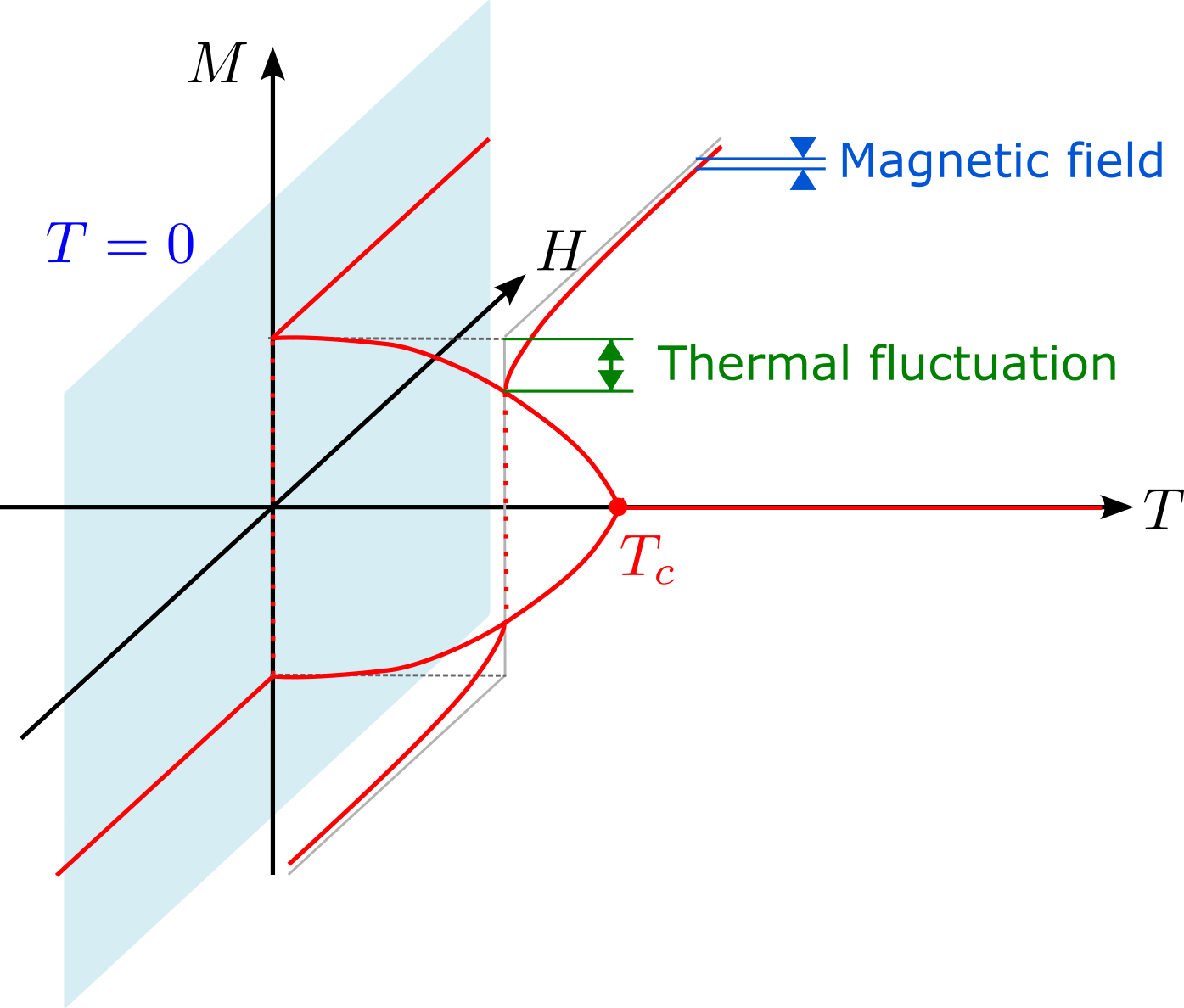
The Thermodynamic Limit and the Role of an External Field
A subtle but crucial question arises: if the states with magnetization and are equally likely, shouldn't the measured average magnetization still be zero? For any finite system, this is true; the system could tunnel between the two states, restoring the symmetry on average.
SSB is strictly a phenomenon of the thermodynamic limit (). In this limit, the energy barrier to flip the entire system from one ordered state to another becomes infinite, trapping the system in its chosen state. We formalize this by introducing a symmetry-breaking field.
[PDF] Broken Symmetry - Physics Courses
Let's formalize how a non-zero order parameter emerges despite the Hamiltonian's symmetry. This requires a careful look at the thermodynamic limit.
Read the section 'Spontaneous symmetry breaking' (part of 1.3.1). Focus on the two ways to resolve the 'conundrum' of how the average magnetization can be non-zero. Pay special attention to the second method involving the order of limits: taking the system volume V o \infty before the external field h o 0. This is a cornerstone of the formal definition of SSB.
As the notes explain, the spontaneous magnetization is formally defined by an order of limits:
You first take the thermodynamic limit in the presence of an infinitesimal symmetry-breaking field . This field, no matter how small, selects one of the degenerate ground states. Because the system is infinite, it gets "locked" into this state. Only then do you remove the field by taking the limit . The magnetization that remains is the spontaneous magnetization.
Consequences: Discrete vs. Continuous Symmetries
The physical consequences of SSB depend critically on the nature of the broken symmetry. Your background in group theory will be useful here.
-
Breaking a Discrete Symmetry: Consider the Ising model, where the Hamiltonian has a discrete symmetry (). Below , the system chooses one of two states: all spins mostly up () or all spins mostly down (). These are two distinct, degenerate ground states. To get from one to the other, you must flip a macroscopic number of spins, which costs a finite amount of energy, even for the lowest-energy excitation. We say there is an energy gap to excitations that would restore the symmetry.
-
Breaking a Continuous Symmetry: Consider the Heisenberg model, where the Hamiltonian has a continuous O(3) rotational symmetry. Below , the system picks a single direction for the magnetization to point. But any other direction would have been equally good. This means there isn't just a pair of degenerate ground states, but a continuous manifold of them. The system can transition from one ground state to a neighboring one (e.g., by slightly rotating ) through a long-wavelength fluctuation that costs vanishingly little energy.
This leads to one of the most important results related to SSB: Goldstone's Theorem.
3. The Landau-Ginzburg Approach Part 2
The emergence of these low-energy fluctuations is a universal consequence of breaking a continuous symmetry. This segment from an MIT OpenCourseWare lecture explains this beautifully.
Watch from 47:35 to 52:34. The lecturer explains how SSB in the Landau-Ginzburg model leads to a manifold of ground states. He then distinguishes between discrete and continuous symmetries, introducing the resulting low-energy 'Goldstone modes' (like phonons and magnons) for the continuous case.
Goldstone's Theorem states that for every broken generator of a continuous global symmetry, there must exist a corresponding massless (gapless) excitation, known as a Goldstone mode or Goldstone boson.
These modes represent long-wavelength fluctuations of the order parameter along the degenerate ground state manifold.
- In a crystal, the breaking of continuous translational symmetry gives rise to phonons.
- In a Heisenberg ferromagnet, the breaking of continuous rotational symmetry gives rise to magnons (spin waves).
- In a superfluid, the breaking of continuous U(1) phase symmetry gives rise to a sound-like mode.
Test your understanding!
Consider two magnetic models on a 2D square lattice:
- The Ising Model: Spins are scalars , pointing up or down. The symmetry is discrete ().
- The XY Model: Spins are 2D vectors that can point anywhere in the plane. The symmetry is continuous (U(1) or O(2) rotation in the plane).
Both models have a ferromagnetic phase at low temperatures where spins align. Based on Goldstone's theorem, how would you expect the spectrum of low-energy excitations to differ between the two models in their ordered phase?
Show answer
- In the Ising model, a discrete symmetry is broken. There is no continuous manifold of ground states (only two). The lowest-energy excitation involves flipping a spin, which costs a finite amount of energy. The excitation spectrum is therefore gapped. There are no Goldstone modes.
- In the XY model, a continuous symmetry (rotation in the plane) is broken. Goldstone's theorem applies. There must be a gapless excitation mode corresponding to slow, long-wavelength variations of the spin angle across the lattice. These are the spin waves of the XY model.
To solidify this with a concrete quantum mechanical derivation you are likely familiar with, let's see how spin waves arise as Goldstone bosons in the Heisenberg ferromagnet.
[PDF] Broken Symmetry - Physics Courses
This reading provides a concise derivation showing how spin waves emerge as gapless excitations from the symmetry-broken ground state of the Heisenberg model.
Read the first part of section 1.5.4, 'Goldstone's theorem', up to and including equation (1.118). This section shows how applying the spin-lowering operator S^-(k) to the fully polarized ground state (which has broken rotational symmetry) creates an excitation (a spin wave). You should verify for yourself that the calculated dispersion relation, \hbar\omega_k = S[\hat{J}(0) - \hat{J}(k)], goes to zero as k o 0 for a short-range interaction, confirming it is a gapless mode.
Conclusion
This lesson has unpacked the crucial concept of spontaneous symmetry breaking, the engine that drives phase transitions within the Landau paradigm.
Key Takeaways:
- Spontaneous Symmetry Breaking (SSB) occurs when a system's ground state (or equilibrium state) possesses a lower symmetry than the Hamiltonian that governs it.
- This phenomenon is visualized by a change in the free energy landscape, where the symmetric state becomes unstable and is replaced by a set of degenerate, asymmetric minima.
- Formally, SSB is defined in the thermodynamic limit, where an infinitesimal symmetry-breaking field selects one ground state, and this choice persists after the field is removed.
- Breaking a discrete symmetry leads to a finite number of degenerate ground states, separated by an energy gap.
- Breaking a continuous symmetry results in a continuous manifold of degenerate ground states and, by Goldstone's theorem, the emergence of gapless excitations (Goldstone modes) like phonons and magnons.
Preview of the Next Lesson:
We have now seen how the shape of the free energy potential, governed by symmetry, determines the state of the system. In our next lesson, we will begin to use this framework quantitatively. We will learn how to derive measurable thermodynamic response functions—such as magnetic susceptibility, specific heat, and compressibility—directly from the derivatives of this free energy, connecting the abstract concept of the free energy landscape to concrete experimental observables near a phase transition.