Recommended resources
The freely available resources this lesson will direct you to.
- The Perfect Software Engineer Résumé: What Actually Gets You Interviewswww.youtube.com
- Ex-Google Recruiter Teaches Resume Masterclass to get FAANG Interviewswww.youtube.com
- YoUR step-by-step resume guide – Career Services | University of Richmondcareerservices.richmond.edu
- Software Engineering Resume Examples and Templates for 2026 | ResumeTemplates.comwww.resumetemplates.com
Good to see you again. Last lesson, you built an evidence map: what a project shows about your technical scope, decisions, collaborators, and impact. Today we’ll compress one such account into a résumé bullet. The challenge is to make the problem, your engineering action, the system’s scale, and the observed result visible without making a claim you could not defend in an interview.
Your PSA and virtual SCSI work is a useful source of material for Staff-level storage roles. A bullet that merely says you maintained those components hides the engineering judgment involved. A stronger bullet shows which storage-path problem you addressed and what changed. Allow about 40 minutes for the short resources, the worked example, and a draft from your own evidence card.
From responsibility to evidence
A résumé bullet is not a miniature project history. It is a compact claim that gives a reviewer a reason to ask for the fuller story. Watch how The Serious CTO distinguishes a list of technologies from a defensible accomplishment, then describes the work records that can support one.
The Perfect Software Engineer Résumé: What Actually Gets You Interviews
Watch “The Perfect Software Engineer Résumé: What Actually Gets You Interviews” from The Serious CTO for its distinction between naming a system and showing what you did to it.
Watch accomplishments, beginning with the examples of generic technology names, and focus on the call for a specific action and outcome. Then watch the evidence chain, beginning with work artifacts such as logs and post-mortems; notice the advice to use a bounded outcome when a broad numerical claim cannot be justified.
The University of Richmond’s résumé guide offers a complementary way to recover details before you write. Its STAR questions are expansive, but your finished bullet should contain only the answers most relevant to the role.
YoUR step-by-step resume guide – Career Services | University of Richmond
Read the University of Richmond Career Services guide to see how a bare responsibility becomes an accomplishment by asking who did the work, why it mattered, how it was done, and what followed.
In “How to describe your experiences,” read the STAR overview, from the opening paragraph through the advice on action verbs. Continue into the report example: follow the prompts from “Who?” through “Big picture?” in the question sequence. Focus on the questions, rather than copying the report example’s wording into an engineering résumé.
For a technical bullet, those questions resolve into four pieces:
| Piece | What the reader needs to learn |
|---|---|
| Problem | What failure, limitation, or engineering need made the work necessary? |
| Action | What did you diagnose, design, implement, or change? Name the technical lever when you can. |
| System scale | Where did the work operate, and over what verified scope? This might be a cross-subsystem path, workload size, supported configurations, or deployment footprint. |
| Measurable result | What was observed, compared with what baseline, under what conditions? A bounded test result is better than an unsupported production-wide claim. |
This is a content check, not a rigid sentence template. Lead with the result when it is especially clear; lead with the problem when its complexity is the strongest signal. You can split a substantial project across two bullets if one sentence would become unreadable.
A storage-path bullet, built in stages
We’ll extend the fictional failover example from the previous lesson. None of its figures or actions describe your actual work. Suppose the supporting evidence shows that an engineer correlated timestamps across virtual SCSI and PSA, diagnosed a retry interaction during path failover, and worked with PSA owners on a correction. A controlled failover test with 32 concurrent VMs measured 99th-percentile I/O completion time before and after the change: 480 ms and 130 ms. Guest-visible error behavior and data checks were also validated.
A first draft might read:
Maintained PSA and virtual SCSI and improved storage performance.
It names a domain, but an interviewer cannot tell what problem arose, what the engineer contributed, or how “improved” was established. Adding impressive adjectives would not fix it. Adding evidence does:
Diagnosed virtual SCSI/PSA retry handling behind slow VM I/O during path failover and co-designed a correction with PSA owners; in a controlled 32-VM workload, measured p99 completion time falling from 480 to 130 ms after the change, with guest-visible error behavior and data checks validated.
The bullet is fairly dense, but every part has a job. “During path failover” identifies the problem context. “Diagnosed … retry handling” states the engineer’s technical contribution; “co-designed … with PSA owners” preserves shared ownership. “Controlled 32-VM workload” gives the measurement a scope without pretending it represents the entire production fleet. The before-and-after p99 values state an observed result, while the final clause prevents a faster-but-incorrect storage path from sounding like a success.
You could shorten this for a tightly spaced résumé, but remove detail deliberately. “Cut latency by 73%” is mathematically reasonable for these fictional figures, yet 480 to 130 ms under a named test often tells a technical reader more. Conversely, do not include every tracepoint, code path, and validation step in the bullet. Keep that depth for the interview.
The supplied Lead Software Engineer example image makes action, project, and result easy to spot:
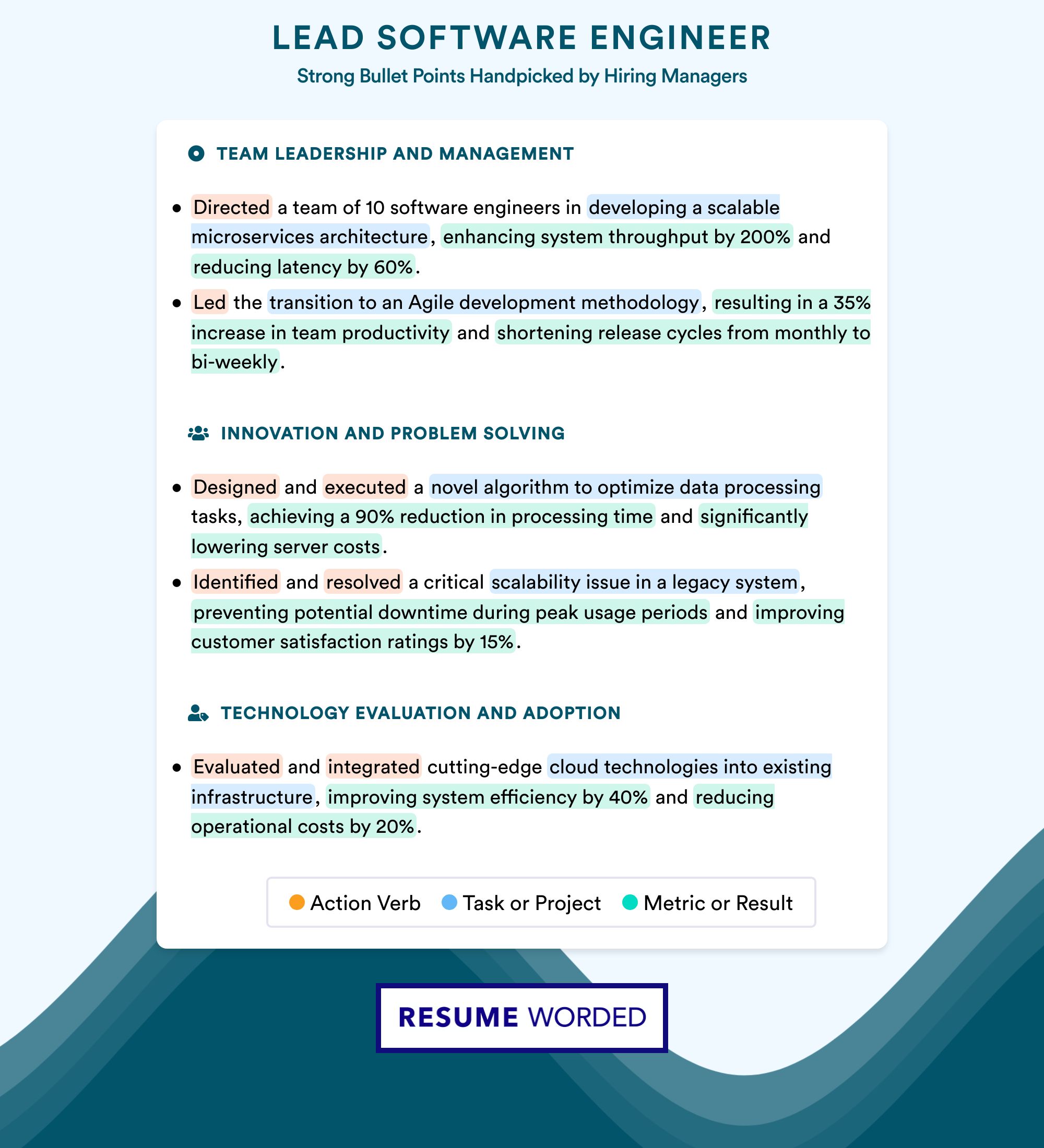
For storage and kernel roles, use the image as a visual structure check, not as a standard for how dramatic your numbers should be. A claim such as “enhancing throughput by 200%” invites immediate follow-up: which workload, which baseline, which system boundary, and whose change produced it? Your own, narrower measurement can be more persuasive.
Make scale and results precise enough to defend
Scale is not synonymous with a big number. “Across virtual SCSI and PSA” describes technical breadth; “32 VMs” describes a test workload; “production-wide” would describe deployment reach. These are different claims. The fictional bullet includes the first two, but it has no evidence for the third. Likewise, the number of engineers involved may show collaboration without telling the reader how much I/O the system handled.
For a real PSA or virtual SCSI project, possible scale markers include the components at the guest–hypervisor boundary, the configurations affected, the workload used in validation, or the scope of rollout. Use only markers you can substantiate and disclose. Do not turn “tested on several configurations” into “supported all storage devices,” or a lab failover result into a fleet-wide reliability improvement.
A measurable result also need not be a latency percentage. Depending on your evidence, it could be a before-and-after timeout count under the same test, a reduction in reproducible failures, coverage of previously untested failover cases, or time saved in diagnosing a recurring incident. State the boundary of the observation. For example, “the failure did not recur in the failover regression suite” is narrower—and more defensible—than “eliminated failover failures.”
If the outcome cannot yet be verified, do not manufacture one. Recover it from an incident record, test report, trace comparison, or release note if available. If those records establish only the action, describe the action and its validated scope honestly while you seek a better-supported accomplishment for a prominent bullet. Also check what you are permitted to disclose: replace confidential customer names or internal measurements with an accurate, authorized description rather than an invented figure.
Ownership deserves the same precision. “Diagnosed” should mean you drove that diagnosis; “implemented” should mean you implemented the change. If another team owned the fix and your contribution was establishing the cause or designing the validation, say so. At Staff level, credible cross-team influence is stronger than taking sole credit for shared work.
Draft for the role, then perform an interview check
Return to one evidence card from the previous lesson. In a short drafting pass, pull out its starting problem, your specific decision or action, the verified system or test scope, and the strongest supported outcome. Write a plain version first; then remove words that do not help a storage engineer understand the claim. One bullet does not have to demonstrate every Staff competency.
Keep the target posting beside the draft. For a role emphasizing storage-path performance, a supported latency measure, workload, and diagnostic method may deserve prominence. For a role emphasizing architecture or technical leadership, the important detail might instead be the boundary you redesigned or a decision you drove with another team. Tailoring changes which true evidence you foreground; it does not change what happened. In particular, describe VMkernel work as VMkernel work—do not relabel it Linux kernel development to match a posting.
Finally, give the bullet a five-minute interview check. You should be able to explain what each acronym means, where the numbers came from, what remained constant in a comparison, what teammates did, and what evidence would challenge your conclusion. If a phrase fails that check, narrow or remove it. This also turns résumé preparation into useful interview preparation while you begin applying.
Key takeaways
A strong technical bullet connects a real problem, your particular engineering action, verified system scale, and an observed result. Specificity matters more than a spectacular percentage: name the technical lever, distinguish test scope from production scope, and give collaborators appropriate credit. The evidence card you made last lesson supplies the facts; the bullet selects the few facts a hiring team needs first.
Next, you’ll use those same facts in a 90-second professional introduction, where you can connect your storage and virtualization experience to a Staff-level role without reciting your résumé.