Recommended resources
The freely available resources this lesson will direct you to.
- Ex-Google Recruiter Explains: How to Answer “Tell Me About Yourself” (Step-by-Step)www.youtube.com
- How Successful Software Engineers Answer 'Tell Me About Yourself' In Interviewswww.youtube.com
- Staff Engineer - Backend Development [ 12 - 15 years ], Bangalore, India | Nutanix Careerscareers.nutanix.com
- How to Answer: ‘Tell Me About Yourself’ – Career Services | University of Pennsylvaniacareerservices.upenn.edu
Hello again. Last lesson, you turned project evidence into a résumé bullet: a compact claim about the problem, your action, the system’s scope, and the observed result. Today you’ll use that same evidence for a different purpose. In 90 seconds, your introduction should tell an interviewer what kind of engineer you are, why your experience matters for this Staff role, and which project is worth discussing further. It is not your résumé read aloud.
Your background already gives you a clear starting point: 17 years in systems engineering, including recent work on PSA and virtual SCSI at the boundary between VM storage commands and the hypervisor. The task is to connect that experience to a specific opening without claiming expertise—such as Linux kernel development or distributed storage work—that your evidence does not yet establish. Allow about 40 minutes for the resources, drafting, and spoken rehearsal.
Give the interviewer a direction, not a chronology
“Tell me about yourself” sounds broad, but in an interview it calls for a selective professional introduction. The interviewer needs enough context to understand your fit and enough specificity to choose a useful follow-up question. A tour through every job you have held makes both harder.
Watch how HAMY LABS approaches the question for software engineers. In particular, notice the distinction between establishing your level and reciting your work history.
How Successful Software Engineers Answer 'Tell Me About Yourself' In Interviews
Watch “How Successful Software Engineers Answer ‘Tell Me About Yourself’ In Interviews” from HAMY LABS for a software-engineering example of a concise, role-aware introduction.
Start with the purpose of the question, then watch common mistakes, especially length and credibility. In setting expectations, focus on how a pitch signals level and relevant projects. Finally, watch the example pitch for how the speaker selects and adapts experience rather than giving an exhaustive history.
A practical structure is present, selected evidence, future:
- Present — about 20 seconds: Name your engineering identity and current technical focus.
- Selected evidence — about 45 seconds: Give one project a clear problem, your contribution, and an outcome you can defend. Add a brief Staff-level signal if the evidence supports it: technical ownership, a design decision, or influence across a team boundary.
- Future — about 20 seconds: Explain why that combination is relevant to the particular role and what you want to work on next.
These are speaking-time guides, not a script to recite mechanically. The University of Pennsylvania’s career guidance describes a similar story-shaped approach and explains why the answer should add context beyond the résumé.
How to Answer: ‘Tell Me About Yourself’ – Career Services | University of Pennsylvania
Read this University of Pennsylvania Career Services article for its narrative structure and guidance on choosing what to leave out.
In “How to Actually Answer the Interview Question?”, go to “Keep It Short, Relevant, and Positive!” Read the story structure. Then continue below that subsection, from “It is completely normal to feel like you have a lot to say” through the paragraph ending “aligned with where you are heading”; read the length guidance with attention to what an introduction should add beyond a résumé recap.
The article allows a range of lengths. For this lesson, 90 seconds is the target: long enough to offer one meaningful technical example, short enough to leave room for questions. Your introduction should create an opening for a deeper discussion, not contain the entire project discussion itself.
Tailor the last sentence—and the evidence before it
Role tailoring starts before you write. In a posting, distinguish the work the team needs done from a list of technologies it mentions. Then choose the strongest true evidence that addresses that work.
The Nutanix posting below is for Cloud Manager backend development, not necessarily for the storage/kernel opening you may pursue. Use it to inspect Staff-level expectations and overlapping technical requirements; do not treat it as proof that every Nutanix Staff role has the same remit.
Staff Engineer - Backend Development [ 12 - 15 years ], Bangalore, India | Nutanix Careers
Read the “Your Role” and “What will you bring” portions of this Nutanix posting to see how technical leadership and systems experience appear together in a Staff-level description.
Under “Your Role,” read the responsibilities, from technical leadership through the customer-interaction bullet. Under “What will you bring,” read the technical requirements, ending at the bullet that mentions storage, networking, and virtualization. Focus on which requirements your project evidence actually supports; this posting also asks for experience that may not be established by your PSA and virtual SCSI work.
For a relevant opening, your experience can support a concise statement about C, systems programming, virtualization, and storage I/O at the guest–hypervisor boundary. A project in which you made or influenced a technical decision may support the Staff-level part. But “I work on VMkernel storage paths” is not interchangeable with “I have developed the Linux block layer.” You can express interest in moving closer to Linux-based storage systems without disguising that distinction.
The supplied “Do’s and Don’ts” image offers a useful quick check:
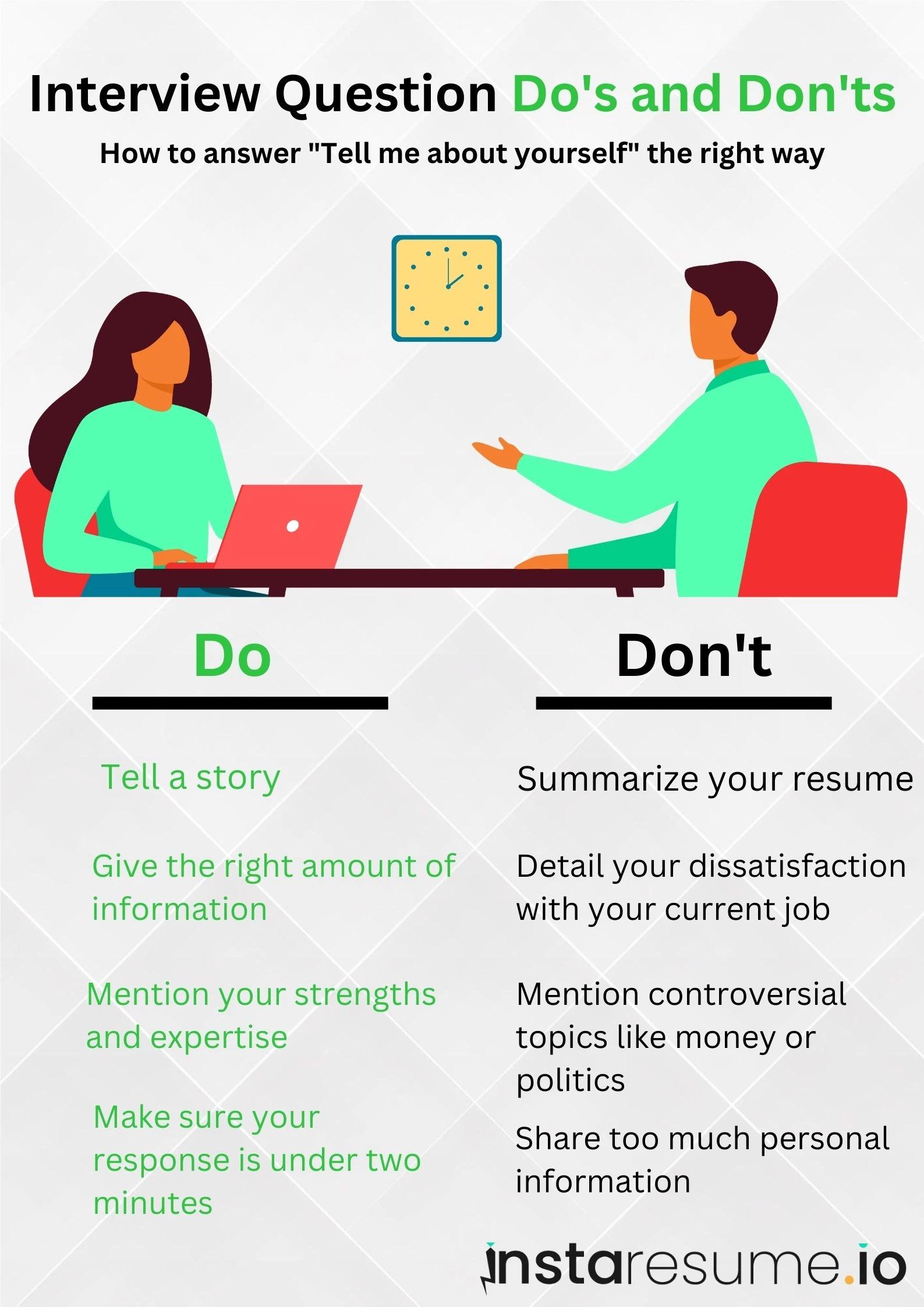
“Tell a story” does not mean starting at the beginning of your career. It means making the connection between your current work, one meaningful contribution, and the role you want next easy to follow.
Build a version you can actually say
Here is a model, not a statement of your achievements. Its failover project and measurements come from the fictional example used in the previous lesson. Replace that portion with your own verified evidence before using any version in an interview.
“I’m a systems engineer with 17 years of experience in C and low-level software, currently working at Broadcom India. For the past three years, my focus has been PSA and the virtual SCSI layer, where storage commands from VMs are handled at the hypervisor boundary.
“One project I’d highlight involved slow I/O during path failover. I correlated behavior across virtual SCSI and PSA, then worked with PSA owners on a retry-handling correction. In a controlled 32-VM test, p99 completion time fell from 480 to 130 milliseconds, while we also checked guest-visible error behavior and data integrity.
“I’m now looking for a Staff role where I can apply that storage-path and virtualization experience to larger systems problems, while taking technical ownership and working across subsystem boundaries.”
The middle paragraph is entirely hypothetical. Do not use its actions, collaboration, or numbers unless they match a real project you can discuss and are permitted to disclose. The first paragraph establishes your area; the example makes your contribution discussable; the final paragraph states a direction. None requires you to call yourself a storage-domain expert.
For an actual application, make the closing more precise. If a posting emphasizes kernel I/O and performance, you might name storage-path debugging and performance work as the match. If it emphasizes cross-team architecture, select a project where your evidence shows design judgment and influence. For Nutanix or DDN, use the specific opening you are applying to, rather than a generic statement about the company.
Notice what the model leaves out: a complete employment history, a catalogue of languages and data structures, an explanation of every acronym, and a full failure analysis. Those belong in later answers. Likewise, you do not need to introduce your perceived storage-domain gaps in the opening. If asked about them, answer directly; here, lead with the work you have done.
Turn the draft into a 90-second delivery
Start with the evidence card and résumé bullet from the previous lessons. Choose one project you would welcome a follow-up question about. Draft in spoken language: short sentences, acronyms only where they help, and a result stated with its real scope. If you do not have a defensible number, use a verified qualitative outcome rather than inventing one.
Then rehearse aloud with a timer:
- First pass: Say the draft naturally. Mark where you run out of breath or have to explain a phrase before moving on.
- Second pass: Cut background details until the project remains understandable. If it runs long, do not speed up to rescue it.
- Third pass: Speak without reading every word. Check that your identity, one contribution, and role-specific closing still appear, and that you finish near 90 seconds.
A useful final test is to imagine the interviewer asking, “What exactly did you do in that project?” Your introduction should make that question welcome. It should not force you to defend a title, metric, or claim you borrowed for effect. Since you are beginning applications immediately, you can use a truthful first version now and refine its emphasis for each interview.
Key takeaways
A strong 90-second introduction is selective, evidence-backed, and role-specific. Establish your current engineering focus, offer one project that demonstrates your contribution, and connect that experience to the work in the opening. Keep VMkernel experience accurately named, and let the interviewer invite the deeper technical account.
In the next lesson, you’ll prepare that deeper account as a concise STAR response—with enough engineering detail to withstand follow-up questions without losing the story.