Recommended resources
The freely available resources this lesson will direct you to.
Introduction
In our previous lesson, we explored the fundamental disagreement between libertarianism and socialism on the question of property. We saw that while libertarians defend a broad right to private property as essential for liberty, socialists argue for collective ownership of the means of production to eliminate exploitation. This naturally leads us to our topic for today: the deeply related conflict over equality and redistribution.
If a society of free individuals trading voluntarily leads to some people becoming vastly wealthier than others, is that a problem? Should the state intervene to reduce this inequality by taxing the rich and giving to the poor? This lesson will compare how libertarians and socialists answer these questions. We will delve into different meanings of "equality" and examine the powerful philosophical arguments, for and against, the redistribution of wealth.
What Kind of Equality?
Before we can compare views on equality, we need to be clear about what the word means. In political philosophy, it's crucial to distinguish between two main concepts:
- Equality of Opportunity: The idea that everyone should have a fair chance to succeed, regardless of their background. This is often analogized to all runners starting at the same line in a race.
- Equality of Outcome: The idea that everyone should end up with a similar amount of wealth and resources. In our race analogy, this would mean everyone finishing at the same time.
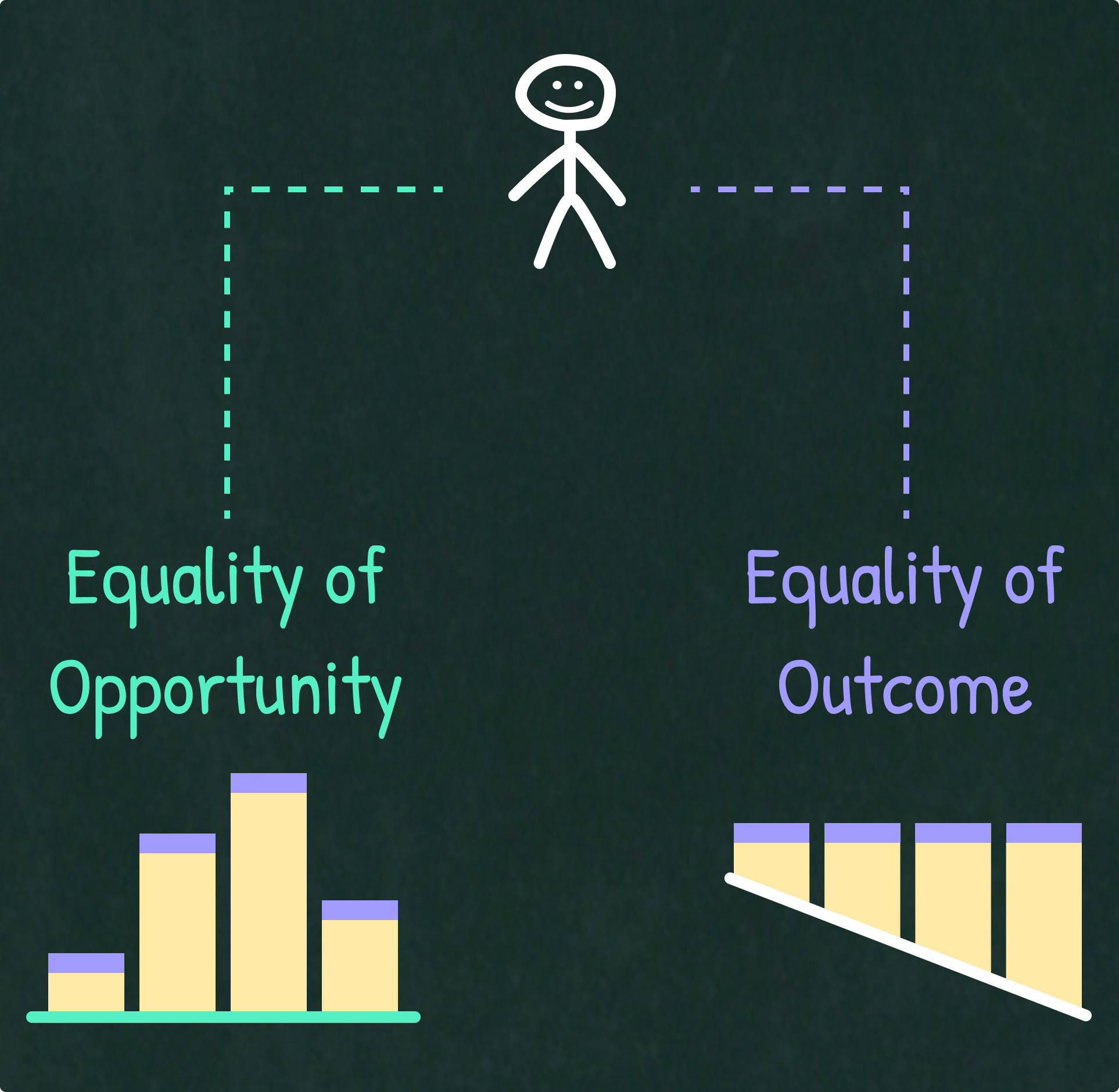
Libertarians are strong proponents of equality of opportunity, or more precisely, "equality of rights." For them, a just society is one where everyone is equal before the law and has the same fundamental rights to life, liberty, and property. However, they argue that enforcing equality of outcome is unjust because it requires violating these rights.
A more nuanced way to look at this involves the concepts of equality, equity, and justice.

Socialists and other egalitarians argue that true fairness requires more than just formal equality. They would point to the 'Equity' and 'Justice' panels, arguing that we must either provide tailored support to overcome disadvantages (equity) or remove the systemic barriers that create those disadvantages in the first place (justice). For many socialists, capitalism itself is the systemic barrier—the wooden fence—that must be removed. Libertarians, in contrast, would see the government taking boxes from one person to give to another as a form of theft, even if done with good intentions.
Let's explore these competing visions by looking at their most influential philosophical defenders.
The Libertarian View: Liberty Upsets Patterns
For libertarians, the justice of a distribution of wealth has nothing to do with the pattern it forms—whether it's equal, unequal, or something in between. All that matters is the process by which it came about. This view is most famously articulated in Robert Nozick's Entitlement Theory.
As a brief refresher, Nozick argued that a person is entitled to their holdings if they acquired them through:
- Justice in Acquisition: Taking something previously unowned without making others worse off.
- Justice in Transfer: Receiving something through a voluntary exchange or gift from someone who was entitled to it.
- Justice in Rectification: Receiving something as compensation for a past injustice.
This leads to a radical conclusion: any distribution of wealth, no matter how unequal, is just if it arose from a just process. To force an equal outcome would require violating people's rights.
To understand Nozick's powerful argument against redistribution, let's watch a video that explains his philosophy and his most famous thought experiment.
Nozick's Entitlement Theory: The Philosophy of the Free Market - Debate
This video from Philosophy Vibe clearly presents Nozick's core arguments against the redistribution of wealth, including the famous Wilt Chamberlain example.
Please watch two key segments: First, watch the section that explains why Nozick viewed government taxation as an unjust form of coercion (Taxation as coercion). Then, watch the explanation of the Wilt Chamberlain example. Focus on the central question: If people freely choose to give their money to Chamberlain, making him very rich, on what grounds could a third party (the government) justly take that money away from him?
The Wilt Chamberlain argument is designed to show that "liberty upsets patterns." Even if you start with a perfectly equal society (a "pattern" of equality), as soon as people are free to make voluntary exchanges, that pattern will be disrupted. To maintain the original pattern of equality, the state would have to constantly interfere with people's free choices—either by forbidding certain transactions ("You can't pay to see Wilt play!") or by forcibly taking money from Wilt and giving it to others.
For Nozick, this leads to a startling conclusion, which is at the heart of the libertarian view on redistribution.
Unit 9: Libertarianism - Introduction to Philosophy
This excerpt from an introductory philosophy course text spells out Nozick's conclusion in the starkest possible terms.
Read the section beginning with Nozick's discussion of socialism and ending with his radical claim about taxation. Focus on this key passage: "Taxation of earnings".
The claim that "taxation is on par with forced labor" is the logical endpoint of the libertarian position. If you own yourself, you own your labor. If someone takes a portion of your earnings without your consent, they are, in effect, claiming ownership over a portion of your time and labor. This, for libertarians, is a fundamental violation of individual rights.
The Egalitarian Response: Justice as Fairness
Egalitarians, including socialists, find this conclusion appalling. They argue that the formal "freedom" of the marketplace is an illusion if people are starting from vastly different positions of power and wealth. They believe that the outcome—the level of poverty and inequality in a society—is a crucial measure of its justice.
One of the most influential counter-arguments to Nozick came from his Harvard colleague, John Rawls. Rawls developed a thought experiment to determine the principles of a truly just society, one that provides a sophisticated philosophical basis for a redistributive welfare state.
Rawls vs Nozick (Ronald Dworkin)
In this classic interview, philosopher Ronald Dworkin explains John Rawls's groundbreaking theory of justice.
Watch from the beginning of the video. Pay close attention to the concepts of the "original position" and the "veil of ignorance." What two principles of justice does Dworkin say people would agree to in this situation? Focus especially on the second principle, often called the "difference principle."
Rawls's "veil of ignorance" is a brilliant device. He asks us to imagine we are designing the rules of society without knowing who we will be—rich or poor, talented or untalented, healthy or sick. Behind this veil, what kind of society would you choose?
Rawls argues that rational, self-interested people would not gamble on being a Bill Gates or a Wilt Chamberlain. Fearing they might end up as the poorest person, they would agree to a system that protects everyone. He concludes they would choose two principles:
- The Liberty Principle: Everyone should have the maximum amount of basic liberties compatible with similar liberty for others.
- The Difference Principle: Social and economic inequalities are acceptable only if they work to the greatest benefit of the least-advantaged members of society.
The Difference Principle is a powerful justification for redistribution. It means that Wilt Chamberlain's massive income would only be just if the system that allows for it (e.g., capitalism, free markets in sports) also makes the poorest people in society better off than they would be under any other system. If not, the state is justified in taxing Chamberlain to improve the lot of the worst-off.
Critiques and Counter-Critiques
The debate between Nozick and Rawls represents a deep philosophical divide. Libertarians critique Rawls by arguing that his "difference principle" is still a patterned theory. It requires the state to coercively take property from some to give to others, violating self-ownership and the non-aggression principle, regardless of the clever "veil of ignorance" justification.
But Nozick's argument has also faced powerful critiques, which question the idealized world his thought experiments assume. The Wilt Chamberlain example seems clean and simple, but reality is far messier.
Wilt Chamberlain, Robert Nozick, and Egalitarianism - Undrafted
This article from the blog Undrafted provides a fascinating and accessible critique of Nozick's argument by comparing his hypothetical to the career of the real Wilt Chamberlain.
Please read the two sections of the article titled "Doesn’t Something Feel Off About This?" and "The Real Wilt." As you read, consider these questions: How does the "Wilt box" oversimplify how value is created and measured? The goofy idea. How did the real world of professional basketball, with its lack of free agency and collective bargaining, differ from Nozick's "free" market? The market isn't free. What does the author argue about the relationship between collective action (unions) and individual liberty/prosperity for star players? Collective action's role.
This critique is powerful because it reveals the hidden assumptions in Nozick's argument. It suggests that economic exchanges don't happen in a vacuum. Value is co-created, and markets are often shaped by power imbalances and rules that benefit one group over another (like team owners over players before free agency). The author's point about unions is particularly challenging for the libertarian view: rather than restricting liberty, collective action empowered players and dramatically increased their wealth, suggesting that liberty and equality are not always in opposition.
Conclusion
We have now mapped the battlefield in the war of ideas over equality and redistribution. The two sides operate from fundamentally different conceptions of justice.
- Libertarianism champions procedural justice. The key question is "How did you get what you have?" If the process involved voluntary acquisition and exchange, the resulting distribution is just, no matter how unequal. They prioritize liberty, arguing that enforcing a pattern of equality inevitably requires coercion and violates individual rights.
- Socialism and Egalitarianism champion distributive justice. The key question is "Who has what?" The pattern of distribution is morally significant. A society with extreme wealth alongside extreme poverty is seen as fundamentally unjust, regardless of the process. They prioritize equality, arguing that liberty is meaningless without the material means to exercise it.
This debate over liberty versus equality is one of the most enduring in modern political thought. Libertarians see it as a clear choice, where redistribution sacrifices freedom for a false promise of fairness. Critics, however, argue that this is a false dichotomy. They contend that extreme inequality can itself destroy freedom for the many, and that measures promoting greater equality can sometimes be the very things that enhance liberty for everyone.
This brings us to our final ideological comparison. While socialists attack libertarianism for its tolerance of inequality, conservatives offer a completely different line of critique, one focused on tradition, social order, and moral community. In our next lesson, we will explore this fascinating and very different debate.