Recommended resources
The freely available resources this lesson will direct you to.
Introduction
In our previous lessons, we built foundational understandings of both socialism and conservatism, two major ideological traditions that provide a crucial context for our study of libertarianism. Now, we begin to place these ideologies in direct conversation with one another. This lesson focuses on one of the most fundamental points of disagreement in all of political philosophy: the question of property rights.
We will compare how libertarianism and socialism approach this issue. You'll recall from our earlier modules that for libertarians, strong private property rights are a non-negotiable cornerstone of individual liberty. For socialists, as we saw recently, the private ownership of productive resources is often identified as the primary source of inequality and exploitation. Our goal is to move beyond these general statements to dissect precisely what each side means by "property," why they defend or condemn it, and what the practical implications of their views are.
What Do We Mean by "Property"?
At the heart of the debate is the very definition of property. In a typical capitalist framework, private property is seen as a fundamental right.
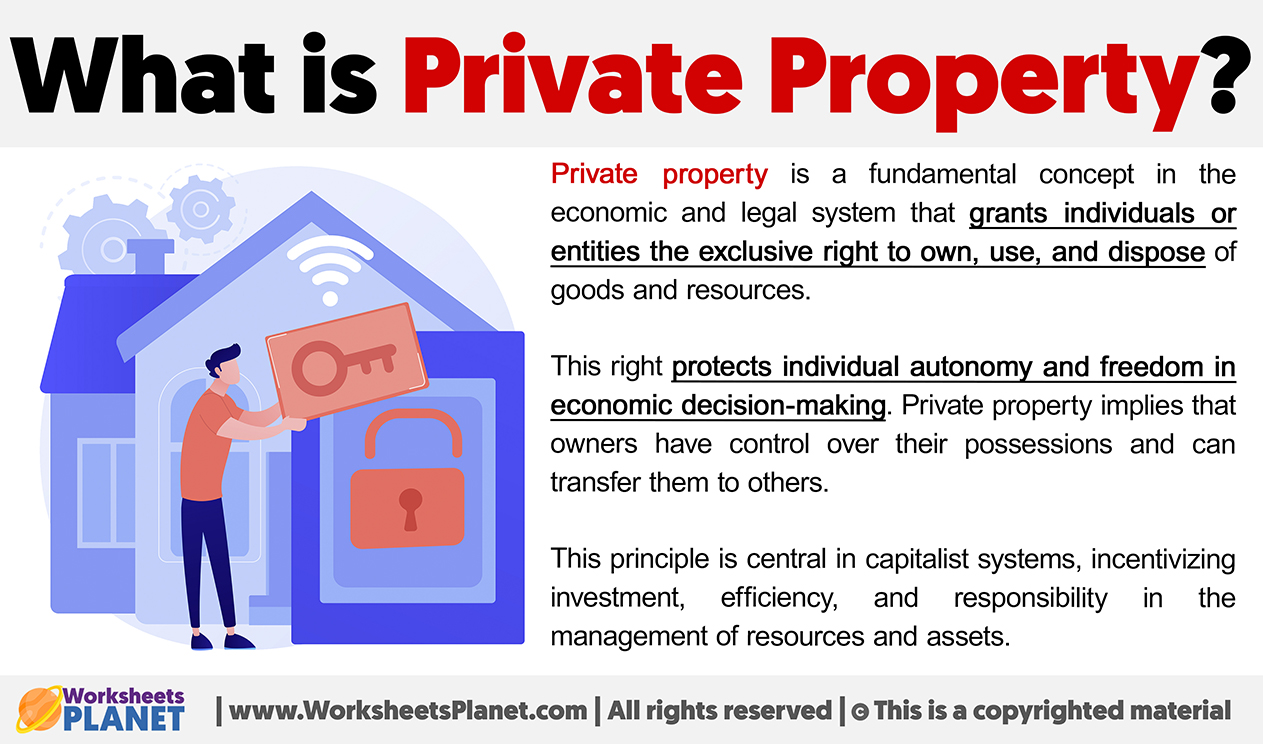
Libertarians largely accept this broad definition, grounding it in the principle of self-ownership. If you own yourself, you own your labor, and by extension, you own the fruits of your labor. This right of ownership is considered a fundamental negative right—a right that others not interfere with your justly acquired possessions.
Socialists, however, make a crucial distinction that is essential to understanding their critique. They divide property into two categories:
- Personal Property: These are your consumer goods—the things you use for your own enjoyment and consumption. This includes your clothes, your food, your computer, your furniture, and even your house and car. Socialists generally have no desire to abolish personal property.
- Private Property: This term is used by socialists in a more specific sense. It refers to the means of production—the assets used to create more wealth, such as factories, machines, farmland, and office buildings.
When socialists, particularly those in the Marxist tradition, call for the "abolition of private property," they are referring specifically to this second category: the means of production.
The Private Property and Personal Property Distinction
This article by Matt Bruenig clearly explains the socialist perspective on property. It's a very helpful clarification that cuts through a lot of common confusion.
Read the article from the beginning down to the end of the section that starts "The typical socialist view..." Focus on how he breaks the tangible world down into three categories: non-produced assets, capital goods, and consumer goods. Then, pay close attention to the summary of the socialist position on who should own what.
As the article clarifies, the core socialist argument is that assets used for production should be owned collectively by society, while goods for personal consumption should be owned by individuals. The conflict with libertarianism, therefore, is not about whether you can own a toothbrush, but about whether an individual or corporation can own a factory.
The Socialist Case Against Private Property
Why do socialists advocate for the collective ownership of the means of production? Their argument stems from the belief that private ownership of these assets inevitably leads to an unjust society.
SOCIALISM: An In-Depth Explanation
This video provides a deep dive into the historical and philosophical roots of socialism. We'll use it to pinpoint the origin of the socialist critique of property.
Please watch the following segments: First, watch the section explaining how socialism emerged as a reaction to liberalism and the Industrial Revolution, focusing on the distinction between the liberal concern with political power and the socialist concern with economic power (Socialism vs. Liberalism). Next, jump to the section detailing Karl Marx's view. Focus on his argument that the right to own industrial property is the source of the bourgeoisie's power (Marx's critique). Finally, watch the short segment that explicitly defines communism's features, noting the centrality of abolishing private property (the means of production) to achieve a classless society (Communism defined).
As the video explains, socialists like Karl Marx argue that a society is fundamentally divided between two classes: the bourgeoisie (who own the means of production) and the proletariat (the workers who own only their ability to labor). In this view, the owner of a factory can exploit workers by paying them a wage that is less than the full value of what they produce, keeping the surplus for themselves as profit. This relationship is seen as inherently exploitative and creates vast economic inequality. The legal system that protects this form of private property, therefore, isn't a neutral guardian of rights but an instrument of class rule.
The socialist solution is to eliminate this class division by transferring the ownership of the means of production from private hands to the community as a whole. The goal is to create a society where production is organized for the common good, not for private profit.
However, historical attempts to implement this have faced enormous challenges. Libertarians and other critics point to these examples as evidence that abolishing private property has disastrous consequences.
Property Rights 1 Private v. Collective
This video from Marginal Revolution University provides several historical case studies that libertarians often cite to argue for the importance of private property rights.
Watch the video from the beginning up to the summary. Pay attention to the recurring theme across the examples of China, the Plymouth Pilgrims, and Vietnam: how did the shift from collective farming to a system recognizing individual or household claims on output affect productivity and social dynamics?
As the video illustrates, collectivization often severs the connection between effort and reward. The saying, "He who has no hope that he shall reap, will not take the trouble to sow," captures the core of the problem. When individuals do not directly benefit from their hard work and investment, the incentive to be productive diminishes dramatically, often leading to economic stagnation and, in the extreme cases shown, famine and social breakdown.
The Libertarian Defense of Private Property
Faced with the socialist critique, how do libertarians defend private property? Their defense is multi-layered, resting on moral principles, practical consequences, and a different interpretation of concepts like coercion and freedom.
First, libertarians reject the socialist distinction between "personal" and "private" property as arbitrary. For them, the right to property is a universal principle derived from self-ownership. Whether you create a chair for your home or build a factory to produce chairs for others, the principle is the same: you mixed your labor and ingenuity with resources, and the result is yours.
Second, libertarians challenge the socialist claim that private property is inherently "coercive."
Private Property and Two Kinds of Force | Libertarianism.org
This article from Libertarianism.org directly engages with the socialist argument that property is a form of coercive violence.
Please read the following sections to understand the libertarian counter-argument: Start with the paragraph that distinguishes between initiatory coercion and defensive force: "initiatory coercion". Next, read the section that argues that abolishing private property doesn't eliminate ownership but merely centralizes it: "actual ownership". Then, read about property as an extension of self-ownership and the role of the Lockean Proviso: "implication of Herbert Spencer’s law". Finally, read the concluding critique of collective ownership: "remedy for monopoly is monopoly".
As the article argues, libertarians distinguish between initiatory force (aggression) and defensive force. Excluding someone from your property is an act of defensive force, justified to protect your rights. It is not the same as initiating aggression against them.
Furthermore, libertarians argue that the socialist "solution" of collective ownership doesn't actually abolish property; it merely transfers it to the state or a collective. This creates a new, far more dangerous concentration of power. Instead of multiple private owners competing in a market, you have a single, monopolistic owner—the state—which controls all productive resources. This, libertarians contend, is the ultimate form of monopoly, leaving the individual powerless against a bureaucratic elite that decides how all resources are used. The historical examples of the USSR and Maoist China are often cited as proof of this danger.
For libertarians, the right to private property is not a tool of oppression but a bulwark against it. It disperses power throughout society, creating a private sphere where individuals can act, create, and trade without needing permission from the state. It is the foundation of economic and personal independence.
A Head-to-Head Comparison
The gap between the libertarian and socialist views on property is immense. It reflects their different starting points: the individual for libertarians, and the collective or class for socialists.
Here is a summary of their contrasting positions:
| Aspect | Libertarian View | Socialist View |
|---|---|---|
| Core Principle | Individual liberty and self-ownership. | Social and economic equality. |
| Justification | A natural right, an extension of the self, necessary for freedom. | A social construct; private ownership of the means of production is a tool of exploitation. |
| Key Distinction | No fundamental distinction; all justly acquired property is protected. | Personal Property (consumer goods) vs. Private Property (means of production). |
| Means of Production | Should be privately owned and managed through voluntary exchange in a free market. | Should be collectively owned and managed by society (e.g., through the state or worker cooperatives). |
| Consumer Goods | Privately owned, as a matter of right. | Individually owned (as "personal property"), distributed according to social principles. |
| Role of the State | To protect property rights from force and fraud. | To abolish private ownership of the means of production and administer them for the public good. |
| Ultimate Goal | A society where individuals are free to pursue their own ends, leading to widespread prosperity. | A classless society free from economic exploitation, where production meets human needs. |
Conclusion
We've now mapped out the profound ideological chasm between libertarianism and socialism on the question of property. This is not a minor disagreement over policy; it is a fundamental conflict over the very structure of a just society.
Let's recap the key points of comparison:
- Definition: Libertarians hold a broad view of private property as a right covering all justly acquired goods. Socialists make a critical distinction, targeting only the "private property" of productive assets for abolition while preserving "personal property."
- Justification: Libertarians justify property rights on moral grounds (self-ownership) and practical grounds (incentives and prosperity). Socialists critique private ownership of the means of production as inherently exploitative and the root cause of class conflict.
- The "Solution": Libertarians see the protection of property rights as the solution to conflict and the path to prosperity. Socialists see the abolition of private ownership of productive assets as the solution to inequality and injustice. Libertarians counter that this "solution" merely creates an all-powerful state monopoly.
This debate over property naturally leads to another core point of contention: equality. What kind of equality, if any, should a just society pursue? And what is the proper role of the state in redistributing wealth? In our next lesson, we will compare libertarian and socialist answers to these very questions.