Recommended resources
The freely available resources this lesson will direct you to.
Introduction
In our last lesson, we explored the core principles of socialism, focusing on its critique of capitalism and its commitment to collective ownership, equality, and redistribution. We now turn to another major ideological tradition that offers a different lens through which to view the world: conservatism. Just as with socialism, understanding conservatism is essential for placing libertarianism in its proper context and appreciating the full spectrum of political thought.
This lesson will introduce you to the foundational principles of conservatism. We will move beyond the day-to-day political labels you might hear in the news to uncover the philosophical commitments that have defined conservative thought for centuries. Specifically, we will focus on three interconnected pillars: a reverence for tradition, a belief in the necessity of social order, and a commitment to the idea of a moral community. By the end of this lesson, you will be able to summarize these core tenets and understand why they often lead to a vision of society that is profoundly different from those offered by both libertarians and socialists.
A Disposition, Not a Dogma
Before diving into specific principles, it's important to understand the nature of conservatism. Unlike ideologies such as Marxism, which are based on a systematic and comprehensive doctrine laid out in specific texts, conservatism is often described as a disposition, a state of mind, or an attitude toward politics and society. The American writer Russell Kirk, a leading figure in 20th-century conservative thought, emphasized this point.
Ten Conservative Principles | The Russell Kirk Center
This introductory section from Russell Kirk's classic essay explains the character of conservatism.
Please read the first four paragraphs, starting from the beginning of the essay. Pay close attention to how Kirk distinguishes conservatism from a rigid ideology and defines it as "a state of mind, a type of character, a way of looking at the civil social order."
As Kirk suggests, conservatives are people who find "the permanent things more pleasing than Chaos and Old Night." This attitude—a preference for the known over the unknown, for the tested over the experimental—informs all the principles that follow.
Principle 1: Tradition, Prescription, and Prudence
The cornerstone of conservatism is its deep respect for tradition. For conservatives, the institutions, customs, and beliefs that have been handed down through generations represent a form of collective wisdom that is far more reliable than the abstract reasoning of any single individual or generation.
This idea is most famously associated with the Irish statesman and philosopher Edmund Burke, who is widely considered the father of modern conservatism. Burke’s thought was powerfully shaped by his opposition to the French Revolution, which he saw as a catastrophic attempt to destroy an entire society and rebuild it from scratch based on abstract ideals like "the rights of man."
The following video provides an excellent introduction to Burke's critique of radical change.
Edmund Burke - a short introduction to Reflections on the Revolution in France
The video "Edmund Burke - a short introduction to Reflections on the Revolution in France" explains Burke's central arguments against the French Revolution.
Watch the following three segments: The introduction, which establishes Burke's opposition to the revolution and his status as the "father of conservatism." The section on accumulated wisdom, which explains Burke's clock analogy and his belief in "the general Bank and Capital of Nations and of Ages" over individual reason. The explanation of organic society, using the analogy of a slowly growing tree to illustrate his preference for gradual, evolving change over radical upheaval.
As the video shows, Burke argued that society is not a machine to be taken apart and reassembled. It is a complex, organic entity that grows and evolves over time. To violently uproot its traditions is to risk killing it.
This reverence for tradition leads to several related conservative principles:
- Prescription: This is the idea that long-standing customs and institutions have authority simply because they have persisted over time. As Kirk puts it, "The individual is foolish, but the species is wise." We should trust the "prescriptive wisdom" of our ancestors over our own "petty private rationality."
- Prudence: Conservatives believe that prudence is the most important political virtue. Political decisions should be made with caution, with a careful eye to their long-term consequences. They are deeply skeptical of radical, sweeping reforms that promise a perfect world, fearing that such efforts often lead to disasters worse than the problems they sought to solve. Burke believed in change, but saw it as a means of conservation—gentle adjustments to preserve the health of the whole.
Principle 2: Social Order and Human Imperfection
The conservative emphasis on tradition is closely linked to a particular view of human nature. Whereas some philosophies see humans as fundamentally good or infinitely perfectible, conservatives hold a more sober view.
Ten Conservative Principles | The Russell Kirk Center
In his sixth principle, Russell Kirk explains the conservative belief in "imperfectability."
Please read the section titled Principle of Imperfectability. Notice the argument that because "Man being imperfect, no perfect social order ever can be created."
Because humans are seen as imperfect—flawed, driven by passion, and prone to selfishness—conservatives believe that a strong social order is essential to restrain our worst impulses and allow for a peaceful, civilized life. Without the constraints of authority, hierarchy, and established institutions, society would risk descending into anarchy.
This social order is supported by:
- Authority: A respect for legitimate authority, whether it is found in the government, the church, the family, or the community. This authority provides guidance and maintains order.
- Hierarchy: Conservatives tend to believe that a hierarchical social structure is natural and beneficial. Society functions best when it recognizes that people have different talents, roles, and responsibilities. This is not about oppression, but about having honest and able leadership and a functional division of labor.
- Voluntary Community: Conservatives stress the importance of "little platoons"—the local associations, clubs, religious congregations, and communities that Burke wrote about. These are the places where duties are learned and social bonds are forged, creating a healthy society from the ground up.
This belief in the need for order and authority stands in stark contrast to the libertarian emphasis on individual autonomy and skepticism of power.
Principle 3: The Moral Community
For conservatives, society is not merely a collection of individuals pursuing their own self-interest, as a libertarian might see it. Nor is it primarily an arena of class conflict, as a Marxist would argue. Instead, society is an organic community, bound together by shared values and a common moral framework.
The following brief video offers a concise summary of this perspective, highlighting the role of traditional institutions and values.
Traditionalist Conservatism explained
This video, "Traditionalist Conservatism explained," touches upon several key aspects of the conservative worldview.
Please watch these short clips: On hierarchy and organic society, reinforcing Burke's view. On the traditional family and moral values, showing how specific institutions are seen as the bedrock of society. On community over individualism, which directly contrasts the conservative view with that of liberalism and libertarianism.
This idea of an organic, moral community rests on the belief in an enduring moral order. Conservatives generally believe that there are permanent, transcendent moral truths that govern human existence.
Ten Conservative Principles | The Russell Kirk Center
Kirk's very first principle addresses this foundational belief.
Read the section on the enduring moral order. Kirk argues that a good society depends on individuals being governed by a "strong sense of right and wrong."
This moral order provides the ultimate justification for law, justice, and social duties. For many conservatives, this order is rooted in religious faith, which serves as a "moral compass" and a source of social cohesion. The key institutions for transmitting this moral framework are the family and the church. By participating in these, individuals are formed into responsible members of the community, connected by duties and loyalties, not just by contracts and self-interest.
Visualizing Conservative Thought
As we've seen, conservatism is not a single, uniform ideology. Different strands of conservatism place varying degrees of emphasis on these core principles. A helpful way to visualize this is by mapping them on two axes: one representing the degree of Social Order (valuing tradition, authority, and moral community) and the other representing the degree of Economic Freedom (valuing free markets).
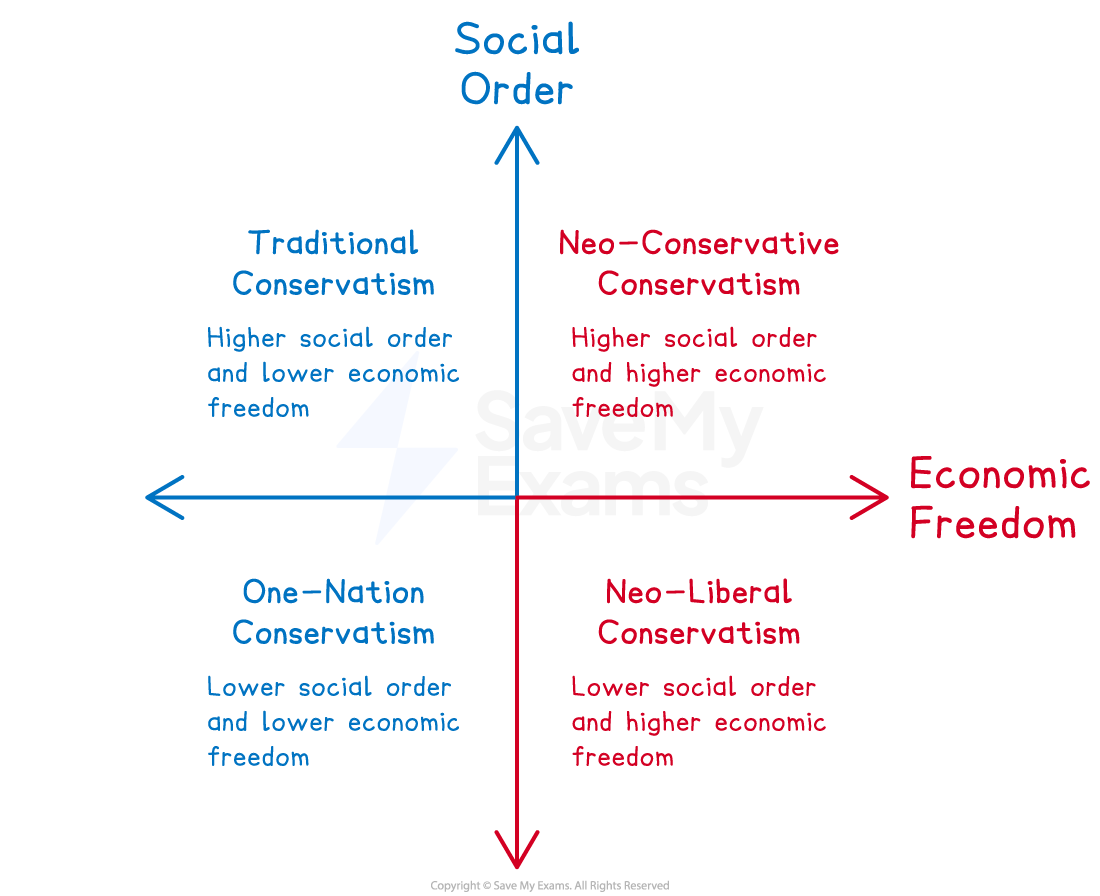
As you can see from the diagram:
- Traditional Conservatism (top left) places a very high value on social order but may be more skeptical of pure, unregulated markets, sometimes supporting economic interventions to preserve social stability. This is the tradition of Burke.
- Neo-Liberal Conservatism (bottom right), which emerged in the late 20th century, combines a strong belief in free-market economics (high economic freedom) with a more individualistic social outlook (lower social order). This strand has significant overlap with libertarianism.
- Neo-Conservative Conservatism (top right) advocates for both a strong social order and a high degree of economic freedom.
- One-Nation Conservatism (bottom left) is more pragmatic, often supporting a social welfare state to promote national unity, thus ranking lower on both social order and economic freedom.
This chart helps illustrate why the term "conservative" can be confusing; it encompasses a wide range of views. The key takeaway is that the fundamental division between conservatism and libertarianism often lies on the vertical axis: the value placed on social order, tradition, and community versus the value placed on individual liberty.
Conclusion
In this lesson, we have moved from the socialist critique of economic inequality to the conservative concern for social and moral continuity. We have established that conservatism is best understood as a disposition rooted in a deep respect for what has stood the test of time.
Let's summarize the key takeaways:
- Nature of Conservatism: It is more of an attitude or disposition than a rigid ideology, characterized by a preference for the "permanent things" and skepticism of radical change.
- Tradition and Prudence: Conservatives believe that tradition is the repository of accumulated wisdom. They advocate for a prudent, cautious approach to change, preferring gradual evolution over revolutionary upheaval.
- Social Order and Human Imperfection: Based on a view of human nature as flawed, conservatism sees a need for a strong social order maintained through authority, hierarchy, and established institutions to restrain destructive passions.
- Moral Community: Conservatives view society as an organic whole, not a mere collection of individuals. This community is bound by a shared moral order, often rooted in religion and transmitted through family and local associations.
You now have a foundational understanding of the core principles of both socialism and conservatism. In our next lesson, we will bring all three ideologies—libertarianism, socialism, and conservatism—together for a direct comparison, analyzing where they agree, where they diverge, and why these differences matter.