Recommended resources
The freely available resources this lesson will direct you to.
Introduction
Welcome to our first lesson in a new module where we broaden our perspective. Having spent considerable time mapping the internal landscape of libertarianism—from its philosophical roots to its competing branches—we now turn our attention outward. To truly understand libertarianism, we must see how it stands in relation to its major ideological rivals. Our first subject is socialism.
This lesson aims to provide a clear and foundational understanding of socialism's core principles. We will focus on the ideas that unite the many different movements that call themselves socialist, specifically their views on collective ownership, equality, and redistribution. By grasping these core tenets, you will be equipped to draw sharp and meaningful comparisons with the libertarian principles we've already studied. This will be the first crucial step in evaluating the strengths and weaknesses of each worldview.
A Reaction to Capitalism
To understand socialism, we must first understand what it was reacting against. Socialism as a distinct political and economic philosophy emerged in the 18th and 19th centuries, directly in response to the social and economic upheavals brought about by the Industrial Revolution and the rise of laissez-faire capitalism.
Thinkers at the time witnessed the immense wealth being generated, but they also saw widespread poverty, dangerous working conditions, child labor, and sprawling urban slums. They concluded that a system based on private ownership of industry and the pursuit of profit was creating deep injustices.
This video provides an excellent overview of this historical context and introduces the core ethical drive behind socialist thought.
SOCIALISM: An In-Depth Explanation
The video "SOCIALISM: An In-Depth Explanation" by Ryan Chapman begins by situating socialism as a response to the concentrations of economic power that emerged under industrial capitalism.
Please watch from the beginning of the explanation. Focus on how socialism is presented as a reaction against liberalism and how its core ethic is defined as "equalitarianism"—a fundamental belief in human equality and a deep-seated concern for the worst-off in society.
As the video explains, while classical liberals (the forerunners of libertarians) were primarily concerned with concentrations of political power (like that of a king), socialists became concerned with concentrations of economic power—the power the wealthy owners of factories and land held over the property-less working class.
This leads us to the first foundational principle of socialism.
Principle 1: Anti-Capitalism and Collective Ownership
At its heart, socialism is a critique of capitalism. Socialists argue that the private ownership of the means of production—the factories, land, tools, and machinery used to produce goods and services—is the root cause of many social ills.
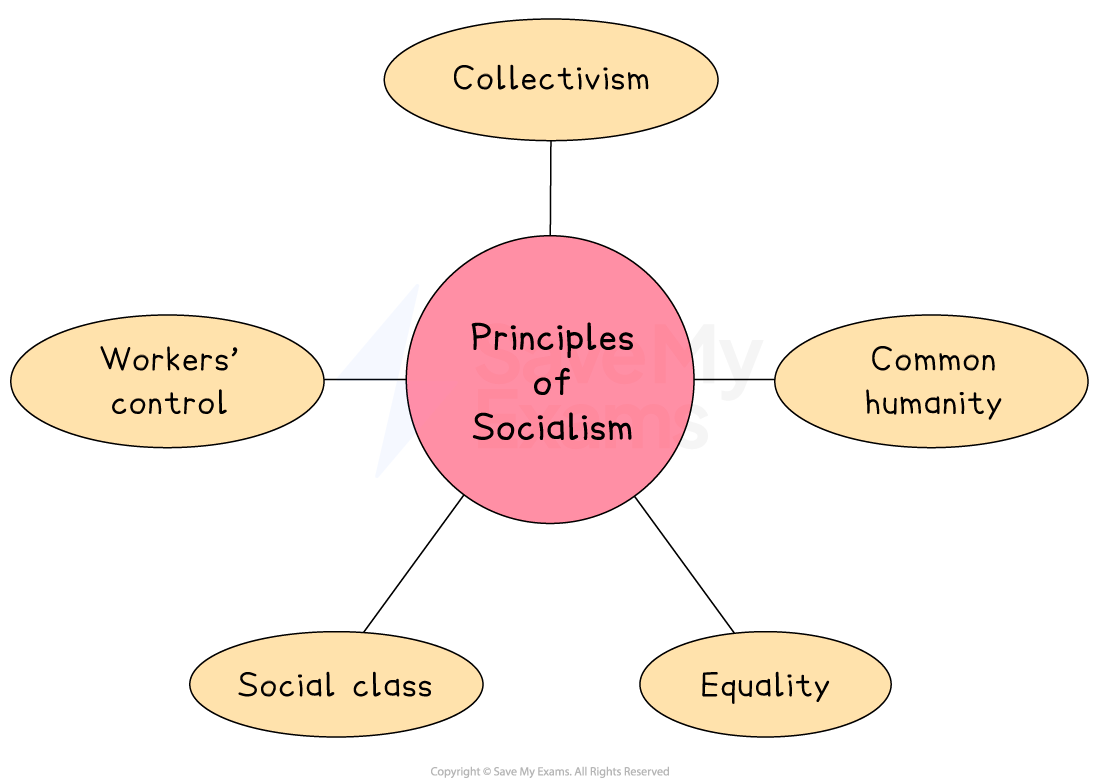
From the socialist perspective, when a small class of people (capitalists or the bourgeoisie) owns the means of production, they can exploit the much larger class of people who must work for them to survive (the proletariat or working class). This relationship is seen as inherently unequal and unjust. The goal, therefore, is to fundamentally change this system of ownership.
The proposed solution is collective ownership. Instead of private individuals owning the productive assets of society for their own profit, these assets should be owned by everyone, in common.
The following video offers a very clear and modern definition of this core concept.
Socialism for Absolute Beginners
In this clip from "Socialism for Absolute Beginners," the narrator directly defines socialism in terms of ownership.
Please watch from this section. The key takeaway is the definition provided: socialism is a society where the means of production "are held by all in common and subject to democratic decision-making, rather than that of a few individuals."
This idea of collective ownership can take several forms:
- State ownership: The government owns and controls key industries on behalf of the people (also known as nationalization).
- Worker ownership: Firms are owned and managed by the people who work in them (cooperatives).
- Common ownership: Resources are managed by the community directly, without a centralized state.
Regardless of the specific model, the underlying goal is the same: to ensure that the economy works for the benefit of all, not just for the profit of a few owners. Production should be for social use and need, not private gain. This is a direct challenge to the libertarian emphasis on absolute private property rights.
Principle 2: The Pursuit of Equality
If collective ownership is the primary method of socialism, then equality is its primary goal. Socialists are driven by the belief that the vast disparities in wealth and power generated by capitalism are fundamentally unjust and harmful to society. They seek to create a more egalitarian society.
This doesn't necessarily mean that everyone should have exactly the same income or possessions. Rather, it refers to several related ideas:
- Reducing Class Distinctions: Eliminating the divide between a wealthy owner class and a poor working class.
- Equality of Opportunity: Ensuring everyone has access to the basic necessities that allow them to flourish, such as education, healthcare, and housing, regardless of their family's wealth.
- Social and Economic Justice: Guaranteeing a basic standard of living and protecting people from poverty and exploitation.
The following reading breaks down the theoretical benefits that socialists believe stem from this focus on equality.
Reading: The Benefits of Socialism | International Business
This article from Lumen Learning summarizes the key advantages claimed by socialist theory, which are all linked to the goal of greater equality.
First, read the "KEY points" section at the top, from the summary. Then, skip down to the section titled "The benefits of socialism also include the following" and read that list, from the list of benefits.
As you can see, socialists believe that by reducing inequality and providing for everyone's basic needs, society as a whole becomes more stable, just, and humane. This contrasts sharply with the libertarian view you studied in Nozick's work, which holds that any distribution of wealth, no matter how unequal, is just as long as it arises from voluntary exchange.
Principle 3: Redistribution, Welfare, and Planning
How do socialist societies aim to achieve this greater equality? The main tools are redistribution and social welfare policies. Even in systems that are not fully socialist (i.e., they still have significant private enterprise, as seen in many European countries), these principles are put into practice.
This is achieved through several mechanisms:
- Progressive Taxation: Taxing the wealthy at a higher rate than the poor. The collected revenue is then used to fund public services.
- Social Safety Net: Providing government assistance for the unemployed, the sick, the disabled, and the elderly (e.g., social security, unemployment benefits).
- Universal Public Services: Offering services like healthcare and education to all citizens, either for free or at a heavily subsidized cost.
- Labor Protections: Implementing laws such as minimum wages, workplace safety regulations, and protections for labor unions to strengthen the position of workers.
Reading: The Benefits of Socialism | International Business
The same article details the specific policy tools used to implement socialist principles.
Please read the section under the heading "How Economies Can Benefit From Socialism," starting from the list of four points. This provides concrete examples of the policies used to redistribute wealth and regulate the economy.
Underpinning many of these policies is a belief in rational economic planning. Socialists often view free markets as chaotic, wasteful, and prone to crises. They argue that a more rational, and often centralized, system of planning can better direct a society's resources to meet human needs, avoid unemployment, and ensure stable prices.
This commitment to planning is one of the most significant points of conflict with libertarianism. As we saw when studying Mises and Hayek, libertarians argue that central planning is precisely what is irrational, as no central planner could ever possess the vast amount of information that is spontaneously coordinated by market prices.
Clarifying a Common Misconception
Given the emphasis on state action in many socialist models, a common caricature arises: "socialism is when the government does stuff." This is an oversimplification that most socialists reject. The goal is not simply a bigger government for its own sake, but a different kind of society where economic power is democratized.
This final video tackles this misconception head-on.
Socialism for Absolute Beginners
This segment from "Socialism for Absolute Beginners" directly addresses and debunks the idea that socialism is just "big government."
Please watch the clip from this point. Note the distinction it draws between any old government program (like the DMV or the military) and the specific socialist goal of collective, democratic control over the economy.
It is also crucial to distinguish between different streams of socialism. Revolutionary socialists, like the Marxists and Leninists, believed that capitalism had to be overthrown by force to establish a new worker's state. In contrast, democratic socialists or social democrats believe that socialist goals can and should be pursued peacefully and gradually through democratic processes within a capitalist society. While Karl Marx is arguably the most influential socialist thinker, his call for revolution represents just one, albeit powerful, variant of socialist thought.
Conclusion
In this lesson, we have laid the groundwork for our comparison between libertarianism and its ideological competitors. We've seen that socialism is not a monolithic doctrine, but a broad tradition united by a set of core principles that stand in stark contrast to libertarianism.
Here are the essential takeaways:
- Origin: Socialism emerged as a critique of industrial capitalism, focusing on the problems of inequality, exploitation, and the concentration of economic power.
- Core Method: The central proposal of socialism is the replacement of private ownership of the means of production with collective ownership, whether by the state, workers, or the community.
- Core Goal: The primary ethical motivation is the pursuit of equality. Socialists aim to reduce class divisions and ensure that everyone's basic needs are met, enabling them to lead flourishing lives.
- Key Policies: Socialist principles are put into practice through redistribution (via progressive taxation), social welfare programs (like universal healthcare and education), and some form of economic planning.
You now have a working model of socialism's foundational ideas. In our next lesson, we will do the same for conservatism, exploring its core commitments to tradition, social order, and moral community. After that, we will be fully prepared to place all three ideologies side-by-side and analyze their fundamental disagreements.