Recommended resources
The freely available resources this lesson will direct you to.
Introduction
In our last lesson, we examined the fundamental clash between libertarianism and socialism over equality and redistribution. We saw that this conflict centers on a core trade-off: libertarianism's prioritization of individual liberty versus the socialist and egalitarian focus on material equality. Today, we turn to a different, but equally profound, ideological comparison: libertarianism versus conservatism.
While libertarians and conservatives often find themselves allied on economic issues, they diverge sharply on the relationship between the individual and society. This lesson explores that divergence, focusing on the essential question of individual freedom versus social order. When a person's free choices are seen to conflict with the stability, morality, or traditions of the wider community, what is the proper role of the state? For libertarians, the answer is almost always to protect individual freedom. For conservatives, the answer is much more complicated.
A Visual Framework: The Nolan Chart
A helpful way to visualize the political landscape from a libertarian perspective is through a diagram called the Nolan Chart. Unlike the simple left-right spectrum, this chart uses two axes: one for economic freedom (free markets, low taxes, property rights) and one for individual freedom (freedom of speech, lifestyle choices, personal relationships).
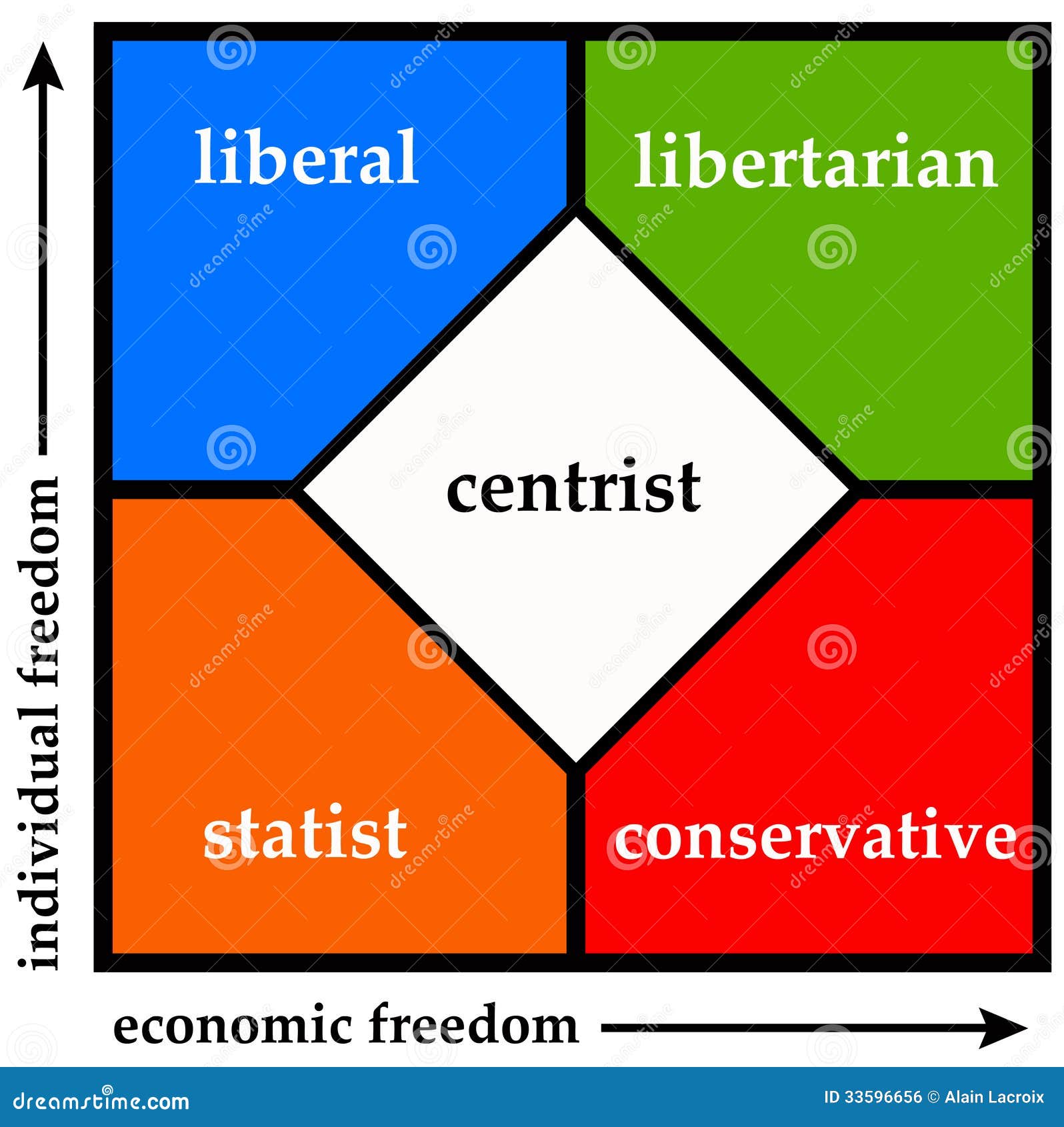
As you can see, this chart places libertarians in the top quadrant, supporting high levels of both economic and individual freedom. Conservatives are placed in the lower-right quadrant, generally supporting high economic freedom but being more restrictive when it comes to individual or personal freedom.
Why this difference? It's not because conservatives are simply "anti-freedom." Rather, it stems from a fundamentally different view about what is necessary to sustain a free and prosperous society over the long run. Conservatives believe that liberty cannot exist in a vacuum; it depends on a stable social order, strong institutions, and shared moral values. Sometimes, they argue, these things must be protected, even if it means limiting certain individual choices.
The Conservative Argument: Order as the Foundation of Liberty
The intellectual father of modern conservatism is the 18th-century Irish statesman and philosopher Edmund Burke. To understand the conservative position, we must start with his ideas. Burke argued against the abstract, radical theories of rights popular during the French Revolution, proposing instead a more pragmatic and cautious approach to government and society.
For Burke, government is not just a tool to protect pre-existing natural rights. It is a practical "contrivance of human wisdom to provide for human wants." And one of the most important human wants, or needs, is for society to provide "a sufficient restraint upon their passions." In a startling turn of phrase for a libertarian to hear, Burke argued that these restraints on our behavior should be counted among our rights.
Let's delve into this foundational conservative argument.
Change from Within Edmund Burke's Reflections on the Revolution ...
This reading from a guide on Edmund Burke's philosophy explains his view on the "Science of Government" and introduces the crucial concept of "Rights as Restraints."
Please read the section titled "The Science of Government." As you read, focus on Burke's argument that society requires our passions to be controlled by a "power out of themselves." Pay close attention to this key passage: the restraints on men.
This idea is central to the conservative critique of libertarianism. Where libertarians see an individual's right to choose as paramount, conservatives see a complex web of duties and obligations. They believe that if everyone pursues their own desires without restraint, the very fabric of society—the families, communities, and traditions that nurture individuals—will unravel. Liberty, in this view, is not the freedom to do whatever you want. It is an ordered liberty, lived within a framework of moral and social institutions that must be preserved.
This exact argument is powerfully articulated in a modern debate between libertarian and conservative interns.
Interns Debate: Libertarianism vs. Conservatism (Cato vs. Heritage)
This video captures a formal debate between interns from the libertarian Cato Institute and the conservative Heritage Foundation. It provides a direct and passionate articulation of both viewpoints.
First, watch the conservative opening argument from 10:13 to 12:50. Notice how the speaker frames conservatism as a "balancing pendulum with order on one end and liberty on the other" and argues that pure libertarianism leads to "societal decay." Then, watch the conservative rebuttal from 17:17 to 19:27. The speaker here argues that the "individual choices that libertarians hold so near and dear sometimes produce large-scale unintended consequences that can rot civil society."
The Libertarian Response: Freedom, Virtue, and Civil Society
Libertarians hear these arguments about "societal decay" and "guardrails" and see a dangerous justification for state coercion. Their response is two-fold: first, they argue that true virtue cannot be forced; and second, they believe that a healthy social order arises spontaneously from free people, not from government directives.
The libertarian position is that forcing someone to be "moral" at the point of a gun is not morality at all. A person who refrains from using drugs only because they fear prison is not virtuous; they are merely obedient. True virtue requires the freedom to choose, to make mistakes, and to learn.
Furthermore, libertarians argue that conservatives misidentify the source of social order. It does not come from the state, but from the institutions of civil society: families, churches, charities, neighborhood associations, and voluntary clubs. In the libertarian view, it is precisely when the state oversteps its bounds to regulate morality that these vital, local institutions wither. When the government takes on the role of moral guardian, communities and individuals lose their own sense of responsibility.
Let's return to the debate to see how the libertarian side counters the conservative argument.
Interns Debate: Libertarianism vs. Conservatism (Cato vs. Heritage)
Now, let's hear the libertarian response from the same Cato vs. Heritage debate.
Watch the libertarian opening argument from 12:50 to 17:17. The speaker argues that "Liberty is the best means of achieving such a virtue" and that the "imposition of moral values by force of law...crowds out the most essential roles of civil society." Next, watch the libertarian rebuttal from 19:27 to 21:40. Notice the argument that conservatives don't explain why the government must be the one to solve social problems, as opposed to "your local church" or "families and communities."
An essay reflecting on this debate offers a sharp summary of the libertarian critique. It argues that the fundamental difference lies in how each philosophy views the citizen.
Reflections on the Libertarianism vs. Conservativism Debate
This article by a Cato Institute scholar analyzes the philosophical differences that surfaced during the debate you've just watched clips from.
Read the section that begins "The conservatives claim that they are taking the ethical high road." Pay close attention to the author's stark comparison: All political theories.
This framing—of treating citizens as adults versus children—is a powerful way to understand the core of the disagreement. Libertarians believe that a free society must be an "adult" society, where individuals are trusted to run their own lives. Conservatives worry that without the guidance and restraint provided by tradition and authority, these "adults" will behave like reckless children, destroying their own inheritance of freedom.
Synthesizing the Core Conflict
We can now map the fundamental points of disagreement between libertarianism and conservatism on the question of freedom versus order.
| Core Question | Libertarian Answer | Conservative Answer |
|---|---|---|
| What is the primary role of government? | To protect individual negative rights (life, liberty, property) from coercion. | To preserve the social order, traditions, and institutions that make lasting liberty possible. |
| What is the source of a good society? | The spontaneous, voluntary interactions of free individuals and the institutions of civil society. | An inherited social fabric, including family, religion, and community, guided by tradition and authority. |
| What is the relationship between freedom and virtue? | Freedom is a prerequisite for virtue. Morality cannot be coerced; it must be chosen. | Freedom is dependent on virtue. Human nature is flawed and requires restraint to guide it towards good and away from self-destructive behavior. |
| How should "victimless crimes" (e.g., drug use, gambling) be treated? | They should be legal. As long as an action doesn't harm others, it is a matter of individual choice and responsibility. | They are not truly victimless, as they weaken the moral character of individuals and erode the social fabric. The state may have a role in discouraging them. |
Conclusion
Today we've explored the deep philosophical rift that separates libertarians from their frequent political allies, the conservatives. This is not a simple disagreement over policy, but a profound difference in how they view human nature, the source of morality, and the very purpose of government.
- Libertarians champion individual autonomy. They place their faith in the ability of free people to create a vibrant and moral social order spontaneously, from the bottom up. They see the state's attempts to enforce a particular moral code as a threat to both liberty and genuine virtue.
- Conservatives champion social order. They see society as a fragile inheritance, a complex ecosystem of traditions and institutions that must be carefully tended and preserved. They place their faith in this inherited wisdom to provide the "guardrails" necessary to protect liberty from its own excesses.
This tension between individual freedom and social order is not easily resolved. It highlights a key challenge to the libertarian worldview: what if free choices, in the aggregate, do lead to outcomes that weaken the foundations of a free society itself? The conservative raises this question not as an enemy of liberty, but as one who is deeply concerned with its survival across generations.
This leads us directly to our next topic. The conservative concern for social order is inextricably linked to their reverence for tradition and established moral authority. In the next lesson, we will delve deeper into this aspect, comparing the libertarian's characteristic skepticism of the past with the conservative's belief that tradition is a vital source of wisdom.