Recommended resources
The freely available resources this lesson will direct you to.
Introduction
In our last session, you learned to visualize the forces on a rocket by creating a free-body diagram, identifying the upward thrust and the opposing forces of weight and drag. This gave us a qualitative understanding that for liftoff, thrust must exceed the downward forces.
This lesson takes the critical next step from visualization to quantification. We will translate your free-body diagram into a mathematical equation based on Newton's Second Law. By the end of this lesson, you will be able to calculate the net force acting on a rocket and determine its resulting acceleration at any given moment during its powered ascent. This is a foundational skill for predicting your rocket's performance.
1. From a Diagram to an Equation
The free-body diagram from our previous lesson serves as the blueprint for our equation of motion. For a rocket accelerating vertically, we identified three key forces: Thrust (T), Weight (W), and Drag (D).
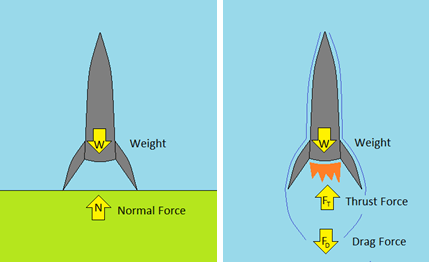
By convention, we define the upward direction as positive. Therefore, the net force () is the sum of these forces, respecting their directions:
Newton's Second Law of Motion states that , where is the mass of the rocket and is its acceleration. By substituting our expression for net force, we arrive at the governing equation for a rocket in vertical flight:
To solve for the acceleration, which is our primary goal, we simply divide by the mass :
This can also be written as:
...since Weight .
The following resource provides a clear and direct derivation of this exact formula. Focus on the logic that connects Newton's Second Law to the specific forces acting on the rocket.
[PDF] Python Model Rocket Trajectory Simulator Tutorial - SpaceLab Illinois
This tutorial from SpaceLab Illinois derives the rocket's acceleration equation, which is central to this lesson.
In the PDF, navigate to the section "F. Discussion of Equations" on page 8. Read the derivation from Equation (1) to Equation (5). This passage shows precisely how we get from the general F=ma to the specific formula for a rocket's acceleration.
2. Quantifying the Forces
To use our acceleration formula, we need numerical values for Thrust, Weight, and Drag.
-
Thrust (T): This force, measured in Newtons (N), is a characteristic of the rocket motor you choose. Manufacturers provide this data, typically as an average thrust value over the motor's burn time.
-
Weight (W): This is the force of gravity acting on the rocket's mass. It is calculated as , where is the total mass of the rocket in kilograms (kg) and is the acceleration due to gravity (approximately near Earth's surface).
-
Drag (D): This is the force of air resistance. It is not a constant value; it depends on the rocket's velocity, the air density, and the rocket's shape. The formula for drag is:
Where:
- (rho) is the density of the air (approx. at sea level).
- is the rocket's current velocity in m/s.
- is the drag coefficient, a dimensionless number that depends on the rocket's geometry (shape of the nose cone, fins, etc.). For a typical model rocket, a of 0.75 is a reasonable starting estimate.
- is the cross-sectional area of the rocket in . For a cylinder, .
The following resource provides a practical guide to finding these values for a typical model rocket.
This guide from "Rocket Mime" explains how to gather the necessary parameters for your calculations, focusing on model rocketry.
Read the section "Compute Some Useful Terms". Pay close attention to how mass (M), area (A), the wind resistance factor (k), thrust (T), and gravitational force (M*g) are calculated. Note that the "wind resistance factor k" is just a convenient way of grouping the constant parts of the drag equation: k = \frac{1}{2} \rho C_d A, so that D = k v^2.
3. Worked Example: Calculating Acceleration
Let's apply these concepts to calculate the acceleration of a rocket at two different points in its flight. We will use the Estes Alpha III as our example, a classic model rocket.
Scenario A: Initial Acceleration at Liftoff ()
At the very instant of liftoff, the rocket's velocity is zero (). This simplifies our calculation significantly, as the drag force is also zero.
- Given:
- Rocket mass (including engine),
- Engine average thrust, (from a C6 motor)
- Step 1: Calculate Weight (W)
- Step 2: Calculate Net Force ()
Since , Drag .
- Step 3: Calculate Acceleration (a)
This is a very high acceleration, over 10 times the acceleration of gravity ().
Scenario B: Acceleration During Flight (when )
Now, let's calculate the acceleration at a moment when the rocket has reached a velocity of . Now we must include drag.
- Given:
- All values from Scenario A.
- Velocity,
- Cross-sectional area,
- Drag coefficient,
- Air density,
- Step 1: Calculate Drag (D)
- Step 2: Calculate Net Force ()
- Step 3: Calculate Acceleration (a)
As you can see, as the rocket's speed increases, the drag force grows, which reduces the net force and therefore reduces the acceleration.
To see a complete, integrated example that calculates not just a single point but the entire boost phase, study the example provided in the "Rocket Equations" resource.
This section applies all the formulas to a real model rocket, the Estes Alpha III.
Read the section titled "alfred Can I See A Simple Example?". Follow the calculations step-by-step. Don't worry about the complex final formulas for velocity and altitude yet (like v = q*[1-exp(-x*t)] / [1+exp(-x*t)]). Focus on steps 1 and 2, where the author calculates the fundamental terms: Mass, Area, wind resistance factor (k), and gravitational force. This reinforces the process of finding the values you need to calculate net force.
Conclusion
In this lesson, you have moved from a qualitative diagram of forces to a quantitative method for calculating a rocket's acceleration. This is the cornerstone of trajectory analysis and rocket design.
Key Takeaways:
- The net force on a vertically launching rocket is given by .
- The resulting acceleration is calculated using Newton's Second Law: .
- To perform this calculation, you must quantify three key forces:
- Thrust (T): From motor specifications.
- Weight (W): Calculated as .
- Drag (D): Calculated as .
- A rocket's acceleration is not constant; it changes as its velocity (affecting drag) and mass change.
Our calculations today made a significant simplification: we assumed the rocket's mass is constant. In reality, a rocket's mass decreases as it expels propellant. In our next lesson, we will address this by exploring how to apply Newton's laws to a variable-mass system, a crucial concept for accurately modeling rocket flight.