Recommended resources
The freely available resources this lesson will direct you to.
Introduction
In our last lesson, we developed a formula to calculate a rocket's acceleration, , by applying Newton's Second Law. However, we made a crucial simplification: we treated the rocket's mass, , as a constant. This is a reasonable approximation for a very short period, but a rocket's mass is fundamentally variable—it decreases significantly as it burns and expels propellant.
This lesson confronts that complexity head-on. We will explore why a variable-mass system demands a more nuanced application of Newton's laws. You will learn that simply using is insufficient and can lead to incorrect conclusions. By the end of this session, you will understand how to correctly formulate the equation of motion for a rocket by starting from the more fundamental principle of conservation of momentum.
1. Why Isn't the Whole Story
A common first instinct when dealing with changing mass is to use the form of Newton's second law that relates force to the rate of change of momentum, . Since momentum , one might apply the product rule to get:
This equation, while mathematically correct, is often misinterpreted in the context of a rocket. It tempts one to think that is the familiar term and that the rocket's thrust must be equal to the second term, . This is incorrect. This formula describes a system where mass is being added or removed, but it doesn't properly account for the momentum of the mass that leaves the system. For a rocket, the expelled gas has its own momentum, which is the key to generating thrust.
The following article from PhysicsForums provides an excellent explanation of this common pitfall. It uses the example of a hovering rocket to show how the naive application of this formula leads to a nonsensical result.
How to Apply Newton's Second Law to Variable Mass Systems
This article provides a rigorous look at the physics of variable-mass systems. It's an ideal resource for understanding the subtleties involved.
Please read the introduction. Focus on the "Attempted solution" for the hovering rocket. Note how applying the simple product rule fails to account for the thrust from the expelled gas and leads to a paradoxical conclusion.
The failure of this simple approach shows that we need a more robust method. Instead of focusing on the rocket alone, we must consider a closed system: the rocket plus its ejected fuel.
2. The Correct Approach: Conservation of Momentum
The correct way to analyze a rocket is to apply the principle of conservation of momentum to the entire system (rocket + exhaust) over a small time interval, .
Let's visualize the system at two points in time, as shown in the diagram below.
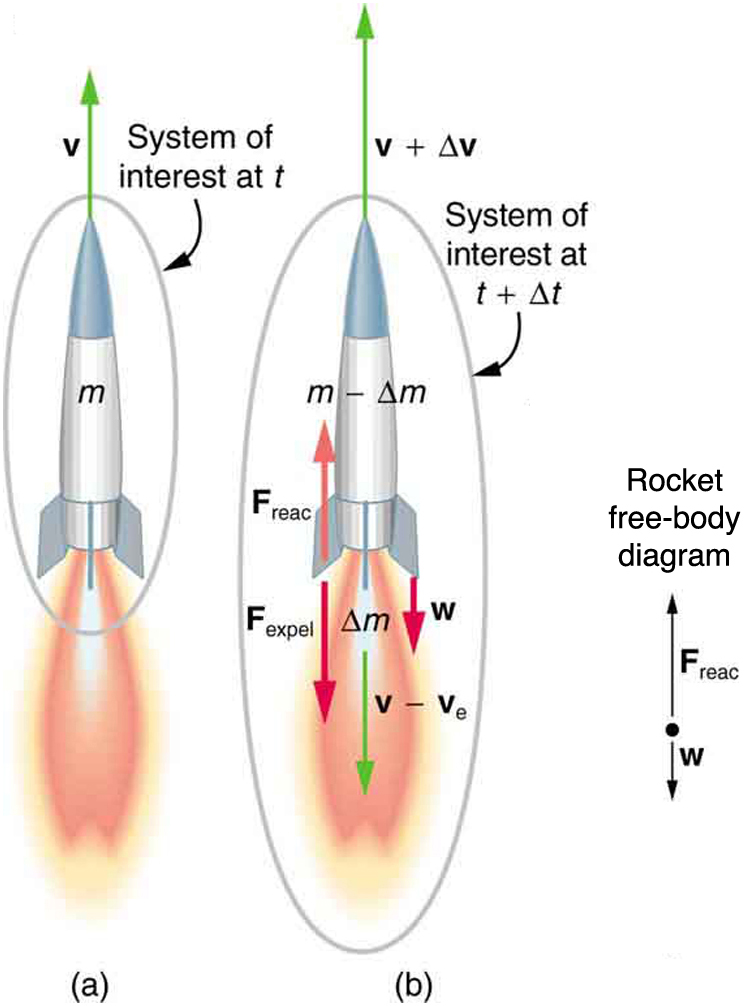
At time , the rocket has a total mass and moves with velocity . The momentum of the system is simply:
At time , a small amount of propellant, which we'll call , has been ejected.
- The rocket now has mass and its velocity has increased to .
- The ejected mass is moving with velocity relative to a stationary observer (the "lab frame").
The total momentum of the system at this later time is the sum of the rocket's momentum and the exhaust's momentum:
The change in the system's momentum, , is equal to the external impulse, . The following video provides an excellent, step-by-step derivation based on this principle.
Rocket Thrust and Speed Calculation
This video from the Physics Ninja channel derives the thrust equation from first principles using conservation of momentum. It clearly breaks down the momentum of the system before and after the mass is ejected.
Watch the section from the beginning of the derivation. Pay close attention to how the total momentum is defined at time t and t + Δt, and how the relative exhaust velocity is used to simplify the expression and arrive at the final force equation.
3. The General Rocket Equation
As derived in the video, by applying the impulse-momentum theorem () and defining the exhaust velocity relative to the rocket (), we arrive at the correct equation of motion. Let's formalize the result.
The impulse-momentum theorem states:
After substituting the momentum expressions, expanding the terms, and neglecting the very small second-order term (), the equation simplifies to:
where is the magnitude of the exhaust velocity relative to the rocket.
Let's define as the change in the rocket's mass, so . Substituting this and dividing by , we get:
Rearranging this gives us the general form of Newton's second law for a rocket:
Let's break this down:
- is the familiar term, representing the product of the rocket's instantaneous mass and its acceleration.
- represents the sum of all true external forces, such as gravity () and drag (). For a vertical launch, this would be .
- is the thrust. Since the rocket is losing mass, is a negative quantity, making the entire term positive. This shows that thrust is not an external force but an effective force that arises from ejecting mass.
So, our equation of motion from the previous lesson, , is still conceptually correct, but now we have a precise physical definition for thrust:
The PhysicsForums article you looked at earlier also derives this exact equation. Reading its formal derivation will solidify your understanding.
How to Apply Newton's Second Law to Variable Mass Systems
This reading will reinforce the derivation and show you how to think about applying this new equation.
First, read the section deriving the equation. This is a more formal, mathematical version of the derivation shown in the video. Note that their final "Equation (2)" is identical to the one we just derived. Next, read the short section titled "A working recipe". This gives a clear, structured procedure for solving variable-mass problems. Finally, read the "Afterthoughts" section. This summarizes the crucial conceptual difference between a force-based analysis (F=ma) and an impulse-momentum analysis, which is required for variable-mass systems.
Conclusion
In this lesson, you've moved beyond the simplified, constant-mass view of rocket motion to a more accurate and powerful physical model. You now understand that the familiar is a special case and that for variable-mass systems like rockets, a deeper application of physics is required.
Key Takeaways:
- Simply applying the product rule to is misleading for a rocket because it fails to account for the momentum of the ejected mass.
- The correct approach is to apply the principle of conservation of momentum to a closed system (rocket + ejected fuel).
- This leads to the general rocket equation: .
- This equation reveals the physical origin of thrust: . Thrust is directly proportional to the exhaust velocity () and the mass flow rate ().
In our next lesson, we will formally define momentum and impulse, solidifying the concepts we used today to explain how a rocket generates thrust. Following that, we will integrate the very equation you learned today to derive the Tsiolkovsky Rocket Equation, one of the most important formulas in astronautics, which allows us to calculate the total change in velocity () a rocket can achieve.