Recommended resources
The freely available resources this lesson will direct you to.
- The REAL Problem with Awareness Facebook Adswww.youtube.com
- What Is Performance Marketing? Performance Marketing Explained!www.youtube.com
- What is Product Marketing? The 2026 Guidewww.productmarketingalliance.com
- Performance Marketers & How to Build a Brand | Facebook IQ | Meta for Businesswww.facebook.com
Hello! This course begins with the growth system behind a financial product launch. Before choosing audiences, campaign ideas, or Meta settings, it helps to know which kind of marketing work is solving which problem.
In this lesson, you’ll distinguish brand marketing, performance marketing, product marketing, and CRM by the decisions they make and the outcomes they influence. We’ll use a hypothetical mutual-fund app that lets customers start a systematic investment plan (SIP). The aim is not to assign each team one rigid funnel stage; it is to understand how the four roles work together to acquire customers, help them convert, keep them engaged, and contribute to sustainable revenue. Allow about 40 minutes.
Start with the customer, not the team chart
Imagine someone who has heard that investing regularly may help them work toward a long-term goal. Before starting a SIP, they may need to recognize the app, understand what it offers, decide whether they trust it, complete onboarding, choose a fund, and make a first contribution. Later, they must decide whether to continue.
The five-stage lifecycle diagram is a useful first map of those changing needs.

For this lesson, four business outcomes matter most:
- Acquisition: bringing in a new customer. Define “customer” carefully: an app install, a completed account, and a first funded SIP are different achievements.
- Conversion: helping someone complete a meaningful next action, such as moving from an account to a first investment. There can be several conversions within one customer journey.
- Retention: helping customers continue to receive value and remain engaged over time. A second contribution or an active SIP tells a different story from a one-time registration.
- Revenue: the business value that ultimately supports growth. Investment contributions or assets held through an app are not automatically the app’s revenue; the relationship depends on its business model.
These outcomes are connected, but the customer does not move neatly down a funnel. Someone might see an ad, investigate the product, leave, return months later, and ask for reassurance after registering. Marketing therefore needs both distinct responsibilities and a shared view of the journey.
Brand builds the reason to trust; product marketing makes the choice intelligible
Brand marketing shapes what people recognize, remember, and believe about the organization. In a financial category, its work is not just getting attention. It includes establishing a credible identity and a consistent standard of communication, so that a potential customer feels able to consider the company when money is at stake.
A brand campaign might introduce a clear proposition about making regular investing easier to understand. Its near-term indicators could include awareness, relevant consideration, or trust-related research. Its business contribution may emerge later, when more people consider the app or respond to acquisition efforts. Brand marketing is accountable for building and protecting that broader perception, not for claiming sole credit for every later investment.
Product marketing answers a narrower, equally important question: Why is this particular product a good choice for this particular customer need? It investigates customers and alternatives, defines positioning, translates features into understandable benefits, and equips launch teams with accurate messaging. For a SIP offering, that could mean explaining how recurring contributions work, who the experience is designed for, and what a customer must understand before deciding. It must not turn an uncertain investment outcome into a promised return.
Read the short definition and role comparisons below. The distinction to notice is that product marketing can contribute to awareness, but its central task is to make the specific product’s value and use clear.
What is Product Marketing? The 2026 Guide
Read Product Marketing Alliance’s guide for its definition of product marketing and its comparison with broader marketing and brand marketing.
Under “What is product marketing? (The 2026 definition),” begin at the opening definition (“At its core”) and read the definition, then continue through the four responsibility bullets ending with “Product launches.” Under “How is product marketing different from other marketing roles?”, read the subsections “Product marketing vs marketing communications” and “Product marketing vs brand marketing.” In the first, follow the comparison from the opening paragraph through the sentence about awareness. In the second, read the brand distinction. Focus on the different questions each role is trying to answer, rather than treating their activities as mutually exclusive.
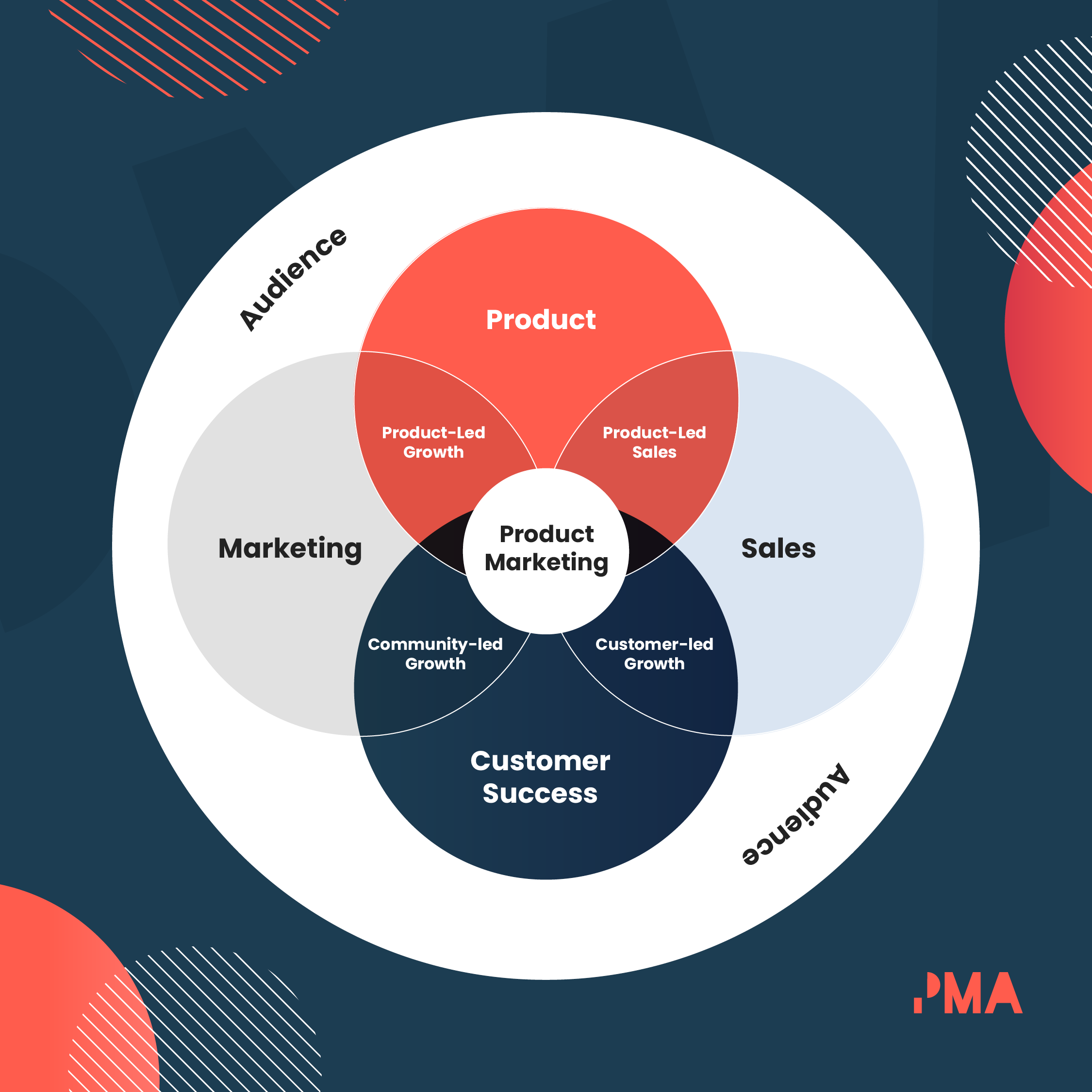
The Venn diagram below places product marketing where product knowledge meets market-facing work. It is useful for understanding why product marketers collaborate across teams, though it does not show all four roles in this lesson.
Consider the difference between these two messages:
“A financial app you can understand and trust.”
“Set up a recurring mutual-fund investment in the app, with the contribution amount and process explained before you confirm.”
The first is closer to a brand-level promise. The second conveys a product-specific use and experience. Neither is sufficient by itself: a credible brand makes the product worth considering, while product clarity helps someone decide whether to act. Both messages would need to match the actual experience and any applicable financial-marketing requirements.
Performance marketing turns a defined action into a managed acquisition effort
Performance marketing uses measurable outcomes to guide campaign decisions. In this course, its most relevant application is paid digital acquisition, including Meta ads. A performance marketer chooses whom a campaign should reach, what action to optimize toward, how much to spend, what creative to test, and whether the resulting customers justify the cost.
Watch Funnel’s explanation for the metrics used in day-to-day performance decisions. Listen especially for the difference between an early signal, such as a click, and a business outcome, such as a qualified new customer.
What Is Performance Marketing? Performance Marketing Explained!
Watch “What Is Performance Marketing? Performance Marketing Explained!” by Funnel for a working definition and a tour of campaign metrics.
Watch the definition, noting the speaker’s acknowledgment that the term has fuzzy boundaries and that ads can be billed for impressions rather than sales. Then watch the metrics, paying particular attention to the move from impressions and clicks to engaged visits, conversions, cost per acquisition, and broader business measures.
A crucial qualification: measuring an investment does not mean an ad platform caused every result it reports, and paying for ad delivery does not mean paying only when a funded customer appears. For a SIP campaign, an inexpensive app install could be a poor result if few installers complete onboarding or invest. Conversely, a more expensive click might lead to more qualified customers. Performance decisions should therefore look beyond the easiest event to count.
Brand and performance are also different jobs, not necessarily different channels. A Meta ad could introduce a company to unfamiliar people, ask interested people to learn about a product, or seek a measurable sign-up. The creative message, campaign setup, and success measure should follow the job.
Meta’s case study shows why brand and direct-response activity can coexist, although its retail example should not be copied mechanically into financial services.
Performance Marketers & How to Build a Brand | Facebook IQ | Meta for Business
Read Meta for Business’s account of a brand-awareness and direct-response approach, then its explanation of why customer journeys do not stay in separate funnel compartments.
In the opening RXBAR case, start with the paragraph beginning “RXBAR was already” and read the campaign setup, continuing through the reported sales results immediately after it. Then, in the discussion beginning “RXBAR’s strategy reflects a broader shift,” find the paragraph beginning “The surge in product choice” and read the journey discussion. Focus on the distinct jobs of the two ad approaches and on why a person may move back and forth between discovery and purchase. Treat the case’s reported results as an example, not a promised effect for another campaign.
For the hypothetical SIP app, a brand message might help unfamiliar people understand why the app is worth examining. A performance campaign might then seek completed, eligible sign-ups or first investments, depending on what can be measured responsibly and reliably. If the ad makes a clear promise but onboarding is confusing, the solution is not automatically a new audience or a cheaper click.
CRM helps a known customer take the next appropriate step
CRM, or customer relationship management in this context, is the marketing work that uses a known customer’s relationship and permitted contact points to support their next useful action. It commonly includes onboarding communications, timely reminders, educational messages, and re-engagement. Its channels might include in-app messages, email, push notifications, or other permission-based messaging.
The defining difference is context. A broad paid ad may address people whose circumstances are largely unknown. A CRM message can be informed by an observed state: someone registered but has not finished onboarding, started a SIP setup but did not confirm it, or has an existing plan and needs relevant account information. That context should make the communication more useful, not give the marketer unlimited permission to contact the person.
In the SIP example, CRM could help an opted-in customer locate an unfinished setup or understand what to review before confirming a contribution. Later, it could provide appropriate service information to someone with an active plan. Product marketing should help ensure those explanations are accurate; brand standards should keep the tone trustworthy. CRM cannot repair a broken setup flow, and it should not pressure someone into an investment decision.
Its measures depend on the message’s purpose: onboarding completion, first-investment completion, continuing activity, or re-engagement, alongside opt-outs and complaints. A sent reminder is an output; a customer action is a stronger signal. Even then, some customers would have acted without the reminder, a measurement question we will revisit later in the course.
Four roles, one set of business outcomes
Here is a compact way to compare the roles. The “primary question” is more reliable than assigning each role a single funnel stage.
| Role | Primary question | Typical contribution | Useful evidence |
|---|---|---|---|
| Brand | Why should people recognize and trust us? | Makes the organization credible and easier to consider | Awareness, relevant consideration, trust indicators |
| Product marketing | Why choose and use this product for this need? | Clarifies positioning, proof, launch messaging, and adoption | Product understanding, conversion and activation patterns, customer feedback |
| Performance | Which paid efforts bring valuable customers efficiently? | Delivers and improves measurable acquisition campaigns | Qualified new customers, conversion rates, acquisition cost |
| CRM | What does this known customer need next? | Supports onboarding, ongoing use, and appropriate re-engagement | Activation, continuing activity, opt-outs, customer feedback |
These are primary responsibilities, not exclusive claims on outcomes. Brand work can improve conversion by reducing doubt. Product marketing can strengthen an acquisition ad and a retention message. Performance can distribute brand-building creative. CRM can influence revenue by helping existing customers continue using a product that serves their needs.
Suppose an app gets many sign-ups but few first funded SIPs. The four-role view produces better questions than “Which team owns conversion?” Brand asks whether the overall promise established appropriate trust. Product marketing checks whether customers understand the product, the decision, and the information they need. Performance checks whether ads attracted people likely to want the offer and whether ad expectations match the destination. CRM checks whether a permitted, timely explanation could help customers who paused. The product team may also need to fix confusing screens or operational friction. Shared diagnosis does not erase distinct decision ownership.
Finally, keep revenue in perspective. More installs, registrations, contributions, or active plans may be encouraging, but they represent different quantities. A sound GTM recommendation states which outcome it seeks, how each role contributes, and what evidence would show that the outcome matters to the business—without pretending that any one campaign created all subsequent value.
Key takeaways
Brand marketing builds recognition and credibility; product marketing explains why a specific product fits a customer need; performance marketing manages measurable acquisition efforts; and CRM supports appropriate next actions for known customers. All four can influence acquisition, conversion, retention, and revenue, but they do so through different decisions and mechanisms.
Next, you’ll map the end-to-end journey for a mutual-fund or SIP customer. The four-role distinction will help you identify not just where friction occurs, but what kind of response it calls for.