Recommended resources
The freely available resources this lesson will direct you to.
Hello! Last lesson established that sexual reproduction passes on genes while producing new combinations of them, whereas common asexual mechanisms usually preserve one parent’s gene combination. This lesson looks inside the cells that make those outcomes possible. You’ll distinguish mitosis, which maintains genetic information as cells divide, from meiosis, which prepares genetic information for inheritance through gametes and generates variation.
The chromosome-count problem
Imagine a species with four chromosomes in a typical body cell. They form two homologous pairs: within each pair, one chromosome was inherited from each parent. Homologous chromosomes carry the same genes at corresponding positions, though they may carry different alleles of those genes.
We describe that body cell as diploid, written : it has two sets of chromosomes. A haploid cell has one set, written . These numbers describe sets, not the number of DNA strands visible in a drawing.
Why must gametes be haploid? If two cells containing four chromosomes fused at fertilisation, the resulting cell would have eight. Instead, meiosis produces gametes with two chromosomes each; their fusion restores four. Mitosis solves a different problem: when an existing cell divides for growth or repair, both new cells need the usual chromosome number.
Before either division process, DNA is copied. Each copied chromosome consists of two sister chromatids joined together. Do not confuse sisters with homologues:
- Sister chromatids are copies of one chromosome made before division.
- Homologous chromosomes are the members of a pair inherited from different parents.
A duplicated chromosome still counts as one chromosome while its sister chromatids remain joined. That distinction makes the diagrams much easier to read.
Follow what separates
Watch the Amoeba Sisters’ Mitosis vs. Meiosis: Side by Side Comparison for the overall sequence. The most useful comparison is not the names of every stage, but which structures line up and separate.
Mitosis vs. Meiosis: Side by Side Comparison
In Mitosis vs. Meiosis: Side by Side Comparison, the Amoeba Sisters animate both processes alongside each other, making their different chromosome outcomes visible.
Watch the starting cells for the distinction between body cells and gametes and for chromosome copying before division. Then watch the divisions. Focus on individual chromosomes lining up in mitosis, homologous pairs lining up and separating in meiosis I, and sister chromatids separating in meiosis II.
In mitosis, duplicated chromosomes line up individually. Their sister chromatids separate, and division produces two cells with the same chromosome number and, ordinarily, the same genetic information as the starting cell. If that cell was diploid, both products are diploid. Mitosis enables growth and tissue repair; in many eukaryotes, it also supports asexual reproduction. Recall that bacterial binary fission is not mitosis.
In meiosis, DNA is copied once but the cell divides twice. During meiosis I, homologous chromosomes pair up, then the members of each pair separate. Each resulting cell has one chromosome from each pair, so it is haploid—even though each chromosome still consists of sister chromatids. During meiosis II, those sister chromatids separate. The textbook diagram therefore ends with four haploid products. In egg formation, not all four products become functional eggs.
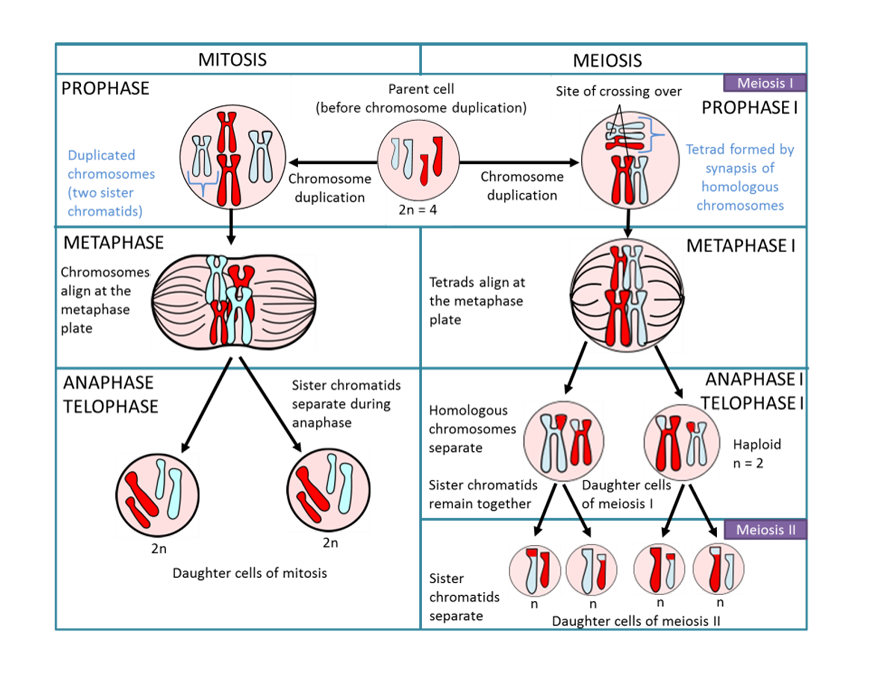
Trace the image from its central starting cell. On the left, the chromosome number is maintained. On the right, it is halved in meiosis I, not meiosis II. Meiosis II separates chromatids but does not halve the number of chromosome sets again.
Khan Academy’s Learn: Meiosis reinforces this distinction. Read the short introductory comparison and the passages that explain the two divisions; you can leave the finer details of spindle structures for another time.
Learn: Meiosis (article) | Heredity | Khan Academy
Khan Academy’s Learn: Meiosis explains why chromosome reduction takes two divisions rather than one.
In “Introduction,” read the comparison, ending with fertilisation. In “Phases of meiosis,” read the two-step explanation, stopping after the overview of the four stages. In “Meiosis II,” begin at the sentence about moving into the second division without copying DNA and read the opening explanation. Track homologues separately from sister chromatids throughout.
Why meiotic products differ
Halving chromosome number explains how inheritance remains stable across generations. It does not, by itself, explain why gametes differ. Two events during meiosis supply much of that explanation.
First, in crossing over, paired homologous chromosomes exchange corresponding DNA segments between non-sister chromatids. This occurs during prophase I. A chromosome can consequently contain a new combination of alleles that were already present in the cell.
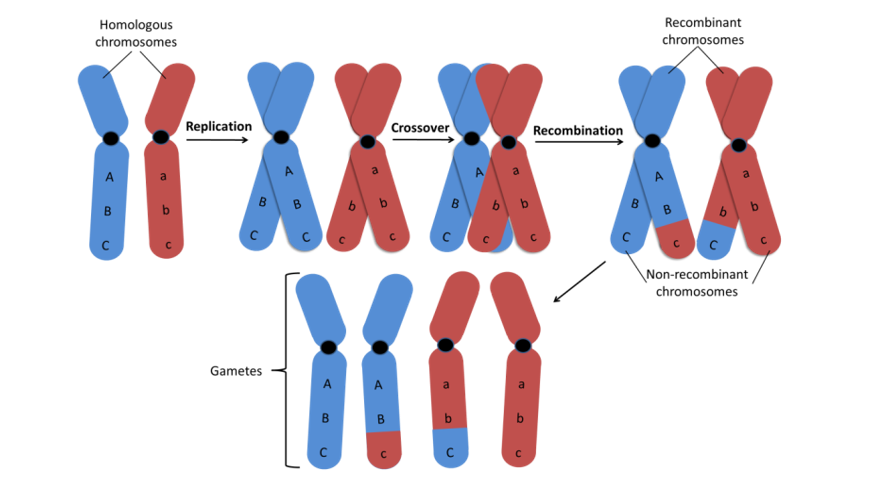
Read the letters in the crossing-over image, not just the colours. Before the exchange, the illustrated chromosomes carry the combinations and . Afterwards, two chromatids retain those combinations, while two carry and . No new allele had to be invented to produce the latter two combinations. Crossing over reshuffled alleles; mutation is a source of new alleles.
Second, independent assortment results from the random orientation of each homologous pair at metaphase I. In the four-chromosome example, a gamete receives one member of each of the two pairs. Which member it receives from one pair does not determine which it receives from the other. Across many meiotic divisions, even without crossing over, the two pairs can therefore be assorted into combinations. This is a count of possible assortments across divisions, not a claim that every single meiosis produces all four.
Read Khan Academy’s account of both events with the first-division diagram in view.
Learn: Meiosis (article) | Heredity | Khan Academy
Return to Khan Academy’s Learn: Meiosis to connect chromosome movements in meiosis I to genetic variation.
In “Meiosis I,” start with the paragraph beginning “During prophase I” and read the crossover example. Then find the paragraph below the diagram of meiosis I that begins “When the homologous pairs line up” and read the orientation explanation. Notice that crossing over changes combinations within chromosomes, while independent assortment changes which homologues travel together.
The two mechanisms act at different scales. Crossing over rearranges segments between homologues. Independent assortment mixes the maternal and paternal homologues allocated to gametes. Then fertilisation combines genetic information from two gametes, adding another source of variation in offspring. Fertilisation is important to the whole story, but it is not a stage of meiosis.
Place each process in the inheritance story
The processes are sometimes presented as competitors: mitosis makes “identical” cells, while meiosis makes “different” ones. A more useful picture shows how they cooperate in a sexually reproducing organism.
Meiosis produces haploid gametes. Fertilisation combines gametes to form a diploid zygote. Repeated mitosis then produces the cells from which the organism develops, maintaining its inherited chromosome complement in those cells. Later, cells in the reproductive lineage can undergo meiosis to contribute genetic material to another generation.
This distinction also sets a boundary on what is inherited. A DNA change in a body cell can be copied into that cell’s descendants by mitosis—for example, within a patch of tissue. In a sexually reproducing human, a change confined to such a body cell is not normally passed to offspring. For transmission through a gamete, the genetic change must be present in the cell lineage that produces it. Do not infer that mitosis never transmits mutations: mitotic division can pass changes to daughter cells, and asexual reproduction can pass inherited changes to offspring.
| Feature | Mitosis | Meiosis |
|---|---|---|
| Main role here | Growth, repair and genetic continuity among daughter cells | Production of haploid cells for sexual reproduction |
| Divisions after DNA copying | One | Two |
| Key separation | Sister chromatids | Homologues in meiosis I; sister chromatids in meiosis II |
| Products from one diploid starting cell | Two diploid cells, ordinarily genetically alike | Four haploid products, ordinarily genetically varied |
| Contribution to variation | Usually preserves an existing combination; copying errors can introduce changes | Crossing over and independent assortment reshuffle existing alleles |
For an HSC distinguish question, the strongest response links a structural difference to its consequence. For example:
Mitosis separates sister chromatids in one division, ordinarily producing two genetically similar cells with the starting chromosome number; this maintains genetic information during growth and repair. Meiosis separates homologous chromosomes in its first division and sister chromatids in its second, producing haploid cells for sexual reproduction. Crossing over and independent assortment during meiosis create different allele combinations in gametes. When gametes fuse, the diploid chromosome number is restored and offspring inherit genetic information in a new combination.
The crucial claim is not merely “mitosis makes two and meiosis makes four.” It is why chromosome number is maintained or reduced, and how meiosis contributes to variation.
Key takeaways
Mitosis maintains chromosome number as cells divide, supporting growth, repair and some forms of asexual reproduction. Meiosis uses two divisions to produce haploid products: homologues separate first, then sister chromatids. Crossing over and independent assortment make meiotic products genetically varied; fertilisation combines gametes and restores the diploid number.
Next, you’ll examine DNA structure and replication more closely—the molecular copying process that must occur before these chromosome divisions can take place.