Recommended resources
The freely available resources this lesson will direct you to.
- GCSE Biology - Sexual & Asexual Reproduction | Gametes (2027/28 exams)www.youtube.com
- GCSE Biology - Pros and Cons of Sexual and Asexual Reproduction (Part 2) (2026/27 exams)www.youtube.com
- 7.1 Sexual Reproduction - Concepts of Biology | OpenStaxopenstax.org
- 43.1 Reproduction Methods - Biology 2e | OpenStaxopenstax.org
Hello! This lesson begins the heredity module by asking a question that runs through the rest of it: how can offspring inherit their parents’ characteristics yet differ from them? You’ll compare sexual and asexual reproduction by tracing what happens to genetic information, then connect each mechanism to genetic continuity and variation. That cause-and-effect approach is more useful in an HSC response than simply listing advantages and disadvantages.
Continuity does not mean identical offspring
Genetic continuity means that genetic information is passed between generations. An offspring inherits genes that contribute to the characteristics of its species. Genetic variation means differences in inherited genetic information among individuals; different versions of a gene are called alleles.
Both sexual and asexual reproduction provide continuity. The crucial distinction is how much genetic information is copied or combined, and therefore how offspring come to differ.
GCSE Biology - Sexual & Asexual Reproduction | Gametes (2027/28 exams)
Watch “GCSE Biology - Sexual & Asexual Reproduction | Gametes” from Cognito for a quick visual introduction to the two mechanisms.
Watch sexual reproduction for gamete fusion and the restoration of chromosome number. Then watch asexual reproduction for the contrast: one parent and no fusion of gametes. Keep the video's description of asexual offspring as “exact” copies in mind; we will qualify it when discussing mutation.
In the sexual cycle described in the video, gametes carry half the usual chromosome number. When two gametes fuse at fertilisation, their chromosomes combine, restoring the usual number in the offspring. In asexual reproduction, there is no fusion of gametes. Instead, a parent produces offspring using its own genetic material.
Asexual reproduction: copying an established combination
In common asexual mechanisms, genetic information is copied and one parent gives rise to new individuals. A bacterium can reproduce by binary fission: it copies its DNA and divides. A single-celled eukaryote can also divide into two; unlike a bacterium, it has a nucleus whose genetic material must be divided. In budding, a new individual grows from part of a parent. In fragmentation, a separated piece can regenerate into an individual.
43.1 Reproduction Methods - Biology 2e | OpenStax
Read the “Asexual Reproduction” part of OpenStax’s “43.1 Reproduction Methods” to see how several physical mechanisms can have a similar genetic outcome.
Under “Asexual Reproduction,” read the subsections “Fission,” “Budding” and “Fragmentation.” Begin at these mechanisms, stopping immediately before “Parthenogenesis.” Focus on what separates the new individual from its parent in each case, rather than memorising every organism mentioned.
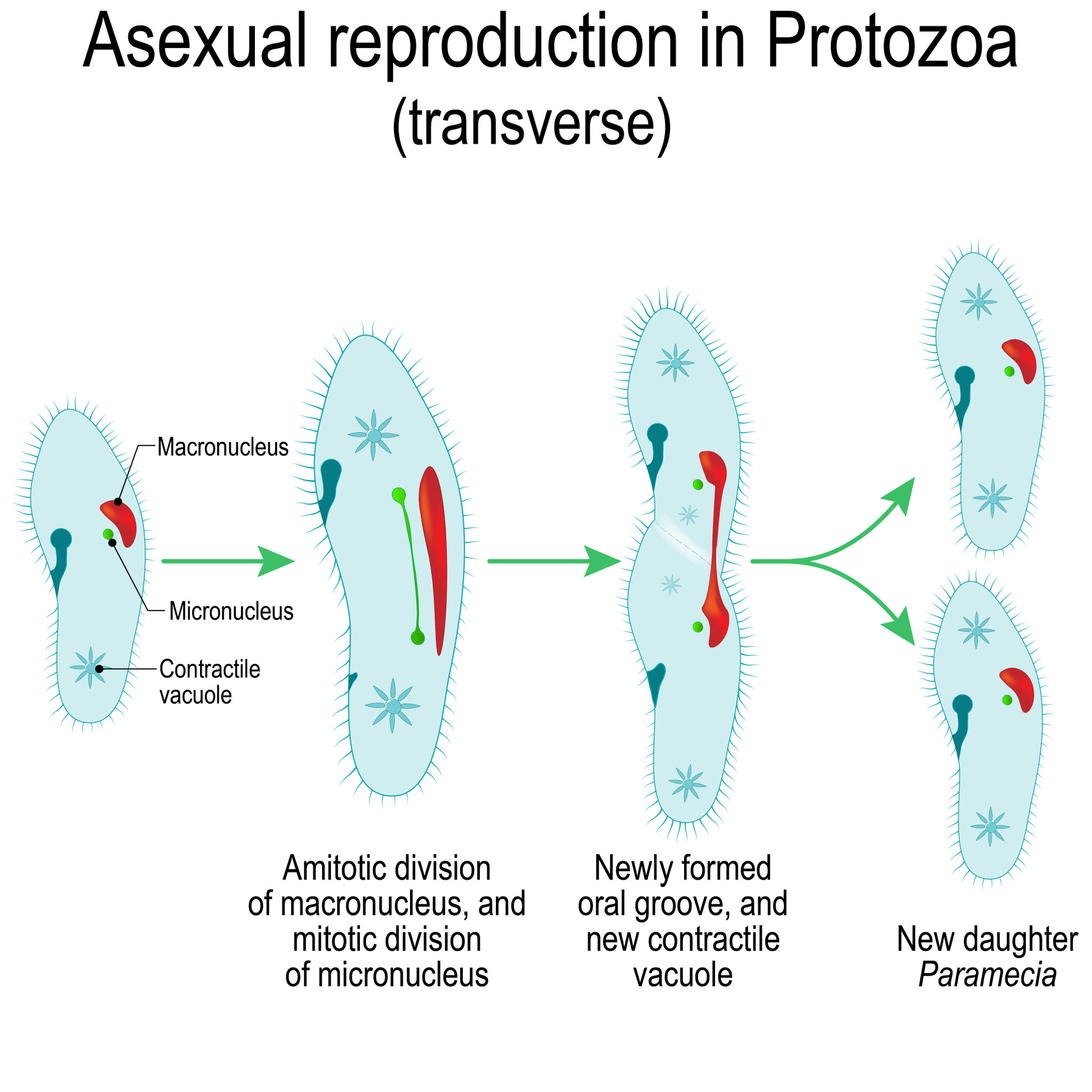
The Paramecium image shows transverse fission: the cell divides across its width. Do not assume every form of fission uses the same cell machinery. Bacterial binary fission is not mitosis; bacteria do not have a nucleus. The shared point for this comparison is that division passes on genetic information without combining it with another parent’s.
Because an offspring in these common asexual mechanisms inherits a copy of one parent’s genetic information, it is usually described as a clone. This gives strong continuity of the parent’s gene combination. It does not mean that variation can never appear: copying errors can produce mutations, and environmental conditions can cause genetically identical individuals to develop differently. The latter are differences in appearance or function, not necessarily differences in inherited DNA.
Sexual reproduction: continuity through combination
Sexual reproduction also transmits genes, but it does not preserve a parent’s entire gene combination intact. Meiosis produces gametes with half the usual chromosome number and creates different combinations of inherited genetic material. At fertilisation, two gametes combine. The offspring therefore inherits genetic information from both sources while receiving a new combination of alleles.
43.1 Reproduction Methods - Biology 2e | OpenStax
Return to the OpenStax reading for its definition of sexual reproduction and its genetic result.
In “Sexual Reproduction,” read the opening paragraph, stopping before “Hermaphroditism.” Focus on the distinction between inheriting genes and inheriting an identical combination of genes.
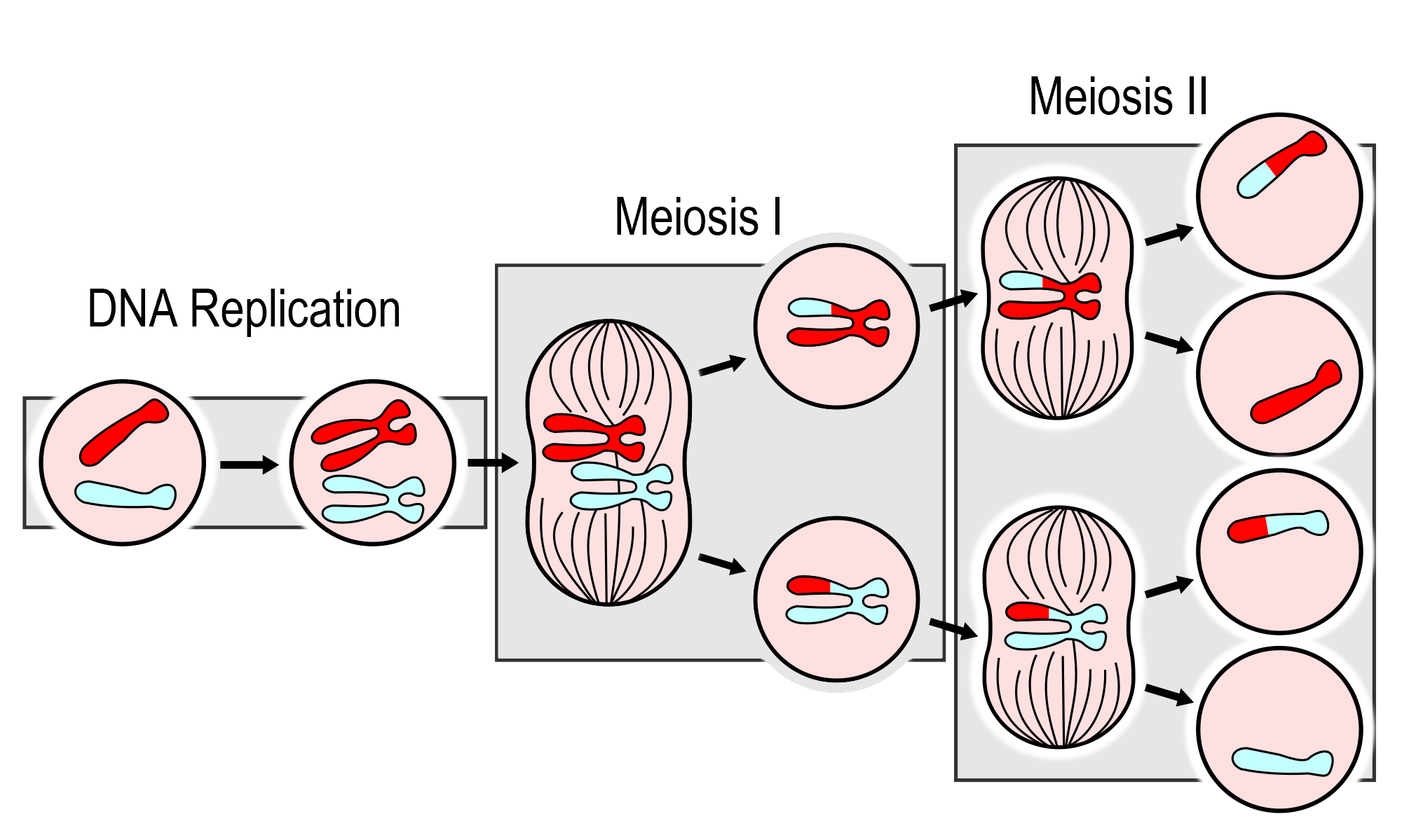
For now, take two ideas from the diagram: gametes end up with half the starting chromosome number, and they need not carry identical combinations of genetic material. The exact roles of mitosis and meiosis are the focus of the next lesson.
Sexual reproduction reshuffles existing alleles; it does not, by itself, invent every difference it produces. Mutation is the ultimate source of new alleles. Meiosis and fertilisation can then place alleles into new combinations in offspring.
7.1 Sexual Reproduction - Concepts of Biology | OpenStax
Read the opening of OpenStax’s “7.1 Sexual Reproduction” to connect genetic variation with the costs and benefits of each reproductive strategy.
In the opening main-text paragraphs, read the comparison. Stop before “Evolution Connection” and “The Red Queen Hypothesis.” Pay particular attention to the distinction between mutation as a source of new variation and meiosis and fertilisation as ways of recombining it.
Sexual reproduction is often described using two parents, and that is a useful typical example. Fusion of gametes is the defining feature, though—not a rule that the gametes must always come from two separate individuals.
Comparing consequences, not just naming them
The mechanisms matter because populations face different conditions. Imagine a plant whose inherited traits allow it to thrive in a stable habitat. Asexual reproduction can rapidly produce offspring with that successful gene combination without requiring gamete fusion. If conditions change, however, a population of similar clones may have little inherited variation relevant to the new challenge.
Sexually produced offspring are genetically varied. If a new disease appears, some might inherit combinations that make them less vulnerable. That is a possibility, not a guarantee: variation can be neutral or disadvantageous too. Producing offspring sexually can also require more time and energy, including finding a mate in species that require one.
GCSE Biology - Pros and Cons of Sexual and Asexual Reproduction (Part 2) (2026/27 exams)
Watch Cognito’s “GCSE Biology - Pros and Cons of Sexual and Asexual Reproduction (Part 2)” to see how the genetic contrast affects reproduction in different environments.
Watch asexual trade-offs for rapid reproduction and vulnerability when conditions change. Continue with sexual trade-offs for the potential value of variation and the costs of reproduction. The ranges overlap briefly. Treat the video's “zero genetic diversity” description of clones as a simplification: mutations can arise in an asexual lineage.
| Question | Asexual reproduction | Sexual reproduction |
|---|---|---|
| What is inherited? | A copy of one parent’s genetic information in common clonal mechanisms | Genetic information combined through gamete fusion |
| How is continuity maintained? | The parent’s gene combination is largely retained | Genes are passed on, while their combinations change |
| Where can variation come from? | Primarily mutations within a clonal lineage | Mutation supplies new alleles; meiosis and fertilisation recombine alleles |
| What is a possible consequence? | Rapid reproduction can preserve a successful combination | Varied offspring may improve the chance that some cope with changed conditions |
Notice the careful wording: can, may and possible. Asexual reproduction does not prevent evolution, and sexual reproduction does not guarantee survival. Your conclusion should follow from the particular mechanism and conditions described.
Turning the comparison into an HSC response
When asked to compare, organise your response around shared criteria—such as continuity, sources of variation and likely consequences—rather than writing an unrelated paragraph about each type.
Model response: Both sexual and asexual reproduction maintain genetic continuity by passing genes to offspring. In common asexual mechanisms such as fission and budding, one parent’s genetic material is copied without gamete fusion, so offspring usually retain its gene combination. Mutations can still introduce inherited differences. In sexual reproduction, meiosis produces gametes with different genetic combinations, and fertilisation combines genetic material from gametes. Offspring therefore inherit genes but are not usually genetically identical to either parent. Asexual reproduction can rapidly preserve a successful combination in stable conditions, whereas the variation generated by sexual reproduction may increase the chance that some offspring survive changed conditions.
The response earns its comparison by repeatedly linking mechanism, genetic result and consequence. It also avoids two tempting overstatements: that clones can never vary and that varied offspring must be better adapted.
Key takeaways
Both mechanisms transmit genetic information across generations. Asexual reproduction usually preserves one parent’s gene combination closely, while sexual reproduction combines genetic material and produces new combinations in offspring. Mutation can introduce new inherited variants in either lineage; meiosis and fertilisation additionally reshuffle variants during sexual reproduction.
Next, you’ll look more closely at mitosis and meiosis—the cell-division processes that help explain why these reproductive mechanisms have different genetic outcomes.