Recommended resources
The freely available resources this lesson will direct you to.
Hello! Last lesson showed that DNA is copied before mitosis or meiosis, so each new cell can receive genetic information. This lesson asks a more precise question: what is it about DNA’s structure that makes that copying possible—and usually accurate? You’ll connect the double helix, complementary base pairing and the work of replication enzymes into one explanation you can use in an HSC response.
The information is in the bases
A DNA molecule consists of two strands wound into a double helix. Each strand is a chain of nucleotides. Every nucleotide contains a deoxyribose sugar, a phosphate group and one of four bases: adenine (A), thymine (T), guanine (G) or cytosine (C). The sugars and phosphates form the outside of each strand; the order of bases carries genetic information.
Read the structure account first. Its aim is not to make you memorise a drawing, but to show why either strand can provide information for rebuilding its partner.
Learn: DNA structure (article) | Khan Academy
Read Khan Academy’s Learn: DNA structure to connect the parts of a nucleotide with the arrangement of the two DNA strands.
In “DNA is made up of nucleotides,” read from the paragraph beginning the nucleotide description to the end of the paragraph about the sugar-phosphate backbone. Then, in “DNA forms a double helix,” read its opening paragraph, from the helix description through the description of the bases as rungs. Continue through the subsections “Antiparallel strands,” “Hydrogen bonds between strands” and “Complementary base pairing.” Start at three key features, then read the following explanation and ACTG example, beginning the sequence example. Stop after that example; the later page links are not needed.
The two strands run in opposite directions, called antiparallel. Their ends are labelled and , after positions on the sugar molecule. If one strand runs to from left to right, its partner runs to from left to right. More importantly for copying, the bases face inwards and pair specifically: A pairs with T, and G pairs with C. Their shapes and chemical properties make these pairs possible.
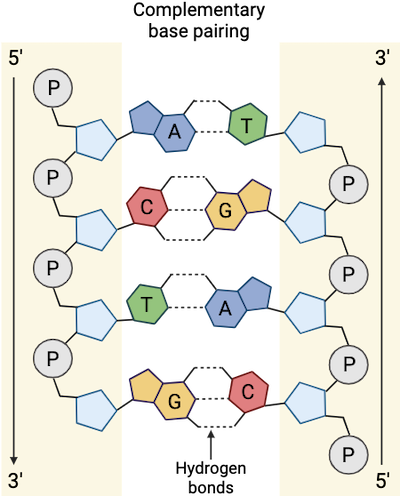
Notice the distinction between two kinds of bonds. Strong covalent bonds connect nucleotides along each sugar-phosphate backbone. Hydrogen bonds connect paired bases between the strands. Individual hydrogen bonds are comparatively weak: enzymes can separate the strands without dismantling their backbones. Once separated, each intact strand retains its sequence of bases.
Each original strand supplies a template
A pairing rule is more powerful than it first appears. If you know the sequence on one strand, you can determine the sequence opposite it. For example:
The second row is not a guess. A requires T opposite it, C requires G, and so on. The opposite and labels also matter: the strands are complementary and antiparallel.
OpenStax connects this structural fact to the outcome of replication. Concentrate on its opening account rather than the later detail about multiple origins and DNA fragments.
9.2 DNA Replication - Concepts of Biology | OpenStax
Read the opening of OpenStax’s 9.2 DNA Replication for the link between complementary strands, templates and the two resulting DNA molecules.
In “9.2 DNA Replication,” go below “Learning Objectives.” Read from the opening explanation, stopping immediately before “DNA Replication in Eukaryotes.” Focus on what remains from the original molecule in each copy.
During replication, the two original strands separate. Each original strand acts as a template: complementary nucleotides are added opposite its exposed bases, and a new sugar-phosphate backbone is formed. One original double-stranded molecule therefore gives rise to two double-stranded molecules.
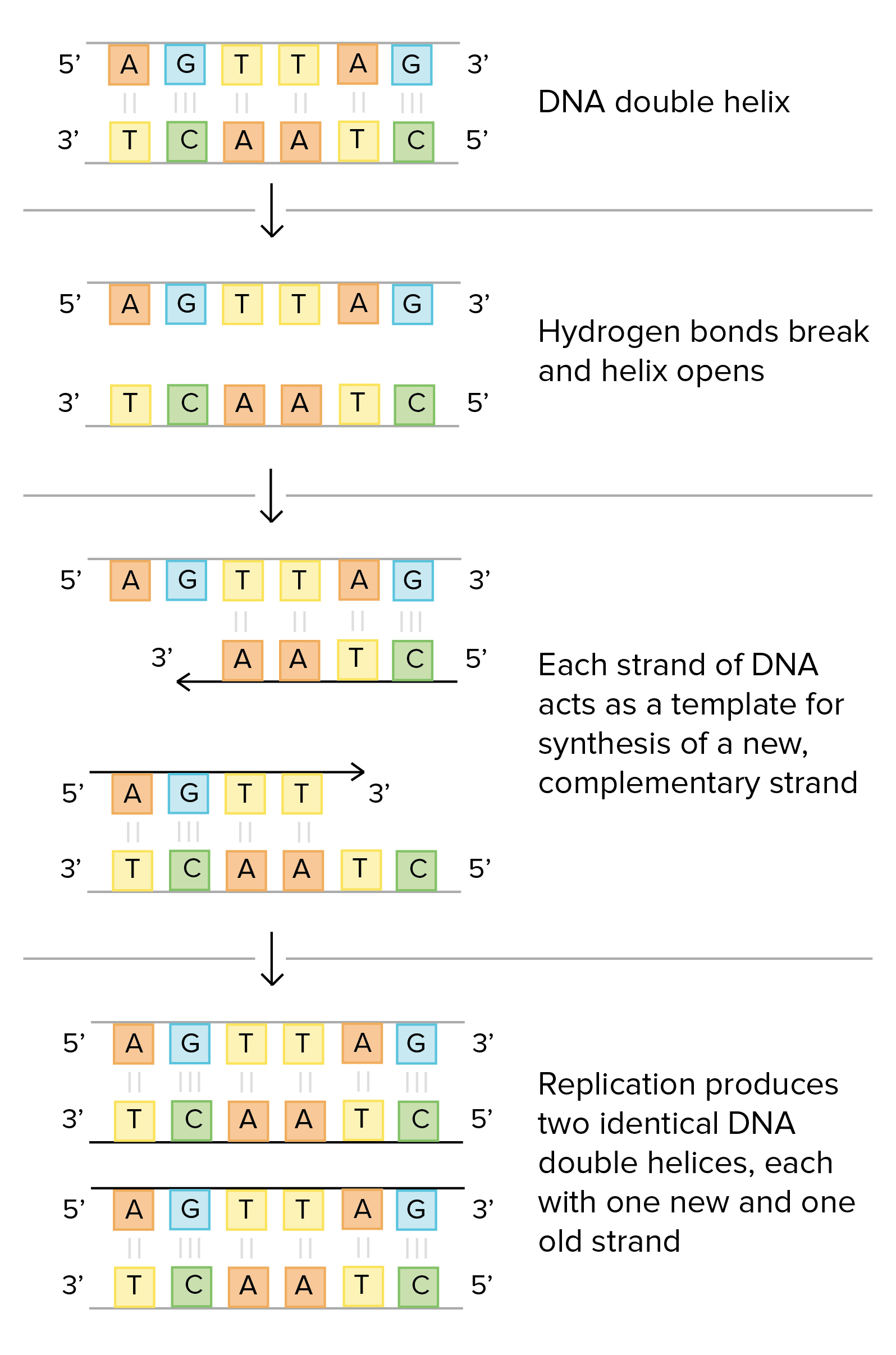
Trace the original top strand in the image into one completed molecule, then trace the original bottom strand into the other. This arrangement is called semi-conservative replication: each product conserves one strand from the starting molecule and contains one newly made strand. Provided copying is correct, both products have the same base-pair sequence as the original.
This is the molecular detail behind last lesson’s “DNA is copied before division.” Replication makes the copies; mitosis or meiosis subsequently distributes copied genetic material among cells. Replication is not itself a type of cell division.
How enzymes use that structure
Complementary bases do not assemble into finished DNA unaided. Watch the Amoeba Sisters’ DNA Replication (Updated) to see how enzymes use the properties you have just studied. The video includes more machinery than you need to name in an HSC explanation of how structure enables accurate replication; prioritise helicase, DNA polymerase and proofreading.
Watch the Amoeba Sisters’ DNA Replication (Updated) to see the double helix opened and its exposed strands copied.
Watch the key enzymes for when replication occurs and what helicase and DNA polymerase do. Then watch strand direction for antiparallel templates and why new DNA is synthesised in the 5'-to-3' direction. Finish with products and proofreading. You need not memorise every protein or fragment named in the middle passage; attend to how the same pairing rules operate on both templates.
Helicase opens the helix by disrupting the hydrogen bonds between paired bases. It does not break the sugar-phosphate backbone of each template. DNA polymerase then extends new strands using complementary nucleotides: it places T opposite A, A opposite T, G opposite C and C opposite G, joining the nucleotides into the new backbone.
Antiparallel orientation imposes a constraint. DNA polymerase extends a new DNA strand only at its end, so new DNA grows to . As the helix opens, one new strand can be made continuously in the direction of opening; the other is made in sections that are later joined. Both still use an original strand as a template and both obey the same base-pairing rules. The details of those sections are less important here than the structural reason they arise: opposite template orientations, but one direction of new-strand synthesis.
Why “accurate” does not mean “infallible”
Complementary pairing makes copying predictable: a base on the template strongly favours a particular partner. But an incorrect nucleotide can occasionally be incorporated. DNA polymerase can proofread, removing many incorrectly added bases and replacing them before copying continues. Additional repair processes can correct some errors that remain.
Read the short error-correction passage in OpenStax. Keep the distinction between the source of the copying instruction and the mechanisms that check its execution in mind.
9.2 DNA Replication - Concepts of Biology | OpenStax
Return to OpenStax’s 9.2 DNA Replication for its account of proofreading and repair.
Near the end of section 9.2, after the discussion of telomere replication, find the paragraph beginning proofreading. Continue through the account of mismatch repair, then read the closing paragraph from uncorrected errors. You can skim the intervening example of damage caused by ultraviolet light; the focus here is copying accuracy.
A useful distinction for an HSC explain question is that complementary base pairing provides the template rule, while proofreading and repair reduce errors when that rule is not followed. Replication is highly accurate, not perfect. An error that escapes correction can become a lasting change in DNA sequence—a mutation, which you will examine later in the course.
A concise explanation could read:
DNA has two complementary, antiparallel strands held together by hydrogen bonds between their bases. During replication, helicase separates the strands without breaking their sugar-phosphate backbones. Each original strand acts as a template: DNA polymerase builds a new strand using A–T and G–C pairing, so the template determines the new base sequence. Each resulting molecule contains one original and one new strand. Proofreading helps correct copying errors, making replication highly accurate but not infallible.
Notice what makes this an explanation rather than a list of features: every structural property is linked to a copying consequence.
Key takeaways
DNA’s two strands can be separated because the bases between them are joined by hydrogen bonds, while each strand’s backbone remains intact. Complementary base pairing lets each original strand specify a new partner, producing two semi-conservative DNA molecules. Antiparallel orientation determines how polymerase builds the new strands, and proofreading further improves accuracy.
Next, you’ll use a related template idea for a different task: explaining how a DNA sequence is transcribed into messenger RNA, rather than copied into another DNA molecule.