Recommended resources
The freely available resources this lesson will direct you to.
Hello! Last lesson explained how each DNA strand can guide the making of a new DNA strand during replication. Transcription uses the template principle for a different purpose: it makes an RNA copy of the information in a gene, rather than a second DNA molecule. In this lesson, you’ll follow RNA polymerase from the start of a gene to the release of an RNA transcript, then practise expressing that mechanism as a clear HSC explanation.
Why make an RNA message?
A gene is a region of DNA whose base sequence contains information used by a cell. For a protein-coding gene, that information must become available to the machinery that makes proteins. In cells with a nucleus, the DNA remains in the nucleus, while ribosomes use a messenger RNA (mRNA) sequence as the message for protein production.
Watch the opening of DNA and RNA - Transcription from Nucleus Biology for the purpose of making that message. Keep the question “Why does the cell need an intermediary?” in mind; the molecular steps come next.
Nucleus Biology’s DNA and RNA - Transcription introduces mRNA as the messenger between DNA in the nucleus and ribosomes.
Watch the purpose, from the question about what transcription is through the introduction of mRNA. Focus on the different roles of DNA, mRNA and ribosomes.
Transcription is the production of an RNA sequence using DNA as a template. It copies the information from a particular region; it does not replicate the whole DNA molecule. Nor does it build a protein—that is the job of translation, which you’ll study next lesson.
Choosing and opening the template
DNA has two complementary strands, but RNA polymerase uses one strand as its template for a given gene. The other is called the coding strand. That name can be confusing: the coding strand resembles the resulting RNA sequence, but it is not the strand RNA polymerase reads.
Read the Transcription overview and the opening of Transcription initiation in Khan Academy’s Stages of transcription. These passages establish which strand is read and how transcription begins. The later bacterial and human promoter details are beyond what you need for this explanation.
Stages of transcription: initiation, elongation & termination (article) | Khan Academy
Khan Academy’s Stages of transcription distinguishes the template from the coding strand and explains the promoter’s role in starting transcription.
In “Transcription overview,” read the overview, from its opening definition through the paragraph below the strand-sequence diagram. Then find “Transcription initiation” and read the promoter introduction, including its diagram. Stop before “Promoters in bacteria”; you can skip the intervening detail on numbered initiation sites and types of polymerase.
A promoter is a DNA region that helps position RNA polymerase at the start of the gene to be transcribed. RNA polymerase, with the help of other proteins in many cells, opens a short stretch of the double helix. This exposed region is the transcription bubble. As in replication, opening the DNA makes its bases accessible without destroying the strands’ sugar-phosphate backbones. Unlike replication, only one of those strands supplies the sequence for this RNA transcript.
The promoter matters for an HSC explain response because it connects where transcription starts to which stretch of DNA is copied. You need not memorise promoter sequences to make that connection.
Building RNA from the DNA template
RNA polymerase moves along the DNA template strand, reading it to . It joins RNA nucleotides to the growing transcript, which lengthens to . These opposite directions reflect the antiparallel arrangement you met last lesson.
The bases obey a pairing rule, but RNA uses uracil (U) instead of thymine (T):
| Base on DNA template | Base added to RNA |
|---|---|
| A | U |
| T | A |
| G | C |
| C | G |
Read Khan Academy’s account of the enzyme and the Elongation section. Prioritise the direction of synthesis, the strand the enzyme reads, and the growing RNA sequence; you can skim the chemical-reaction illustration.
Stages of transcription: initiation, elongation & termination (article) | Khan Academy
Return to Khan Academy’s Stages of transcription to see how RNA polymerase extends an RNA strand and why its sequence differs from the DNA coding strand.
Under “RNA polymerase,” read the enzyme account, through the sentence explaining where nucleotides are added. Then go to “Elongation” and read the elongation account. This starts just after the section’s opening definition and ends after the transcription-bubble diagram and its explanation. Follow that diagram closely; skim the intervening chemical-reaction detail.
The image below captures the crucial distinction: the lower DNA strand is the template, while the upper DNA strand is the coding strand. The red RNA is being built against the lower strand. Behind the polymerase, the RNA peels away and the DNA strands can pair with each other again.
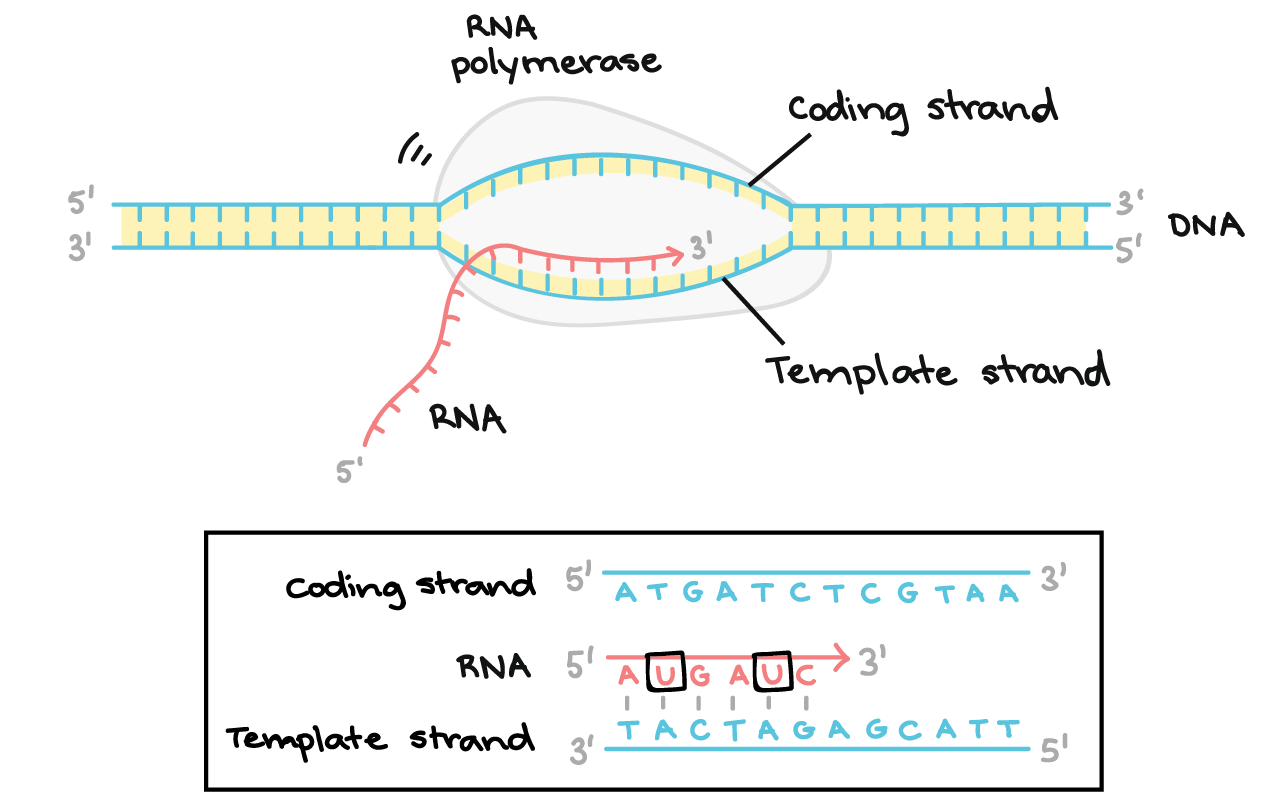
The inset shows a transcript partway through synthesis. Extending its example across the whole displayed DNA sequence gives:
Read the bottom and top rows at the same position. Where the template has T, the RNA has A; where the template has A, the RNA has U. Now compare the coding DNA and RNA rows: their sequences match apart from T in DNA appearing as U in RNA. That is a useful check of your answer, not evidence that polymerase copied the coding strand.
There is another distinction from replication worth holding onto. DNA polymerase makes DNA during replication; RNA polymerase makes RNA during transcription. Both processes use a template and complementary pairing, but their products and purposes differ.
Finishing the transcript and using the message
RNA polymerase does not continue indefinitely. Signals associated with the end of the transcribed region bring transcription to an end, and the RNA transcript is released. Read the short general account in Khan Academy’s Transcription termination section, then skip its organism-specific stopping mechanisms.
Stages of transcription: initiation, elongation & termination (article) | Khan Academy
The closing portion of Khan Academy’s article establishes what termination accomplishes without requiring its detailed bacterial or eukaryotic mechanisms.
In “Transcription termination,” read the opening account through the end of that paragraph. Skip “Termination in bacteria” and “Transcription termination in eukaryotes.” At “What happens to the RNA transcript?”, read from the opening comparison through the sentence about bacterial transcripts.
There is a qualification when discussing cells with a nucleus. The RNA first made from a protein-coding gene is an initial transcript, often called pre-mRNA. It is processed before becoming mature mRNA that can leave the nucleus. The overview image shows this distinction without requiring you to learn the processing steps today.
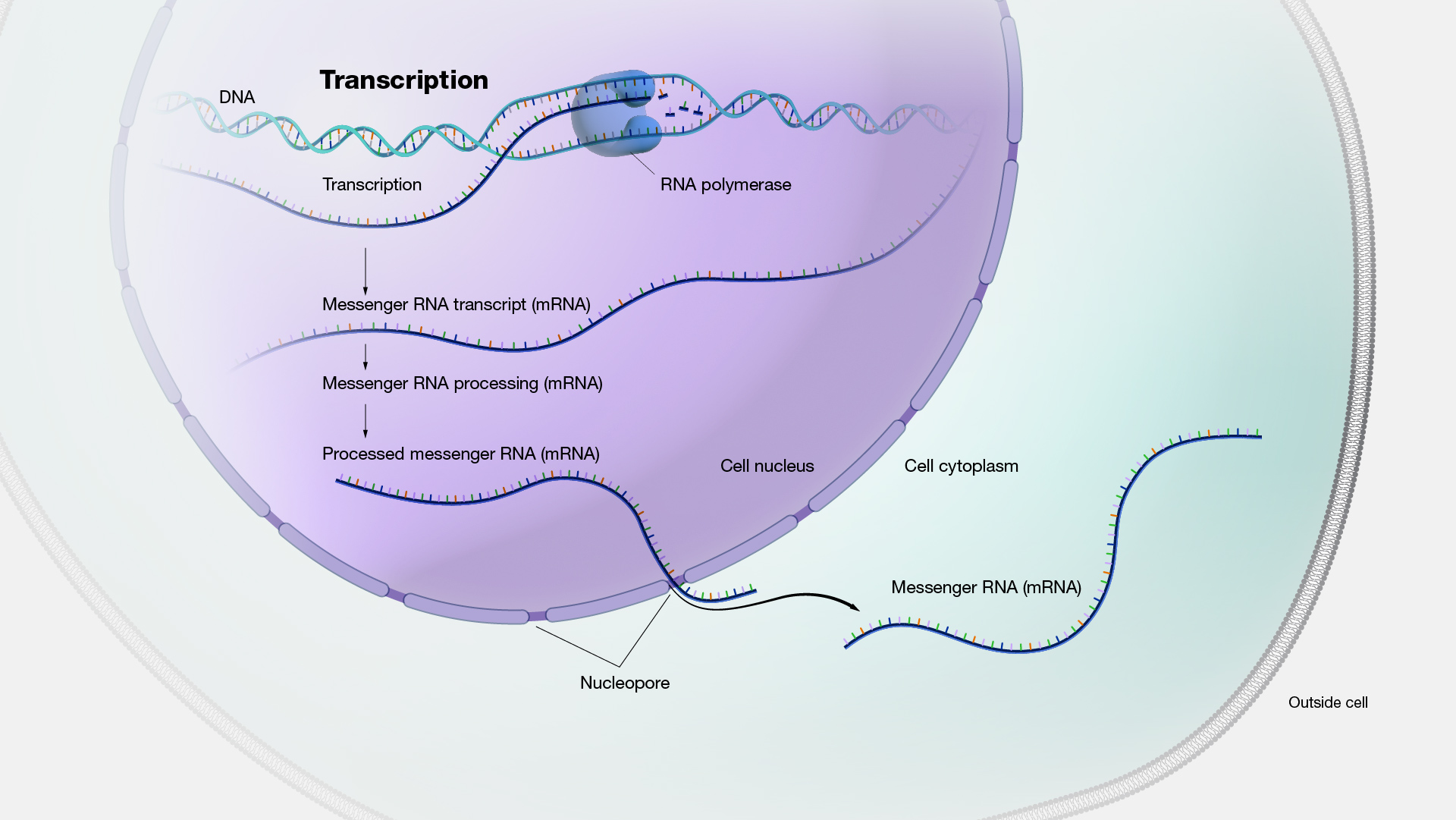
You may hear transcription described as “making mRNA,” which is useful shorthand for this learning outcome. For precision, distinguish the RNA sequence produced by polymerase from the mature mRNA available after processing in eukaryotic cells. The next lesson begins where this one ends: it asks how a ribosome uses that mRNA sequence to assemble a polypeptide.
Putting the mechanism into an HSC explanation
An explain question calls for links between events, not just the words initiation, elongation, termination. A compact response would be:
RNA polymerase begins transcription at a promoter associated with a gene and opens a short region of DNA. It reads one DNA strand, the template, and joins complementary RNA nucleotides to form a strand that grows to . RNA contains U instead of T, so an A on the DNA template pairs with U in the RNA. When transcription ends, the RNA transcript is released; in eukaryotic cells, it is processed before functioning as mature mRNA.
Notice how each sentence advances the mechanism: a starting position, a template and enzyme, a rule that determines the RNA sequence, and a released product. If a question provides DNA bases, label the template strand before applying pairing rules. Calling the coding strand the template—or putting T into the RNA—is a small mistake with a large effect on the resulting sequence.
Key takeaways
Transcription uses one DNA strand as a template to make a complementary RNA transcript. RNA polymerase starts at a promoter, opens a small region of DNA, reads the template to , and builds RNA to using A–U and G–C pairing. The RNA therefore resembles the coding DNA strand, except that it contains U instead of T. After transcription ends, the transcript is released; in cells with a nucleus, processing produces mature mRNA.
Next, you’ll follow that message to the ribosome and explain how translation produces a polypeptide.