Recommended resources
The freely available resources this lesson will direct you to.
Welcome back. In our previous lessons, you implemented the two foundational algorithms of NeRF: the positional encoding function that allows a simple MLP to capture high-frequency detail, and the differentiable volume rendering function that synthesizes a pixel's color from the MLP's output. You now possess the core components required to build a complete NeRF system.
This lesson serves as the capstone for our study of NeRF. We will now assemble these pieces and analyze the original paper, "NeRF: Representing Scenes as Neural Radiance Fields for View Synthesis," through the specific lens you requested: decomposing the work into its core problem, mathematical intuition, and architectural innovations. By the end of this lesson, you will have a holistic understanding of how these individual components synergize to achieve state-of-the-art results in view synthesis.
Let's begin by watching one of the original authors, Jon Barron, give a high-level overview of the work. This will provide a strong conceptual framework before we dive into the technical specifics.
Jon Barron - Understanding and Extending Neural Radiance Fields
This seminar talk by Jon Barron, a co-author of the NeRF paper, provides an excellent introduction to the method's motivation, core concepts, and overall pipeline.
Please watch from the beginning until the end of the overview. As you watch, focus on how he frames the problem NeRF is trying to solve (view synthesis) and the two lines of work it combines: volumetric representations and implicit neural representations. Pay close attention to his description of the basic NeRF pipeline: casting a ray, querying the network, and using alpha compositing.
Decomposing the NeRF Paper
As you saw in the video, NeRF is more than just a single idea; it's a carefully constructed system. We will now dissect it into three distinct parts.
1. The Problem: Photorealistic View Synthesis
The fundamental task NeRF addresses is novel view synthesis. The goal is to generate photorealistic, continuous views of a 3D scene from a sparse collection of 2D input images with known camera poses.
Why is this challenging?
Traditional 3D reconstruction techniques, like creating a polygonal mesh and applying textures, often struggle with several aspects of real-world scenes:
- Complex Geometry: Thin structures, intricate details, and non-solid objects like clouds or smoke are difficult to represent with discrete triangles.
- View-Dependent Effects: The appearance of many surfaces changes with the viewing angle. Think of specular highlights on a car, reflections in water, or the iridescence of a beetle. These are collectively known as non-Lambertian effects.
- Transparency and Occlusion: Handling semi-transparent objects and complex occlusions gracefully is a significant hurdle for many algorithms.
Prior to NeRF, learning-based volumetric approaches existed, but they typically relied on discretizing the scene into a 3D grid of voxels. The primary drawback here is memory: achieving high resolution requires a massive number of voxels (e.g., a 1024x1024x1024 grid), making these methods computationally expensive and often resulting in blurry renderings.
NeRF's central proposition is to overcome this by representing the scene not with a discrete grid, but with the parameters of a "continuous" function—a deep neural network.
2. The Mathematical Intuition: An Implicit Function and Classical Rendering
At its core, NeRF is the fusion of two key ideas: representing a scene as an implicit function and rendering it with classical, differentiable physics principles.
A. Implicit Neural Representation
This is the philosophical leap NeRF takes. Instead of storing scene data explicitly (e.g., in a voxel grid), the entire scene is encoded implicitly in the weights, , of a simple multilayer perceptron (MLP). The network itself becomes the scene representation.
This MLP, , acts as a 5D function that maps a 3D location and a 2D viewing direction to an emitted RGB color and a volume density :
To reconstruct a scene, NeRF doesn't train a network on a huge dataset of different scenes. Instead, it overfits a single MLP to a single scene. The input images for that one scene serve as the entire training dataset. The weights of the network are optimized until the function accurately describes the radiance and density at every point within that scene's volume.
Yannic Kilcher provides a particularly clear explanation of this paradigm shift.
NeRF: Representing Scenes as Neural Radiance Fields for View Synthesis (ML Research Paper Explained)
In this video, Yannic Kilcher breaks down the NeRF paper, emphasizing the novel way it uses a neural network to represent a single scene.
Watch the sections explaining the core method, from overfitting a single network, then the details of the network inputs and outputs, and finally the rendering process. This will reinforce the concept of the MLP as the scene representation itself.
B. Differentiable Volume Rendering
Having an implicit function is powerful, but useless if you can't create an image from it. This is where the volume rendering algorithm you implemented in the last lesson comes in. The process bridges the gap between the implicit representation and the 2D image:
- For each pixel in the desired output image, a camera ray is traced through the scene.
- Points are sampled along this ray.
- The MLP is queried at each point to get a color and density .
- These values are composited using the discrete volume rendering equation to produce the final pixel color .
The crucial insight is that this entire pipeline is differentiable. The final training loss is a simple mean squared error between the rendered pixel colors and the ground truth pixel colors from the input images. Because every step is differentiable, we can use gradient descent to backpropagate the error from the pixels all the way back to the network weights , thereby "teaching" the network about the scene's geometry and appearance.
3. The Architectural Innovations: Making it Work
The mathematical intuition alone is elegant, but insufficient for photorealistic results. The authors of the NeRF paper introduced three critical architectural innovations—"tricks," as Jon Barron calls them—that are essential for its success.
A. Positional Encoding
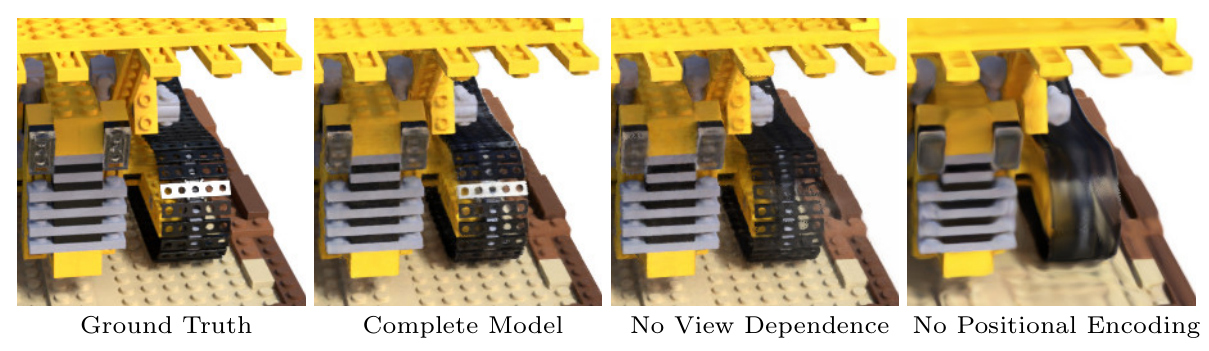
- Problem: As we explored two lessons ago, MLPs exhibit a "spectral bias," meaning they are inherently better at learning low-frequency functions. When fed raw, low-dimensional coordinates like , an MLP will produce overly smooth, blurry outputs, failing to capture the high-frequency details of textures and sharp edges.
- Innovation: Instead of passing the raw coordinates directly to the network, they are first mapped to a higher-dimensional space using a fixed set of sine and cosine functions with exponentially increasing frequencies.
- Effect: This encoding forces the network to become sensitive to high-frequency variations in the input, enabling it to represent fine geometric and textural details.
B. Factored View Dependence
- Problem: How to model view-dependent effects like specular highlights without compromising the geometric consistency of the scene. The geometry (where "stuff" is) should not change when the camera moves, but the color might.
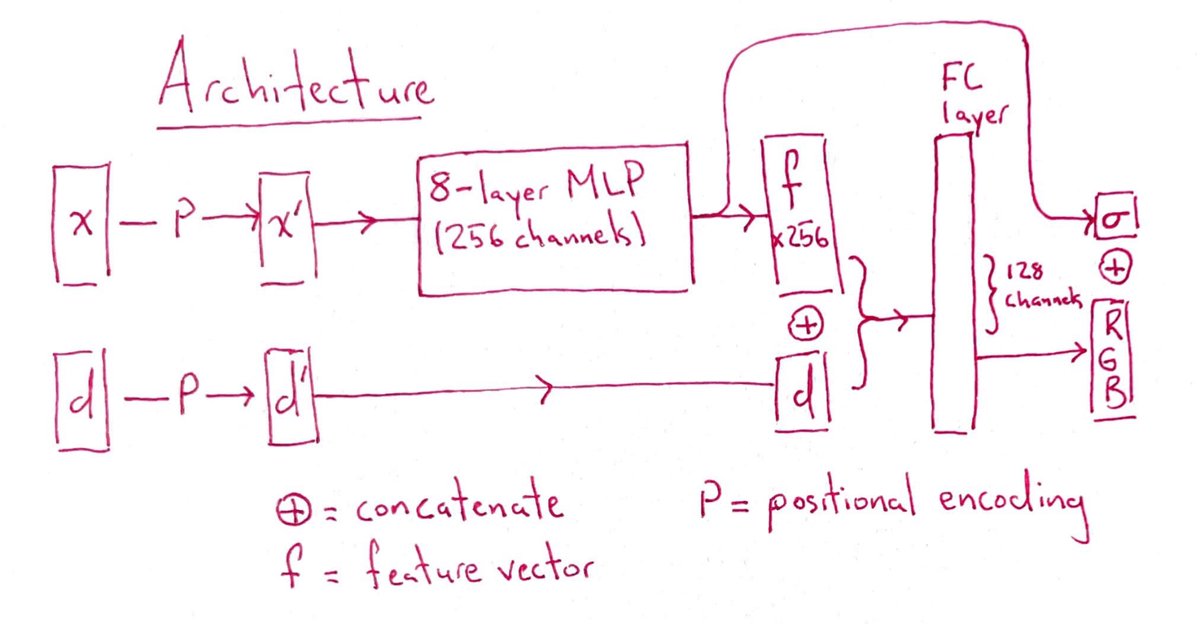
- Innovation: The MLP architecture is intentionally structured to enforce this separation.
- The input 3D location (after positional encoding) is passed through the first 8 layers of the MLP to produce the volume density and a high-dimensional feature vector.
- This feature vector is then concatenated with the encoded 2D viewing direction .
- A final layer takes this combined vector to predict the RGB color .
- Effect: This design ensures that volume density is only a function of location , making the geometry rigid and view-independent. In contrast, color is a function of both location and direction , allowing the model to learn complex, non-Lambertian appearance.
C. Hierarchical Volume Sampling
- Problem: Uniformly sampling points along a ray is inefficient. Many samples will fall in empty space or in occluded regions that contribute nothing to the final image, wasting computational resources.
- Innovation: A two-stage "coarse-to-fine" strategy is employed.
- Coarse Pass: A "coarse" network is first evaluated at a set of uniformly sampled points along the ray. The output weights from this pass provide a rough probability distribution of where the scene content is located.
- Fine Pass: A second set of "informed" samples are drawn from this distribution. This focuses sampling on regions that are likely to contain visible surfaces.
- A "fine" network (which has the same architecture but ultimately stores the high-quality representation) is then evaluated on the combined set of samples to render the final pixel color.
- Effect: This approach allocates computational power more efficiently, leading to higher-quality renderings with fewer wasted samples per ray.
To solidify your understanding of how these pieces fit together, let's turn to the original paper.
[PDF] arXiv:2003.08934v2 [cs.CV] 3 Aug 2020
This is the paper that started it all. Reading the authors' own words will connect all the concepts we've discussed.
Please read the following sections: Abstract and Section 1 (Introduction): This frames the Problem and gives a high-level overview of the solution. Section 3 (Neural Radiance Field Scene Representation): This details the Mathematical Intuition of the 5D function and the architectural choice for view dependence. Section 4 (Volume Rendering with Radiance Fields): This covers the rendering process you implemented previously. Section 5 (Optimizing a Neural Radiance Field): This is the most crucial part, describing the three key Architectural Innovations: Positional Encoding (5.1) and Hierarchical Volume Sampling (5.2).
Conclusion
You have now successfully deconstructed the original NeRF paper into its fundamental components, aligning with a rigorous research-oriented approach. This complete, high-level perspective is what separates a user of a technology from a creator who can innovate upon it.
Key Takeaways:
- Problem: NeRF solves the problem of novel view synthesis for complex scenes by proposing a new way to represent them.
- Mathematical Intuition: The core idea is to represent a scene implicitly within the weights of an MLP that maps 5D coordinates to color and density. This implicit function is then rendered using the classical, differentiable volume rendering equation.
- Architectural Innovations: The success of NeRF hinges on three key components that solve practical problems with the core idea:
- Positional Encoding: Overcomes the spectral bias of MLPs to capture high-frequency details.
- Hierarchical Sampling: Improves rendering efficiency by focusing samples on important regions.
- Factored View-Dependence: Allows for the modeling of non-Lambertian effects while maintaining geometric consistency.
Preview of the Next Module:
While NeRF produces stunning results, it has one significant drawback that is critical from a systems and performance perspective: it is slow to train and, more importantly, slow to render. Rendering a single high-resolution image requires millions of MLP queries, which can take many seconds. Our next module will explore 3D Gaussian Splatting, a more recent technique that tackles this exact problem. It trades NeRF's fully implicit representation for an explicit one—a collection of 3D Gaussians—to achieve real-time rendering speeds while maintaining photorealistic quality. This will be a fascinating case study in the trade-offs between representation choices in computer graphics.