Recommended resources
The freely available resources this lesson will direct you to.
- A Complete Guide to Adjusting Entrieswww.youtube.com
- How to Record Adjusting Entries for Prepaid Expenses and Unearned Revenuewww.youtube.com
- 4.3 Record and Post the Common Types of Adjusting Entries - Principles of Accounting, Volume 1: Financial Accounting | OpenStaxopenstax.org
- 5.3: Adjusting Entriesbiz.libretexts.org
Welcome back. Last lesson, you traced how net income reaches equity while cash follows its own path through the financial statements. A December service can create revenue and a receivable even if the customer pays in January. Adjusting entries are the period-end entries that make that timing work in the accounts.
In this lesson, you’ll record adjustments for deferrals (cash moved earlier), accruals (cash will move later), and estimates (the period’s amount must be calculated). Allow about 40 minutes for the lesson, video, and readings. These entries are foundational for CMA questions that ask not only for a journal entry, but also for its effect on income and the balance sheet.
Why accounts need adjusting
Under accrual accounting, revenue belongs in the period it is earned, and an expense belongs in the period it is incurred. Neither event must coincide with a cash receipt or payment. At the reporting date, an accountant therefore checks what has happened since the routine transactions were recorded: Has an advance payment been used up? Has work been completed but not billed? Have employees earned wages not yet paid?
An adjusting entry updates the accounts for that period before financial statements are prepared. For the common adjustments in this lesson, one side affects revenue or expense on the income statement; the other affects an asset or liability on the balance sheet. Cash does not appear in the adjusting entry: its earlier receipt or payment was already recorded, or its later movement has not happened yet. A cash balance that was recorded incorrectly calls for a correction, not one of these timing adjustments.
Read OpenStax’s “4.3 Record and Post the Common Types of Adjusting Entries” for the period-end rules and five worked adjustments. Keep track of what was already recorded before each adjustment.
In Section 4.3, begin with the entry rules, including the three bullets and the supplies example. Then read Transactions 13–17 and their “Analysis” and “Impact on the financial statements” paragraphs. Notice which account already has a balance for supplies and unearned revenue, versus which receivable or payable must be created.
A little debit-and-credit orientation will help before we use those examples. A debit increases an asset or expense; a credit increases a liability or revenue. The other side decreases that account. Every entry must have equal debit and credit amounts. A contra-asset, such as accumulated depreciation, is an account with a credit balance that reduces an associated asset’s carrying amount.
Deferrals: cash moved before earning or using something
A deferral begins with an amount recorded on the balance sheet. When a company pays in advance, it generally records an asset representing a future benefit. When a customer pays in advance, the company records a liability representing work still owed. As time passes or work is performed, part of that balance becomes expense or revenue.
Watch two short examples of the advance-payment side:
How to Record Adjusting Entries for Prepaid Expenses and Unearned Revenue
Watch “How to Record Adjusting Entries for Prepaid Expenses and Unearned Revenue” from Wild Accounting for its prepaid-insurance and supplies examples. These show two ways to determine the amount used during a period.
Watch prepaid insurance, from the initial payment through one month’s adjustment. Continue with supplies used, where a physical count determines how much of the recorded asset remains. Focus on why neither adjusting entry credits Cash.
Suppose Harbor Services pays $1,200 on December 1 for twelve months of insurance. The payment is initially debit Prepaid Insurance $1,200; credit Cash $1,200. By December 31, one month’s coverage has expired. The adjustment is debit Insurance Expense $100; credit Prepaid Insurance $100. The income statement now includes December’s $100 expense; the balance sheet retains an $1,100 prepaid asset for future coverage. The adjustment records the portion used, not another payment.
Supplies follow the same logic, although a count may be more informative than elapsed time. If the Supplies asset shows $500 before adjustment and $180 is still on hand, $320 was used. Debit Supplies Expense $320 and credit Supplies $320. The adjusted asset balance is $180.
Now consider the opposite advance payment. Harbor receives $2,400 on December 1 for four months of service and initially records debit Cash $2,400; credit Unearned Revenue $2,400. That liability is not an expense: it represents Harbor’s obligation to serve the customer. After providing one month of service, Harbor records debit Unearned Revenue $600; credit Service Revenue $600. It reports $600 of December revenue and still owes $1,800 of service.
The OpenStax illustration shows the same movement with a different customer advance:
The key to a deferral is not simply that it involves cash. It is that cash was recorded earlier, leaving an asset or liability that now needs to be reduced as the benefit is used or the obligation is fulfilled.
Accruals: activity happened before cash moved
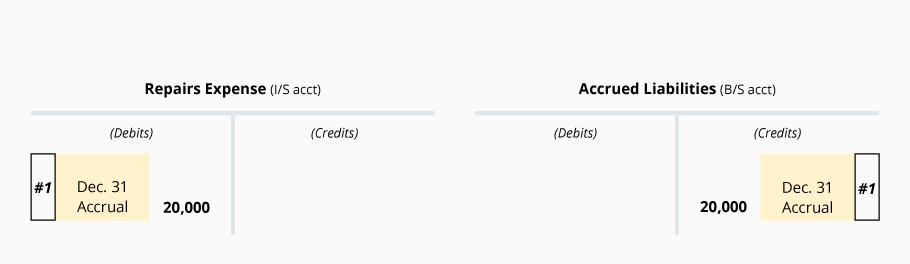
An accrual starts from the other timing pattern. The company has earned revenue or incurred an expense, but it has not yet recorded the related receivable or payable. The adjustment brings both the period’s performance and the outstanding balance onto the books.
Suppose Harbor completes $900 of additional December work that it will bill in January. At December 31, it records debit Accounts Receivable $900; credit Service Revenue $900. Billing or collecting later must not cause it to recognize the same revenue twice. This is the entry behind last lesson’s example of revenue appearing before cash.
For an accrued expense, suppose employees have earned $320 by December 31 but will be paid in January. Harbor records debit Salaries Expense $320; credit Salaries Payable $320. The expense belongs to December, and the payable reports what Harbor owes at year-end. When the wages are subsequently paid, recording the payment reduces the payable and cash; the same $320 is not a second expense.
For a first pass at an unfamiliar transaction, ask: Has the relevant cash movement already been recorded? If yes, look for an existing prepaid asset or unearned-revenue liability to adjust. If no, look for revenue earned or expense incurred alongside a new receivable or payable. Then determine the amount attributable to the period—not merely the eventual payment or contract total.
Estimates: recording the period’s best-supported amount
Sometimes the timing is clear but the amount requires an estimate. Estimation is not a third cash-timing rule: an estimated adjustment still records a current expense and an accompanying balance-sheet account. Two common cases are depreciation and expected uncollectible receivables.
Depreciation allocates the cost of equipment across periods that benefit from its use. Suppose Harbor’s equipment cost $12,000, has an estimated two-year useful life, and has no estimated residual value. Under straight-line depreciation, one month’s allocation is:
At December 31, Harbor records debit Depreciation Expense $500; credit Accumulated Depreciation—Equipment $500. The equipment remains recorded at $12,000 cost. Accumulated depreciation is a contra-asset, so after this first month its carrying amount is $11,500. The $500 is a cost allocation for December, not a claim that the equipment’s market price fell by exactly $500.
Read the depreciation example in “5.3: Adjusting Entries” from LibreTexts to see why the credit goes to a contra-asset rather than directly to Equipment.
Find “Definition: Depreciation,” then “Example 5.3.5” and “Depreciation Example.” Read the example and solution, stopping after the explanation of the earlier cash payment. Focus on the distinction between the equipment’s original cost and its carrying value.
An allowance for expected uncollectible accounts uses another contra-asset. Suppose a company estimates that 3% of its $10,000 receivables will not be collected. Its desired ending Allowance for Doubtful Accounts credit balance is $300. If that allowance already has an $80 credit balance, the needed adjustment is $220, not $300: debit Bad Debt Expense $220 and credit Allowance for Doubtful Accounts $220. This records the period’s additional estimated expense while bringing the allowance to its required ending balance. You will examine receivables measurement in more depth later; for now, notice that an adjustment may depend on both an estimate and an existing account balance.
Putting the period-end entries together
Return to Harbor’s December accounts. Assume the earlier insurance payment, customer advance, supplies purchase, and equipment acquisition have already been recorded. Harbor has not yet recorded the December activity described below. Its six adjustments are:
| December 31 adjustment | Debit | Credit |
|---|---|---|
| One month of insurance expired | Insurance Expense $100 | Prepaid Insurance $100 |
| One month of advance-paid service delivered | Unearned Revenue $600 | Service Revenue $600 |
| Additional service earned, not yet billed | Accounts Receivable $900 | Service Revenue $900 |
| Wages earned, not yet paid | Salaries Expense $320 | Salaries Payable $320 |
| Supplies used | Supplies Expense $320 | Supplies $320 |
| One month of equipment cost allocated | Depreciation Expense $500 | Accumulated Depreciation $500 |
Each row balances. More importantly, each row answers a reporting question. Harbor earned $1,500 of December revenue from these two services. The four expenses total $1,240, leaving $260 of net income from this activity, assuming no other revenues or expenses. The adjusted balance sheet retains $1,100 of prepaid insurance, $180 of supplies, and $1,800 of unearned revenue; it also reports the $900 receivable and $320 salaries payable. The equipment’s carrying amount reflects its $500 accumulated depreciation.
This gives you a useful CMA-style check on an omitted entry. If Harbor forgets the salaries adjustment, expenses and liabilities are each understated by $320, while net income—and, through it, equity—is overstated by $320. If it forgets the unearned-revenue adjustment, the remaining liability is overstated by $600 and revenue, net income, and equity are understated by $600. A balanced trial balance alone would not reveal either omission: both sides of the missing entry are absent.
Key takeaways
Deferrals adjust an asset or liability left by an earlier cash transaction. Accruals record earned revenue with a receivable, or incurred expense with a payable, before cash moves. Estimates supply a supportable period amount when it cannot simply be read from a payment; depreciation and allowances illustrate how a contra-asset can preserve the original asset balance while reducing its carrying amount.
For every adjustment, identify what happened this period, calculate only the amount that belongs this period, and check both the income-statement and balance-sheet effects. Next, you’ll build on that discipline when applying recognition, measurement, and valuation concepts to financial statement items.