Recommended resources
The freely available resources this lesson will direct you to.
- IFA1 – Intro to Intermediate Accounting – The Conceptual Framework Explainedwww.youtube.com
- US GAAP Principles Mapped To The Balance Sheet Accounts. Fully Explained!www.youtube.com
- Concepts Statement 8—Chapter 5—Recognition and ...asc.fasb.org
- 3.1 Describe Principles, Assumptions, and Concepts of Accounting and Their Relationship to Financial Statements - Principles of Accounting, Volume 1: Financial Accounting | OpenStaxopenstax.org
Welcome back. Last lesson, you made period-end adjustments so that revenue and expenses appeared in the right period, even when cash moved at a different time. You also saw that equipment can remain recorded at its purchase cost while accumulated depreciation reduces its carrying amount.
Those entries raise a broader question: How do we decide what belongs in the financial statements, and at what amount? In this lesson, you’ll apply recognition to decide whether and when an item is reported, then use measurement and valuation to decide the amount reported. Allow about 40 minutes for the lesson, videos, and readings. These distinctions will help you approach USA CMA financial-reporting questions systematically rather than relying on the timing of cash alone.
First, identify what is being reported
Financial statements describe a business’s resources and obligations at a date, and changes in those resources and obligations over a period. An asset is an economic resource the entity controls as a result of past events; a liability is a present obligation to transfer an economic benefit as a result of past events. Equity is the residual interest after liabilities are deducted from assets. Revenues and expenses describe changes arising from the period’s activities.
The expanded conceptual-framework image is a useful map of how the objective of reporting, the qualities of useful information, and financial-statement elements fit together. Treat it as an overview, not as a rule that every item must always be measured at historical cost or fair value.
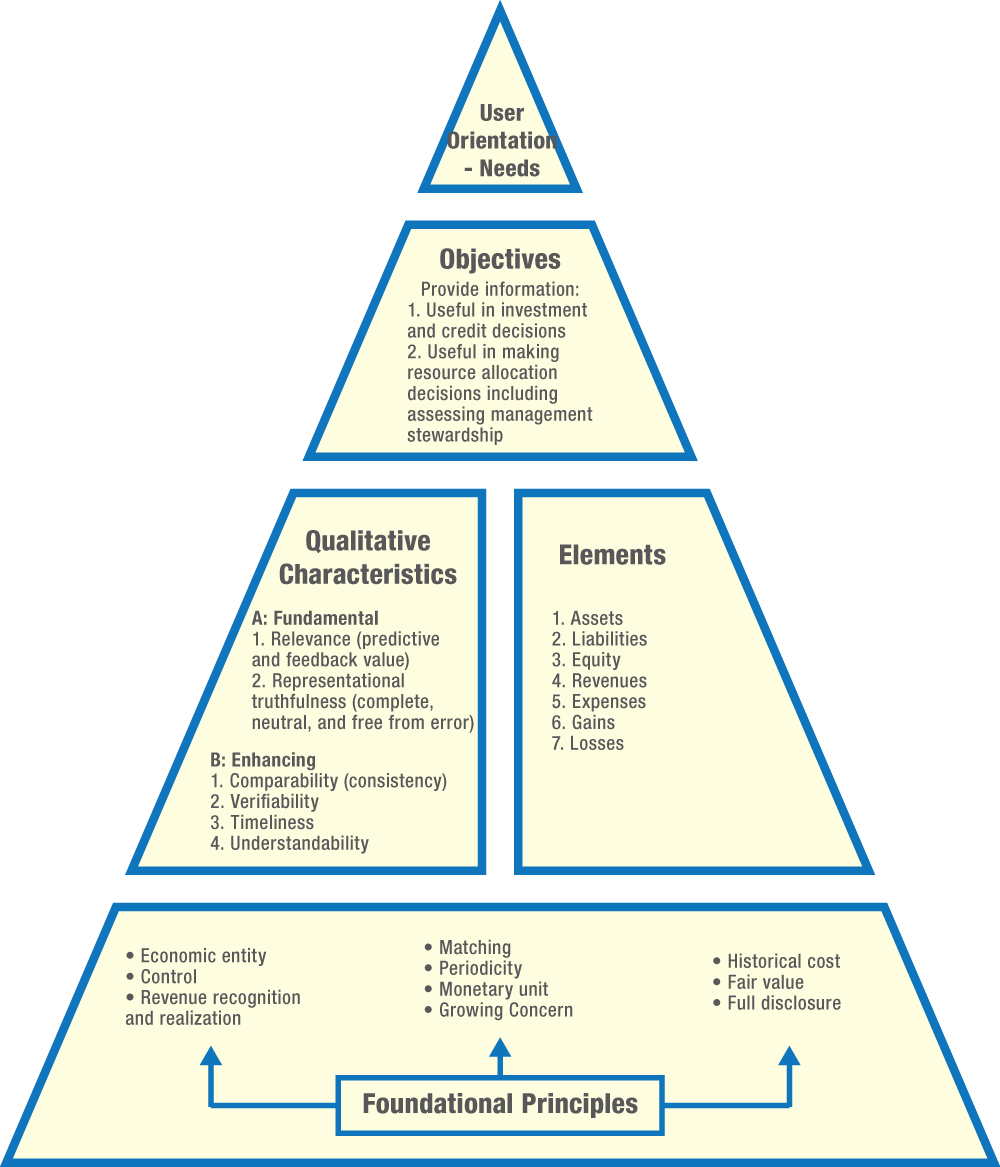
For a concise introduction to why relevance and faithful representation matter, then a review of the statement elements, watch these portions of Tony Bell’s video:
IFA1 – Intro to Intermediate Accounting – The Conceptual Framework Explained
Watch “IFA1 – Intro to Intermediate Accounting – The Conceptual Framework Explained” by Tony Bell to connect reporting decisions with the information users need.
Watch useful information for relevance and faithful representation, then statement elements for the distinction between assets, liabilities, equity, revenues, expenses, gains, and losses. Focus on the questions these concepts help answer rather than memorizing every example.
Relevance means information can make a difference to a user’s decision. Faithful representation means it depicts the underlying activity completely, neutrally, and without errors in the reporting process. An estimate can satisfy both qualities even if the future outcome is uncertain: the aim is a well-supported, unbiased estimate, not a prediction guaranteed to be exact. Materiality also matters—a detail’s size or nature may make its omission consequential.
Recognition: does the item belong in the statements?
Recognition means including an item, in words and numbers, in financial-statement totals. A contract, cash payment, or management plan does not automatically create an expense, asset, or revenue. First ask what economic event has occurred and whether it created or changed a financial-statement element.
The FASB’s conceptual guidance sets out three criteria for recognizing an item:
- It meets the definition of an element, such as an asset or liability.
- It can be measured using a relevant measurement attribute.
- It can be depicted and measured with faithful representation.
These criteria guide reasoning; the applicable US GAAP standard supplies the detailed rule for a particular transaction. Read the FASB’s explanation before applying the criteria to familiar items.
Concepts Statement 8—Chapter 5—Recognition and ...
Read the Financial Accounting Standards Board’s recognition criteria to distinguish “belongs in the statements” from “can be mentioned in a note.”
In “Recognition Criteria,” read paragraphs RD4–RD12, beginning with the recognition discussion. Continue through the discussion of measurability, uncertainty, and faithful representation. Then read “Derecognition,” paragraph RD13, through the removal rule; stop before RD14, which turns to more complex continuing involvement. Focus on why uncertainty about an amount need not prevent recognition, and why disclosure alone does not replace recognition.
Consider three events at Harbor Services, the company from last lesson:
- A customer pays $2,400 before Harbor provides four months of service. Harbor has cash, but it also has a present obligation to serve the customer. Initially it recognizes a $2,400 liability, not $2,400 of revenue. After one month’s service, it recognizes $600 of revenue and reduces the liability to $1,800.
- Harbor completes $900 of work it has not yet billed. The completed work gives Harbor a claim to payment, so it recognizes a receivable and $900 of revenue. Waiting for cash would leave both out of the statements.
- Employees earn $320 that Harbor will pay next month. Their work has already been received. Harbor recognizes $320 of expense and a $320 payable now.
Recognition also has an endpoint. Derecognition means removing an item when it no longer qualifies for recognition. When Harbor collects the $900 receivable, for example, it removes the receivable and increases cash; it does not earn the same $900 of revenue again. When it pays the wages, it removes the payable rather than recording a second wage expense.
Measurement: what amount represents the item?
Once an item qualifies for recognition, measurement assigns it an amount. A measurement attribute is the feature being quantified: original transaction cost, an estimated amount recoverable from a customer, or fair value, for example. Valuation commonly refers to determining an asset’s or liability’s reported amount, particularly as circumstances change after initial recognition. In practice, the terms often overlap.
Watch the measurement portion of Bell’s video for the contrast between original cost and fair value. Stop before its discussion of value in use, which is not needed for this US GAAP foundation.
IFA1 – Intro to Intermediate Accounting – The Conceptual Framework Explained
Continue Tony Bell’s conceptual-framework explanation for the distinction between recognition and assigning a monetary amount.
Watch measurement bases. Focus on why equipment generally retains a cost-based amount while some investments are measured using fair value. Treat the examples as illustrations; the applicable standard determines the required basis for a specific item.
Historical cost begins with the amount paid to acquire an asset. It is often a useful, verifiable starting point, but reported at cost does not mean its balance can never change: depreciation, consumption, or a required write-down may reduce its carrying amount. Fair value, where the relevant standard requires it, is based on a current market-participant perspective rather than the owner’s original outlay. Neither basis is universally correct for every account.
For a short cost-principle example, read the following OpenStax passage. Its introductory wording is deliberately broad; keep the exceptions and subsequent adjustments in mind.
Read OpenStax’s equipment-purchase example to see why an owner’s belief that an asset is worth more does not, by itself, justify recording a gain.
In “Cost Principle,” begin at the cost example and stop after the example of Lynn’s equipment purchase. Notice the distinction between a documented purchase price and a personal estimate of value. The passage also mentions exceptions for certain financial instruments.
Different items answer different measurement questions. Keep these common patterns separate:
| Item | Reporting question | Typical amount illustrated |
|---|---|---|
| Equipment | What cost remains allocated to future periods? | Cost less accumulated depreciation, subject to applicable adjustments |
| Trade receivables | How much is expected to be collected? | Gross receivables less an allowance for expected uncollectible amounts |
| Certain investments | What does the required current-value basis indicate? | Fair value under the applicable classification rules |
| Obligation to provide services | How much of the customer’s advance remains unearned? | The amount attributable to services still owed |
Other measurement approaches include net realizable value—an estimated amount recoverable through an ordinary sale or collection after relevant costs—and present value, which discounts future cash flows when the applicable accounting rule calls for it. You do not choose among these simply because one produces the most favorable income. You identify the item, check the relevant US GAAP treatment, and apply the required basis consistently.
Apply both decisions to a reporting date
Return to Harbor at December 31. Suppose its $900 receivable from completed work is recognized, but based on available evidence Harbor now expects $45 of that amount to be uncollectible. Assuming no existing allowance for this receivable, Harbor reports the receivable at a net carrying amount of $855: $900 gross less a $45 allowance. The $900 revenue reflects work performed; the $45 estimate affects expense and the receivable’s carrying amount. Reducing the receivable does not mean the service was never provided.
Harbor’s equipment illustrates a different basis. It acquired the equipment for $12,000 and recorded $500 of depreciation for the month. Its carrying amount is $11,500. If someone estimates that the equipment could be sold for $15,000, Harbor does not simply replace $11,500 with that estimate and record a $3,500 gain. Its cost-based carrying amount and a possible selling price answer different questions.
Finally, Harbor’s remaining $1,800 unearned-revenue liability represents service still owed after it has earned one month of the $2,400 advance. Measuring that liability requires identifying how much of the obligation remains; the original cash receipt alone cannot tell you December’s revenue.
This distinction is especially useful in a CMA question that asks for a financial-statement effect. Work through it in order: What element exists at the reporting date? Has it been recognized in the correct period? What measurement basis applies, and has its carrying amount changed? Notes can provide important context—for example, about a significant estimate—but describing an item in a note is not a substitute for recognizing it when recognition is required.
Key takeaways
Recognition decides whether and when an asset, liability, revenue, or expense enters the financial statements; derecognition decides when it leaves. Measurement and valuation determine the amount, which may reflect cost, a required current-value basis, or a supported estimate. Cash timing alone answers none of these questions.
In the next lesson, you’ll use reported asset and liability balances to classify them as current or noncurrent on a balance sheet.