Recommended resources
The freely available resources this lesson will direct you to.
Introduction
Welcome to the first lesson of our "System Design Foundations" module. In the previous module, we honed our skills at the code level, focusing on practices like constructive code reviews and systematic debugging to improve the health of an existing codebase. Now, we zoom out to address the "big picture." Making the leap to a senior developer role requires moving from implementing features to designing the systems that house them. This module is designed to give you that architectural perspective.
Today, we will tackle one of the most fundamental decisions in modern software engineering: choosing between a monolithic and a microservices architecture. You'll learn to define each architectural style, analyze their respective strengths and weaknesses, and understand the critical trade-offs involved. This knowledge is the bedrock of system design and is essential for making informed decisions that impact a project's scalability, maintainability, and team velocity.
1. The Two Dominant Architectures: An Overview
At its core, an application's architecture defines how its different parts are organized and how they communicate. For decades, the monolithic approach was standard. In recent years, the microservices approach has gained immense popularity, especially for large-scale applications.
To get a clear, high-level understanding of both styles, their benefits, and their drawbacks, let's start with a video that provides an excellent introduction.
Monolithic vs Microservice Architecture: Which To Use and When?
This video by Alex Hyett provides a comprehensive and balanced overview of both monolithic and microservices architectures, explaining what they are, their pros and cons, and when you might choose one over the other.
Watch the entire video. As you watch, focus on how the presenter describes: The simplicity of developing and deploying a monolith initially. The scaling and maintenance challenges a monolith faces as it grows. How microservices solve these challenges through independent components. The new complexities that microservices introduce, such as network communication and distributed debugging.
This video lays the groundwork for our deeper exploration. Let's now formalize these concepts and analyze the trade-offs in more detail.
2. The Monolith: A Unified System
As the video explained, a monolithic architecture is one where the entire application is built and deployed as a single, self-contained unit. For a Java developer like yourself, this is the classic Spring Boot application packaged into a single JAR or WAR file. It contains the user interface, business logic, and data access layer all within one codebase, connecting to a single database.
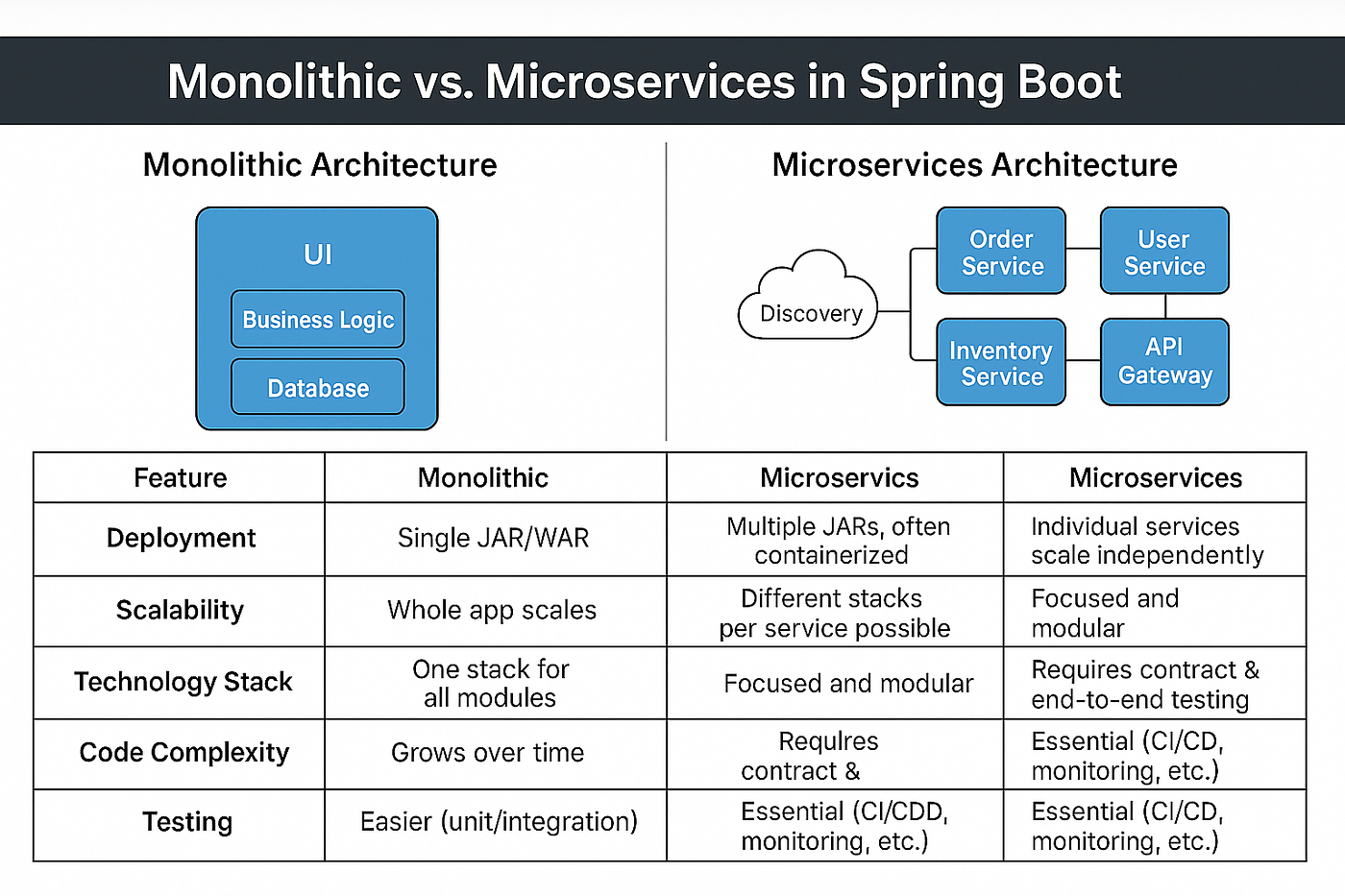
Advantages and Disadvantages
Monoliths are powerful because of their simplicity, especially in the early stages of a project. However, this simplicity comes with trade-offs that become more apparent at scale.
The article "Monolith vs Microservices in 2026" provides an excellent breakdown of these pros and cons.
Monolith vs Microservices in 2026: The Decision Framework Your ...
This article from DistantJob details the characteristics, advantages, and disadvantages of both architectures, providing a solid foundation for comparison.
First, read the section on monolithic architecture, focusing on the discussion of its advantages and disadvantages. Note how the benefits (simpler development, easier testing) are front-loaded, while the drawbacks (scaling limitations, tight coupling) emerge over time. Next, read the section on microservices architecture, again focusing on the pros and cons. Pay attention to how microservices directly address the scaling and team autonomy issues of monoliths but introduce new operational and data management challenges.
As you've just read, the key trade-offs are:
- Monoliths: Offer initial development speed and operational simplicity at the cost of long-term scalability and flexibility.
- Microservices: Provide scalability, team autonomy, and technological flexibility but demand significant operational maturity and introduce the complexities of a distributed system.
3. Head-to-Head: A Detailed Comparison
Understanding the high-level pros and cons is good, but making a real-world architectural decision requires a more granular comparison. The choice impacts everything from deployment pipelines to team structure.
The article "Monolith vs Microservices Architecture" provides a clear, detailed table comparing the two across several critical dimensions. This will help you build a mental checklist for evaluating which architecture fits a given problem.
Monolith vs Microservices Architecture: When, Why, and How
This article by Legacyleap offers a fantastic table that directly compares the two architectures across ten different criteria.
Read the section "A Clear Comparison" and study the table carefully. For each criterion (Deployment, Scalability, Fault Isolation, etc.), make sure you understand why the two architectures differ. For example, why does a monolith have strong data consistency while microservices lean towards eventual consistency?
This comparison highlights that there is no universally "better" architecture. The "right" choice is entirely dependent on context.
4. The Decision Framework: Context is King
So, how do you decide? The answer depends on the specific constraints of the project: the stage of the product, the size and structure of the engineering team, and the complexity of the business domain.
A common industry best practice, often called "MonolithFirst," advises starting with a well-structured monolith and only migrating to microservices when the pain of the monolith becomes greater than the complexity of microservices.
Let's look at some concrete decision criteria.
Monolith vs Microservices in 2026: The Decision Framework Your ...
This article gives clear, actionable guidance on when to choose each architecture.
First, review the "Quick Decision Framework" table at the beginning of the article. This provides a great at-a-glance guide. Then, read the section "When To Use Each". It reinforces the idea that monoliths are excellent for MVPs and small teams, while microservices are suited for large-scale systems and organizations.
Real-world examples make this trade-off even clearer. Netflix and Amazon famously scaled their global businesses using microservices. Conversely, companies like Segment found that the operational overhead of microservices was crippling their small team and strategically moved back to a monolith to increase development velocity. These stories show that architecture is not a one-way street; it's a dynamic choice that must serve the business's current needs.
5. Beyond the Binary: The Modular Monolith
The choice isn't always a stark one between a single "big ball of mud" and hundreds of distributed services. A modern, pragmatic approach is the Modular Monolith. This is an architecture where the application is still a single deployment unit (like a monolith), but its internal codebase is organized into well-defined, loosely-coupled modules with strict boundaries.
This approach gives you many of the development benefits of a monolith (e.g., simple deployment, easy debugging, strong data consistency) while enforcing the clean separation of concerns you'd find in microservices. It also makes a future migration to microservices much easier, as you can "break off" a well-defined module into its own service.
This short video provides a brilliant visual explanation of this evolution.
Microservices vs Monolithic Architecture
This video from the channel Drawing Boxes visually demonstrates how an unstructured monolith can evolve into a structured modular monolith, and then into microservices. It also highlights key pitfalls.
Please watch the full video. Pay close attention to: The Modular Monolith: How clear boundaries bring structure and maintainability to a single codebase. The Leap to Microservices: The idea that microservices are essentially independently hosted modules. Common Mistakes: The warning against creating a "distributed ball of mud" or "nanoservices" by choosing the wrong service boundaries.
The journey of Airbnb is a perfect real-world case study of this architectural evolution.
Monolith vs Microservices in 2026: The Decision Framework Your ...
This case study documents how Airbnb started with a monolith, migrated to a Service-Oriented Architecture (SOA), and then evolved to a hybrid model to manage complexity.
Read the entire case study. Notice how their architecture changed in response to specific business and organizational scaling challenges at each phase of their growth.
Conclusion
In this lesson, we have moved from the code-level concerns of our previous module to the high-level structure of systems. You now have a solid framework for understanding and comparing monolithic and microservices architectures.
Key Takeaways:
- Monolithic Architecture: A single, unified application. It prioritizes simplicity and development speed, making it ideal for new projects and small teams. Its main drawbacks are challenges with scaling, deployment risk, and technology lock-in.
- Microservices Architecture: An application composed of small, independent, and distributed services. It prioritizes scalability, team autonomy, and flexibility, but at the cost of significant operational complexity, distributed data management, and network latency.
- The Choice is a Trade-off: There is no "best" architecture. The right choice depends on the project's context, including team size, product maturity, and scalability requirements.
- The Modular Monolith: A pragmatic hybrid approach that combines the deployment simplicity of a monolith with the structural discipline of microservices, offering a good starting point that keeps future options open.
The communication between services is a cornerstone of a microservices architecture. In our next lesson, we will dive into the most common communication style by learning how to design RESTful API resources and endpoints, a crucial skill for building any distributed system.