Recommended resources
The freely available resources this lesson will direct you to.
Introduction
In our last lesson, we focused on the art and science of the constructive code review, a critical practice for maintaining code health and fostering team collaboration. While a rigorous review process catches many issues before they reach production, some bugs will inevitably slip through. When they do, a chaotic, guess-driven approach to finding the problem can be a significant source of stress and wasted time.
This lesson addresses that challenge directly by introducing a structured, systematic protocol for debugging. This directly aligns with your goal of developing a "Divide and Conquer" protocol for troubleshooting. We will shift the focus from a frantic search for what is wrong to a methodical process of isolating where the problem lies. You will learn how to treat debugging as a scientific process of observation, hypothesis, and experimentation, equipping you with a powerful mental model and practical tools to dissect complex issues efficiently and with confidence.
1. The Debugging Mindset: A Scientific Approach
The foundation of effective debugging is a shift in mindset. Many developers instinctively ask, "What could be causing this bug?" and start guessing. A senior developer, however, starts with a different question: "Where is this bug?" This transforms debugging from a mystery-solving exercise into a more manageable search problem.
Two fundamental principles underpin this systematic approach. The paper "The Science of Application Debugging" outlines them clearly.
[PDF] 003-2009: The Science of Application Debugging - SAS Support
This paper from SAS establishes the core principles that enable a systematic debugging process. Understanding these will help you move from guessing to methodical problem-solving.
Please read the "PRINCIPLES OF DEBUGGING" section. Focus on the two key ideas: Software is Deterministic: Given the same inputs and environment, software produces the same output. If a bug is intermittent, it means the inputs or environment are not truly the same. Software Does Not Rust: If code that once worked is now broken, something has changed. The key to the bug is in that change.
These principles lead to a powerful conclusion: debugging is a science. You can apply the scientific method to methodically eliminate possibilities and zero in on the root cause.
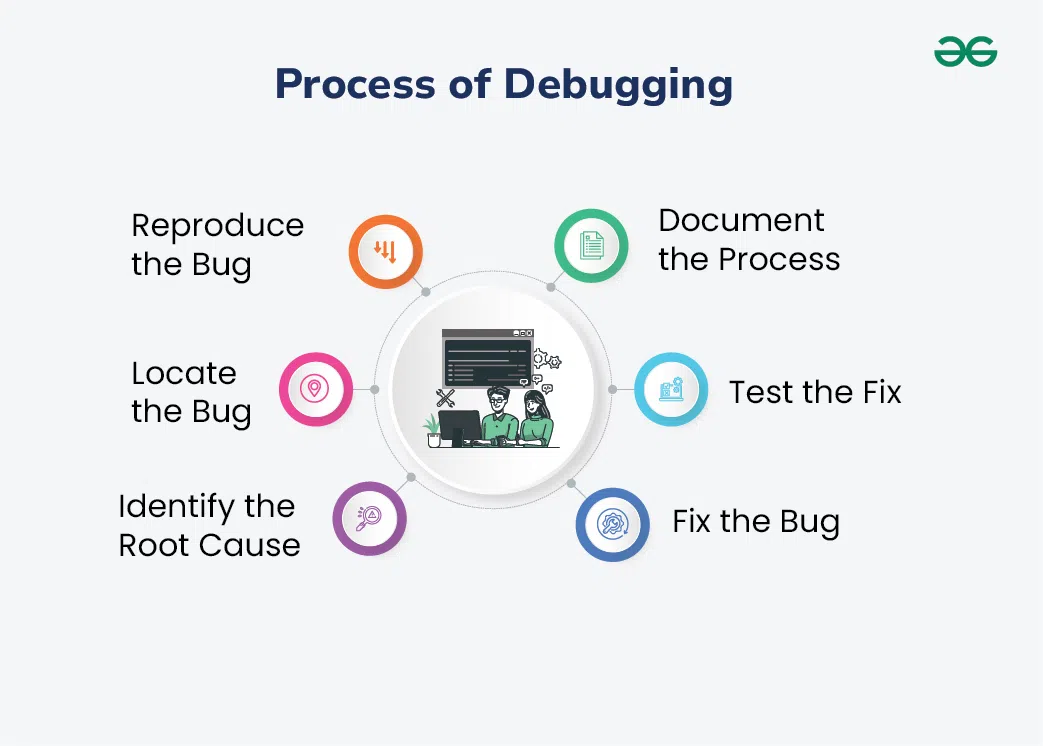
The process looks like this:
- Observe: Replicate the bug consistently.
- Theorize: Form a model of how the code should be working.
- Hypothesize: Based on the observed misbehavior, what part of the code could be responsible? What parts are likely not involved?
- Experiment: Make a single, targeted change to test your hypothesis. Does commenting out a function fix the issue? Does returning a hard-coded value bypass the problem? This experiment should be designed to prove or disprove your hypothesis, thereby narrowing the search space.
2. The "Divide and Conquer" Protocol
The core experimental technique in our protocol is "Divide and Conquer," which you might recognize from algorithm design. In debugging, it means systematically reducing the area where the bug could be until it becomes isolated and obvious. This is often called binary search debugging.
The article "Binary search debugging" explains this concept well.
Binary search debugging - Code with Jason
This article provides a clear analogy for binary search debugging and explains how to apply this powerful search algorithm to your codebase.
First, read the introduction to solidify the core idea of focusing on "where" not "what": the where, not what principle. Next, read the main section on applying binary search to code. Pay close attention to the birthday analogy and how it translates to eliminating large portions of your codebase (or commit history) from your search.
There are two primary dimensions across which you can apply this divide and conquer strategy: code and time.
Dividing the Code
When you have a bug in a complex service or function, you can systematically remove or disable parts of the code to see if the bug persists.
- Tear It Down: Start with the full, buggy code. Comment out or disable half of the logic. Does the bug disappear? If yes, the bug is in the code you just disabled. If no, the bug is in the code that's still active. You've just eliminated 50% of the search space. Repeat this process on the remaining code.
- Build It Up: Start with a minimal, working "shell" of your application. Incrementally add back pieces of the logic from the buggy version. After adding each piece, re-test. The bug will appear as soon as you add the code block that contains it.
These strategies are detailed in the "Science of Application Debugging" paper.
[PDF] 003-2009: The Science of Application Debugging - SAS Support
This resource provides practical strategies for implementing the "divide by code" approach.
Focus on the two strategies discussed in the section "Tear It Down" and "Build It Up". These are concrete methods for isolating a problem within a large application.
Dividing Time with git bisect
Sometimes you don't know where in the code a bug is, but you know it started happening sometime after a specific release or commit. This is a regression. In this case, your search space is the commit history. Manually checking out commits is tedious, but Git provides a powerful tool that automates the binary search for you: git bisect.
You give it a known "good" commit (where the bug didn't exist) and a known "bad" commit (e.g., your current HEAD). git bisect will then automatically check out the commit halfway between them and ask you: "Is this commit good or bad?" Based on your answer, it eliminates half the commit history and repeats the process.
This video provides an excellent and concise demonstration.
Git bisect is insanely good (and so easy)
Joshua Morony demonstrates how git bisect automates the binary search process across your commit history, making it incredibly efficient to find the exact commit that introduced a regression.
Watch the entire video, paying attention to these key parts: The problem: How regressions introduce bugs that are hard to track down. The bisect process: See how marking commits as "good" or "bad" exponentially narrows the search. A practical trick: A clever way to use temporary, untracked test files to reliably check for the bug in older commits.
git bisect is a perfect embodiment of the divide and conquer protocol. If your team uses small, atomic commits, git bisect will often point you to a tiny change, making the root cause immediately obvious.
3. Proactive Debugging: A Senior Developer's Workflow
The most effective way to handle complex bugs is to prevent them from being written in the first place. The "divide and conquer" principle can be applied proactively to your development process. Instead of writing a large amount of code and testing it all at once (a "big bang" approach), you should be in a constant, rapid cycle of writing a small piece of code and immediately testing it.
This iterative workflow ensures that if a bug is introduced, it is confined to the one or two lines of code you just wrote, making it trivial to find and fix. It keeps your stress levels low and ensures you are always working from a stable, known-good starting point.
Jack Herrington's "Senior Developer Workflow" video demonstrates this brilliantly.
Senior Developer Workflow For Stress-Free Coding
This video contrasts the stressful "big bang" coding style with a calm, iterative workflow that senior developers use to maintain control and quality.
Watch the following segments to understand and adopt this workflow: The Problem: The video starts by demonstrating the painful experience of running a large block of new code for the first time, only for it to fail with multiple unknown errors. The "Risk Meter": This is a mental model to help you decide when to test. After a small, trivial change, you're safe. After a complex change, your risk is high, and you must test. The Iterative Workflow: The presenter re-builds the same code, but this time in tiny, tested increments. Observe how each bug is caught and fixed immediately after it's introduced.
Adopting this iterative style is a significant step towards senior-level engineering maturity. It reflects an understanding that code quality is not something you "add in" at the end; it's built in from the very first line.
4. Practical Application: A Debugging Post-Mortem
To internalize this protocol, you will apply it retrospectively to a real-world problem. This will help you build the mental muscles for using it in the future and create a valuable entry for your personal knowledge base.
- Choose a Bug: Think of a recent, non-trivial bug you or your team had to fix. It should be something that took more than a few minutes to figure out.
- Document a Post-Mortem: In a new document in your Notion or Obsidian workspace, create a "Debugging Post-Mortem" for this bug.
- Apply the Protocol: Structure your document to answer the following questions, describing how you could have used the "Divide and Conquer" protocol to solve it systematically.
- The Bug: Briefly describe the observable misbehavior.
- The Initial Search Space: What was the entire scope of code that could have been responsible? (e.g., "The entire
OrderProcessingServiceand its interactions with theProductRepositoryin our Spring Boot backend.") - Replication Strategy: How could you reliably and quickly reproduce the bug in a local development environment?
- Divide and Conquer Plan (Code): Describe a hypothetical first step to divide the code search space in half. What would you have disabled or mocked?
- Example: "My first experiment would be to modify the
OrderProcessingServiceto return a hard-coded mock response instead of calling theProductRepository. If the bug disappeared, I'd know the problem was in the database interaction. If it persisted, I'd know the bug was in the business logic within theOrderProcessingServiceitself."
- Example: "My first experiment would be to modify the
- Divide and Conquer Plan (Time): If this was a regression, how would you have used
git bisect? What would you have used as your "good" and "bad" commits? - The Iterative Path: Describe the chain of experiments you would have run to narrow down the search space until the single faulty line or block of code was isolated.
This exercise isn't about criticizing how the bug was originally fixed; it's about practicing a more structured and efficient method for the next time.
Conclusion
You now have a formal protocol for one of the most challenging aspects of software development. By treating debugging as a scientific process of elimination, you can tackle complex issues with methodical calm instead of frantic guesswork.
Key Takeaways:
- Mindset is Key: Shift your primary question from "What is the bug?" to "Where is the bug?".
- Divide and Conquer: Systematically reduce your search space using binary search principles. This can be applied to both your codebase ("Tear It Down"/"Build It Up") and your commit history (
git bisect). - Debug Proactively: Adopt a highly iterative, test-early-test-often workflow to prevent complex bugs from ever taking root.
- Systematic vs. Random: A structured protocol is faster, less stressful, and more reliable than guessing.
In the previous lessons of this module, we have focused on improving and maintaining the health of existing code. In our next module, "System Design Foundations," we will shift our focus to the "big picture." You will learn the fundamental principles of designing robust and scalable systems from the ground up, a critical skill set for your journey to a senior developer role.