Recommended resources
The freely available resources this lesson will direct you to.
- Former MBB Recruiter Shares McKinsey Resume Tips (+ Resume Templates You Can Edit)www.youtube.com
- 5 CV Fixes That Got Me Interviews Everywhere (Former Bain Consultant)www.youtube.com
- Consulting Resume Guide: 5 Real CV Examples (2026) | MyConsultingCoachwww.myconsultingcoach.com
- What (not) to do: your resume when applying for McKinseywww.mckinsey.com
Hello. In the previous lesson, you built an evidence map for a software-engineering project: the problem, your personal contribution, stakeholders, decisions, and results. This lesson turns that underlying evidence into the form a consulting recruiter actually scans: a concise, quantified accomplishment statement.
For a career transition into management consulting, the objective is not to make your work sound less technical. It is to show, in one defensible sentence, how you used technical work to solve a meaningful problem and create measurable value. By the end, you will be able to draft one résumé-ready statement from a software-engineering project without overstating either your role or the result.
A consulting-style bullet is evidence, not a job description
Compare these two descriptions:
Task description: Developed monitoring tools for a payments platform.
Accomplishment statement: Automated monitoring for 12 payment-service pipelines, reducing weekly incident-triage effort by 10 hours and accelerating escalation of production failures.
The first says what kind of work occurred. The second shows:
- a specific action: automated monitoring;
- scale: 12 pipelines;
- a measurable outcome: 10 hours saved each week;
- a plausible business relevance: faster detection and escalation of failures.
This difference matters because consulting recruiters are looking for proof of problem solving, leadership, collaboration, and impact—not a catalogue of technologies or responsibilities. McKinsey’s recruiting guidance puts the standard simply: communicate what you did, what problem you solved, and why it mattered.
A strong statement usually contains four ingredients:
| Ingredient | What it answers | Example |
|---|---|---|
| Action | What did you personally do? | Led, analyzed, redesigned, automated, prioritized |
| Scope or context | How large, complex, or important was the work? | 4 services, 50,000 users, 3 teams, a critical release |
| Method or decision | How did you create the result? | By diagnosing bottlenecks, redesigning a workflow, coordinating a rollout |
| Result | What changed, and how was it measured? | Reduced cost, time, error rate, risk, complaints, or improved adoption |
You do not need every ingredient in exactly that order. In fact, the best order depends on what makes the bullet easiest to scan. But the reader should be able to identify all four quickly.
This short video segment introduces the same principle through the Action–Impact–Results framework and shows why a recruiter treats specific evidence differently from broad claims.
5 CV Fixes That Got Me Interviews Everywhere (Former Bain Consultant)
Watch “5 CV Fixes That Got Me Interviews Everywhere” from Korean Consultant. A former Bain consultant demonstrates how to turn a vague activity into a quantified résumé bullet and connect each bullet to consulting skills.
Watch the AIR framework, focusing on the contrast between the weak marketing-project statement and its quantified rewrite. Then watch the skill test for the practical test of whether a bullet visibly demonstrates a consulting-relevant capability.
Quantification is broader than dollars
A finance-oriented résumé should certainly include revenue, margin, savings, or investment figures when you can verify them. But technical projects often create value through speed, reliability, risk reduction, or scale. These are legitimate consulting outcomes when they are concrete and connected to a real operating need.
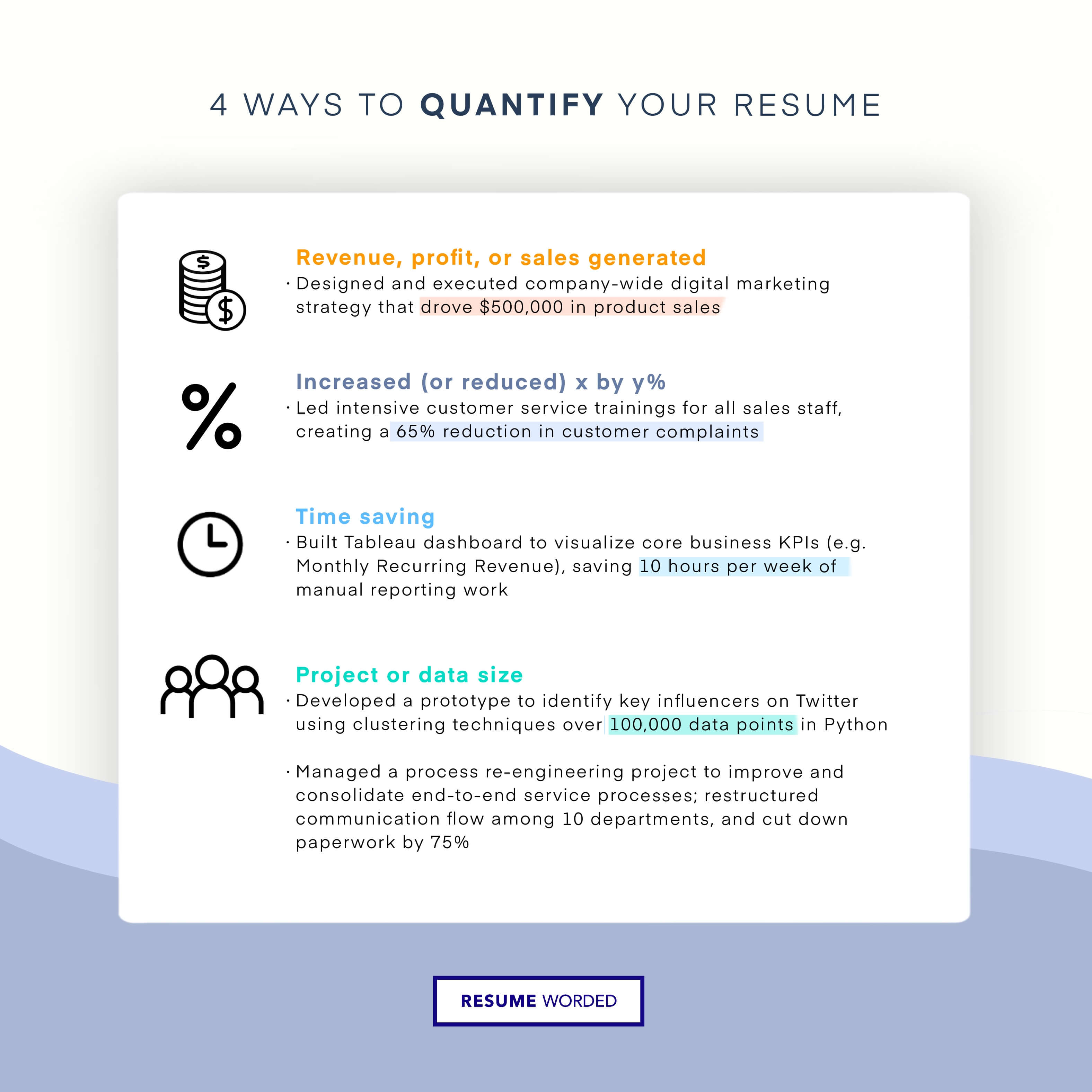
The image’s four measurement families are useful starting points:
-
Financial value
Examples include cloud spend reduced, vendor costs avoided, additional revenue enabled, or annual savings identified. -
Change in performance
Examples include error rate reduced, deployment frequency increased, processing accuracy improved, or customer complaints lowered. -
Time saved or speed improved
Examples include hours of manual effort eliminated, a release cycle shortened, incident resolution accelerated, or onboarding time reduced. -
Scale of the work
Examples include users served, transactions processed, services migrated, engineers coordinated, datasets analyzed, or regions launched.
Scale does not replace impact, but it establishes the significance of your contribution. “Optimized a database query” is a narrow technical task. “Optimized a query serving 2 million daily customer searches” conveys why the task merited attention.
Use percentages precisely
Be careful when writing percentage changes. If conversion rises from 12 percent to 18 percent, the increase is:
- 6 percentage points, and
- 50 percent relative growth.
The relative-growth calculation is:
Both descriptions are valid, but they mean different things. Use the one that your source data supports and that best communicates the business result.
Similarly, distinguish these claims:
- “Identified $1.2 million in annual savings opportunities” means analysis found potential value.
- “Reduced annual run-rate infrastructure spend by $1.2 million” means the savings were realized and measured.
- “Contributed to a migration expected to reduce spend by $1.2 million” means the result belongs to a broader team effort and may not yet be realized.
This distinction is especially important in consulting and finance recruiting. A precise, conservative statement is much more credible than a larger but ambiguous claim.
Turn your evidence map into one sentence
Your previous project evidence map contains more detail than belongs on a résumé. The job now is selective compression: retain the decision, contribution, scale, and result; remove technical detail that does not help a recruiter understand your value.
Use this drafting structure:
[Action verb] [what you owned] for [scope or stakeholder] by [method or decision], [producing a measured result].
Here is a hypothetical software-engineering project, developed in stages.
Raw project facts
A software engineer working on a subscription-billing platform:
- investigated transaction timeouts during peak usage;
- analyzed logs across four services;
- coordinated with product, site reliability engineering, and payments teams;
- led a three-engineer workstream that redesigned retry logic;
- lowered p95 transaction latency from 2.4 seconds to 0.9 seconds;
- reduced monthly timeout-related support tickets by 42 percent.
Weak résumé version
Worked on payment-service reliability and performance improvements.
This is accurate but uninformative. It does not show the engineer’s role, the scale of the work, the analytical contribution, or the outcome.
Overloaded version
Spearheaded a strategic cross-functional initiative to leverage data-driven payment optimization and stakeholder management to enhance customer experience across the organization.
This sounds impressive only until a recruiter asks what actually happened. It uses generic consulting language in place of evidence.
Consulting-style accomplishment statement
Led a 3-engineer workstream to redesign payment-retry logic across 4 services, reducing p95 transaction latency from 2.4 to 0.9 seconds and cutting monthly timeout-related support tickets by 42%.
This version is stronger because it makes several claims a recruiter can test:
- Leadership: led a defined workstream;
- Analytical problem solving: redesigned retry logic after diagnosis;
- Scale and complexity: four interconnected services;
- Customer or operational impact: faster transactions and fewer support contacts.
Notice what it does not claim. It does not say the redesign “increased revenue” unless conversion data demonstrated that result. It does not imply that one person completed every part of a multi-team change. It makes the engineer’s actual role legible.
Choose the result that best signals consulting potential
A project can have many valid metrics. A résumé bullet should usually prioritize the result that is both strongest and most relevant to the skill you want the reader to see.
For example, consider an internal reporting automation project.
| Primary signal | Possible emphasis in the bullet |
|---|---|
| Problem solving | Diagnosed root causes of reporting delays and redesigned the workflow |
| Leadership | Led a cross-functional rollout and resolved competing requirements |
| Teamwork | Coordinated engineering, finance, and operations around common data definitions |
| Impact | Cut monthly reporting time from five days to one day |
You may have evidence for all four. Trying to place all four in one line often produces an unreadable bullet. Instead, select a primary message.
For a software engineer applying to generalist consulting, strong bullets often make one of these connections visible:
- Technical analysis to business decision: analysis identified the cause of a cost, customer, or operating problem.
- Technical delivery to operational value: a system change reduced effort, time, defects, or risk.
- Coordination to execution: you aligned people with different priorities and delivered under constraints.
- Scale to judgment: you made a sound trade-off in a high-volume, customer-critical, or high-risk environment.
The following reading gives a useful five-step process for moving from responsibilities to impact. Its technical examples are particularly relevant here because they avoid both empty buzzwords and unnecessary implementation detail.
Consulting Resume Guide: 5 Real CV Examples (2026) | MyConsultingCoach
Read MyConsultingCoach’s guidance on converting responsibilities into consulting-style achievements. It provides a disciplined way to identify scale, ask why the work mattered, and select evidence that signals consulting skills.
In the section “How to Write Strong Bullets,” skip the earlier layout recommendations and begin at the achievement principle. Continue through the five steps, paying particular attention to the move from daily activity to scale and then to impact. In step 2, read the scale guidance; in step 3, follow the so what test. Then go to “Consulting Resume Bullet Examples” and study the technical examples, noting how each connects an analytical or product action to a measurable business outcome.
A reliable drafting process
For one project from your evidence map, create a private fact sheet before writing the final line. Do not begin with polished language; begin with verifiable evidence.
1. Identify the baseline
Record what was true before your work:
- How slow, costly, error-prone, risky, or manual was the process?
- Who was affected?
- What constraint or decision made the situation important?
- What did the metric look like before the change?
A baseline makes a metric meaningful. “Reduced latency by 0.4 seconds” is less clear than “reduced p95 latency from 1.1 seconds to 0.7 seconds.”
2. Name your individual contribution
Choose the most accurate action verb. The verb must match your actual level of ownership.
| If you actually… | Consider verbs such as… |
|---|---|
| Owned direction or delivery | Led, directed, owned, drove |
| Performed analysis | Analyzed, diagnosed, evaluated, modeled |
| Built or changed a system | Redesigned, automated, implemented, developed |
| Influenced a decision | Recommended, persuaded, aligned, proposed |
| Supported a team-led effort | Contributed to, partnered on, supported |
Avoid upgrading your role merely because the overall project had a strong result. “Contributed to a migration that reduced cloud cost” can be more impressive than a claim you cannot defend under follow-up questions.
3. Add meaningful scope
Use only one or two scale measures. Useful examples include:
- number of users, customers, services, markets, teams, or data records;
- size of budget or spend affected;
- frequency of process use;
- duration of the delivery or time pressure involved.
Scope is particularly valuable where financial impact is not available. For example:
Automated data validation for 15 production pipelines, improving reliability of weekly reporting used by commercial and finance teams.
This still needs a measured outcome if one exists, but it already conveys a larger and more relevant contribution than “built data checks.”
4. State the strongest measured result
Use a result that occurred after your work and is supported by a dashboard, launch review, incident report, finance record, or similarly reliable source.
Good result forms include:
- Reduced manual reconciliation time by 30 percent;
- Cut infrastructure spending by $250,000 annually;
- Improved model accuracy from 76 percent to 88 percent;
- Enabled weekly segmentation for 20 commercial users;
- Prevented a known compliance or operational risk, if the prevention mechanism is documented.
If the project has not yet produced an observable outcome, use an honest output or decision statement instead:
Developed a cost model for three cloud-architecture options, informing the technology leadership team’s selection of the lowest-cost compliant design.
This is weaker than a realized financial result, but it is still a credible accomplishment if the analysis genuinely influenced the decision.
5. Cut everything that does not carry evidence
A résumé bullet is not a project postmortem. Remove:
- programming languages and tools unless they are directly relevant to the decision or role;
- generic adjectives such as “strategic,” “innovative,” or “results-driven”;
- background details that do not explain the stakes;
- multiple secondary outcomes that make the line difficult to scan.
Your final bullet should normally fit within one or two résumé lines. A recruiter should be able to identify the action, scope, and outcome in a few seconds.
A final accuracy and clarity check
Before using the statement in an application, audit it against five standards:
- Specificity: It names a concrete action, project, or decision.
- Personal ownership: The wording accurately distinguishes your work from the team’s work.
- Quantification: It uses a meaningful, sourced number where available.
- Business relevance: The metric connects to customer experience, cost, speed, risk, quality, growth, or decision-making.
- Defensibility: You can explain the baseline, data source, time frame, stakeholder context, and your exact contribution in an interview.
A concise template for your first draft is:
[Strong verb] [specific contribution] for [scope] by [method or decision], [measured result and time frame].
For example:
Automated release validation for 8 customer-facing services by integrating rollback checks into the deployment workflow, reducing failed-release recovery time by 35% over one quarter.
Keep the supporting details from your evidence map. The résumé bullet earns the interview; the underlying facts allow you to handle probing questions with confidence.
Key takeaways
A quantified consulting-style accomplishment statement makes your potential visible through evidence rather than labels.
- Start with a specific action that accurately reflects your role.
- Add limited but meaningful scope.
- Quantify the strongest credible result: financial value, performance change, time saved, or scale.
- Connect technical work to a business-relevant outcome without inventing revenue or overstating causality.
- Preserve your underlying facts so that the statement remains defensible in interviews.
You now have a résumé-ready way to express one software-engineering achievement in consulting terms. In the next lesson, you will create a career-transition timeline covering skill building, networking, applications, and interview preparation.