Recommended resources
The freely available resources this lesson will direct you to.
- How I'd Recruit for McKinsey, BCG, and Bain in 2025www.youtube.com
- How to Get Into Consulting As an Engineerwww.youtube.com
- How Experienced Hires Break Into MBB: A Proven 4-Step System | Management Consultedmanagementconsulted.com
- How to Get into MBB Consulting: Complete Guidewww.hackingthecaseinterview.com
Hello. In the previous lesson, you converted a software-engineering project into a concise, quantified consulting-style accomplishment statement. That bullet is now an asset in a larger transition plan: it supports your résumé, gives you evidence for networking conversations, and becomes material for behavioral interviews.
This lesson brings the pieces together. You will create a practical career-transition timeline with four concurrent workstreams: skill building, networking, applications, and interview preparation. The aim is not to predict an exact hiring date; experienced-hire recruiting can move quickly and varies by office and role. The aim is to be ready before an opportunity appears, while building relationships and evidence systematically.
Treat the transition as four parallel workstreams
A career change is often described as a sequence: improve résumé, then network, then apply, then prepare for interviews. In reality, that sequence is risky. If an application produces an interview within one or two weeks, it is too late to begin learning case interviews. If you wait until you are “fully prepared” to network, you lose months in which conversations could refine your target roles and transition story.
Instead, run four workstreams at once:
| Workstream | Purpose | Evidence that it is progressing |
|---|---|---|
| Skill building | Build business fluency and consulting problem-solving skills | Completed lessons, structured analyses, Excel outputs, market-sizing practice |
| Networking | Learn about roles and offices; develop genuine professional relationships | Target-contact list, conversations, follow-ups, clearer firm insights |
| Applications | Convert your evidence into targeted submissions | Final résumé, role-specific materials, submitted applications, tracked deadlines |
| Interview preparation | Become able to demonstrate structured thinking and fit under pressure | Case log, drill results, story bank, mock-interview feedback |
The workstreams reinforce each other. A networking conversation may reveal that a particular office is hiring people with your industry experience. That insight changes which role you apply for, which accomplishment you foreground on your résumé, and which case topics you prioritize. A mock interview may reveal that your “Why consulting?” answer lacks a credible link between engineering and business impact; that becomes a prompt to revise your story before the next networking conversation.
The experienced-hire guidance below makes this central point clearly: target selection, résumé and pitch development, networking, and interview preparation should start early and proceed concurrently.
How Experienced Hires Break Into MBB: A Proven 4-Step System | Management Consulted
Read this Management Consulted article for its experienced-hire perspective on why reactive applications are risky and why preparation, networking, and applications must overlap.
Start with “The 4-Step System for Breaking Into Consulting as an Experienced Hire,” focusing on the four pillars: selecting roles, communicating value, networking at an appropriate level, and interview preparation. Then, in “Why Experienced Hire Consulting Recruiting Requires a Proactive Strategy,” read the proactive-strategy discussion. Notice the distinction between logical sequence and calendar sequence: the activities are related, but they should not be delayed until the previous one feels finished. Finally, in “How to Prepare for Consulting Case Interviews as an Experienced Professional,” read the two stages of preparation and focus on the shift from foundations to feedback-led practice.
A milestone is not an intention
“Network more” and “practice cases” are intentions. They are hard to track and easy to postpone. A timeline needs milestones: observable results with a due date and a definition of completion.
Compare:
| Vague plan | Useful milestone |
|---|---|
| Improve résumé | Have one one-page consulting résumé reviewed against a checklist and revise it by Friday |
| Learn consulting | Complete one business-model analysis and explain its revenue, costs, and key drivers aloud |
| Network more | Send five tailored outreach messages and hold two informational conversations this week |
| Practice cases | Complete two live cases, log feedback, and repeat one targeted drill based on the feedback |
| Apply broadly | Submit three applications only after verifying role level, office, deadline, and referral process |
The point is not to create a perfect spreadsheet. It is to make the next action visible and to know whether a week moved your transition forward.
Choose a recruiting horizon before choosing weekly tasks
For a career switcher, a 12-week runway is a sensible planning baseline when no imminent deadline is forcing a shorter schedule. It is long enough to build core skills and obtain feedback, but short enough to create urgency. If you discover an application deadline in three weeks, keep the same four workstreams but compress and prioritize them rather than abandoning the plan.
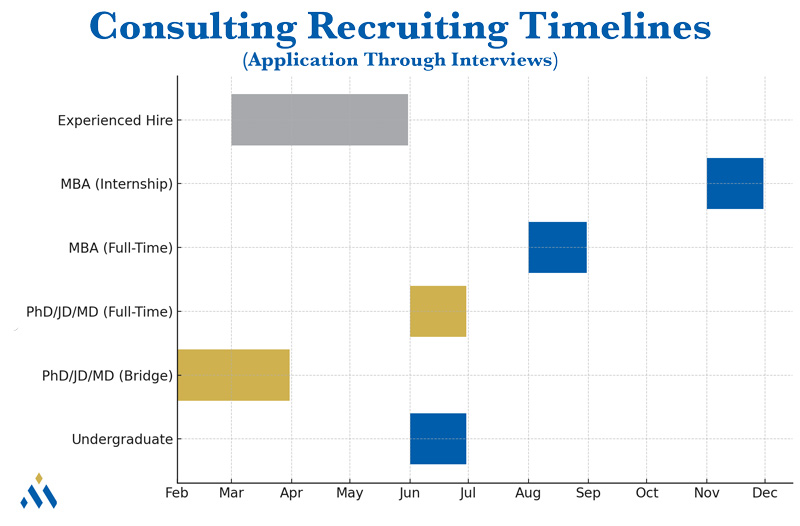
The recruiting-timeline graphic below is useful as a broad reminder that different candidate types recruit on different schedules. It shows experienced-hire hiring as relatively flexible compared with campus pipelines, while undergraduate and graduate recruiting follow more predictable windows. Treat it as orientation, not as a current deadline calendar: always verify the exact office, role, and application-cycle dates on the firm’s career site.
A 12-week plan works best when it begins with two planning decisions.
1. Define a target portfolio
Your goal may be MBB, but your plan should distinguish three levels of priority:
- Priority firms: the firms, offices, and roles you would pursue most actively because the fit is strongest.
- Adjacent firms: strategy, operations, digital, technology, or industry-specialist consultancies where your background also fits.
- Learning targets: firms or roles you will research through conversations, even if you may not apply immediately.
Avoid two opposite errors:
- A target list so narrow that one unsuccessful application stops the transition.
- A target list so broad that every application, conversation, and preparation effort becomes generic.
For example, an engineer interested in management consulting and finance might set up a portfolio with a small group of high-priority generalist and digital-transformation roles, a broader group of strategy or technology consultancies, and a few finance-adjacent advisory practices. The right number depends on location, eligibility, role level, and genuine fit—not an arbitrary quota.
2. Identify the earliest hard deadline
Build the timeline backward from the earliest date that could constrain you:
- application closing date;
- start-date availability;
- visa or work-authorization constraint;
- notice period at your current employer;
- hiring event or referral deadline;
- a personal constraint such as planned travel.
Put this date at the top of your tracker. Then decide what must be true before you submit an application:
- résumé is accurate and reviewed;
- transition story is credible and conversational;
- role level is appropriate;
- a relevant contact has been approached where feasible;
- basic case-interview preparation has begun;
- relevant screening test format is understood.
Do not wait for complete mastery. But do not apply blindly and hope to prepare after the invitation arrives.
Build your 12-week transition timeline
The roadmap below adapts the common 8-to-12-week recruiting-preparation model into a plan for a working career switcher. It assumes roughly 6–10 focused hours a week. If you have less time, reduce the number of targets and preserve the recurring activities: one networking block, one live-practice block, and one planning review each week.
How to Get into MBB Consulting: Complete Guide
Read the roadmap sections from Hacking the Case Interview as a reference schedule, then adapt the activities to your target role, location, and available time.
In “What Is a Realistic MBB Preparation Timeline?”, read the 12-week roadmap. Focus less on its exact volume recommendations than on its sequencing: early research and materials, then sustained networking, feedback-based cases, fit preparation, and mocks. In “How Important Is Networking for MBB Recruiting?”, note the emphasis on relationships built over time rather than asking for a referral immediately. In “How Do You Prepare for MBB Case Interviews?”, focus on the five assessed skills and the value of live practice with feedback.
Weeks 1–2: Set direction and create usable materials
Your first two weeks should produce a target list and a credible professional narrative—not just more research notes.
| Workstream | Milestones by the end of week 2 |
|---|---|
| Skill building | Complete an initial review of consulting business fundamentals; practice structured thinking on one simple business question |
| Networking | Build a list of 20–30 relevant contacts, prioritized by shared background, industry overlap, office, or practice area |
| Applications | Finalize a one-page consulting résumé; create a tracker with roles, deadlines, links, and status |
| Interview preparation | Learn the format of a case interview; complete 1–2 diagnostic cases with a partner or experienced coach; draft a “Why consulting?” answer |
Your résumé should already contain the quantified project statement developed in the previous lesson. Do not treat it as final merely because it is polished. Each target role may require a different ordering of bullets or a different emphasis: leadership, business impact, industry knowledge, analytics, or implementation.
For your transition story, use this simple logic:
- What you have enjoyed and accomplished in your current field.
- What broader problem or decision exposure you now want.
- Why consulting is a credible next environment for that goal.
- Why your technical or industry experience would add value.
The story should be forward-looking. “I dislike engineering” is not a consulting motivation. “I want to use my technical and analytical experience to help organizations make higher-level business and operating decisions across multiple contexts” is a direction that can be supported with evidence.
Weeks 3–4: Begin conversations and establish case foundations
Networking should begin before you feel ready. Early conversations are not only routes to referrals; they are research. They help you test whether your view of the role matches the work consultants actually do.
| Workstream | Milestones by the end of week 4 |
|---|---|
| Skill building | Complete two short analyses of companies or industries, focusing on business model, customer, revenue, costs, and risks |
| Networking | Send tailored outreach consistently; conduct 3–5 informational conversations; send a thoughtful follow-up within 24 hours |
| Applications | Verify deadlines and eligibility for all priority roles; tailor résumé wording for the first applications |
| Interview preparation | Practice core case mechanics: clarifying the objective, structuring a problem, basic mental math, chart interpretation, and synthesis |
Use networking conversations to ask questions that improve your decision-making:
- What type of work does this office or practice do most often?
- What differentiates people who succeed in this role?
- Which parts of an experienced hire’s background are genuinely useful on teams?
- How does recruiting work for this role and office?
- What would you want a candidate with my background to understand before interviewing?
Avoid treating every conversation as a referral request. A referral may become appropriate only after a substantive conversation and demonstrated fit. Whether or not it does, the insight is valuable.
Weeks 5–8: Build performance through feedback cycles
This is normally the highest-effort phase. You are no longer just learning what a case interview is; you are practicing the behaviors that interviewers observe: structured thinking, sensible prioritization, clear calculations, business judgment, and concise synthesis.
| Workstream | Milestones by the end of week 8 |
|---|---|
| Skill building | Build fluency in profitability, market sizing, market entry, customer economics, and basic financial statements |
| Networking | Maintain relationships with prior contacts; add targeted contacts at priority firms; attend relevant recruiting events when available |
| Applications | Submit applications as roles open and materials meet your quality threshold; record submission and follow-up dates |
| Interview preparation | Complete regular live cases across several case types; maintain a feedback log; practice targeted drills for recurring weaknesses |
Your case log can be simple:
| Date | Case type | Main feedback | Root cause | Next drill |
|---|---|---|---|---|
| May 8 | Profitability | Structure missed customer mix | Began analysis before defining revenue drivers | Build two revenue trees aloud |
| May 11 | Market entry | Recommendation was vague | Did not prioritize criteria | Give one-minute synthesis with decision criteria |
| May 15 | Operations | Math was slow | Poor estimation setup | Ten-minute percentage and weighted-average drill |
The most important column is next drill. A case completed without feedback may build familiarity, but a case with one diagnosed weakness and a scheduled correction builds capability.
The following video offers an engineer-focused view of the same transition. Its practical advice is useful, though you should adapt its suggested outreach and application volumes to your actual capacity and target list rather than treating them as fixed rules.
How to Get Into Consulting As an Engineer
Watch “How to Get Into Consulting As an Engineer” from Ziad Shares for practical guidance on deadline tracking, outreach, and the case-preparation gaps that technical candidates often need to address.
Watch deadline tracking to see why consulting recruitment may begin much earlier than many engineering hiring processes. Then watch networking mechanics, focusing on the need for a consistent outreach process rather than on any single response-rate estimate. Finally, watch interview preparation for its advice on broadening from technical solutions to commercial structures, especially profitability and market-entry thinking.
Weeks 9–10: Convert experiences into interview-ready stories
By this point, your résumé bullets should be stable enough to become stories. Select five to seven experiences that can demonstrate different dimensions of consulting fit:
- leadership;
- personal impact;
- teamwork and influence without authority;
- resilience under pressure;
- entrepreneurial initiative;
- analytical problem solving;
- a difficult professional decision or conflict.
For each story, prepare the context, your specific actions, the reasoning behind those actions, the result, and what you learned. Do not memorize a speech. Prepare the factual sequence well enough that you can adapt it to different questions.
| Workstream | Milestones by the end of week 10 |
|---|---|
| Skill building | Explain your transition rationale and the business fundamentals behind common case decisions without notes |
| Networking | Reconnect selectively with valuable contacts; share a concise update or thank them for a prior insight |
| Applications | Ensure every active application has a documented next action and no deadline is unverified |
| Interview preparation | Prepare and time 5–7 fit stories; practice “Why consulting?” and “Why this firm?” aloud; run at least one full mock interview |
Weeks 11–12: Simulate the real process and decide readiness
The final phase is not about cramming more frameworks. It is about reproducing interview conditions and fixing the one or two weaknesses that could most damage performance.
| Workstream | Milestones by the end of week 12 |
|---|---|
| Skill building | Review business concepts through short, applied analyses rather than passive rereading |
| Networking | Keep relationships warm without over-contacting people; prepare targeted questions for any upcoming interviews |
| Applications | Confirm interview dates, formats, interviewers if known, and any digital assessments |
| Interview preparation | Complete 2–3 full mocks per week; review feedback; rehearse concise final recommendations and behavioral answers |
At this stage, reduce random volume. If your issue is weak synthesis, the next case should focus on synthesis. If your issue is a shallow personal-impact story, practice probing follow-up questions rather than adding a new story. Readiness comes from reliable performance, not from counting cases alone.
Turn the timeline into a weekly operating system
A timeline fails when it remains a document you created once. Use a short weekly review—perhaps 20 minutes on Sunday—to decide the next week’s actions.
Your weekly review
- Check deadlines. Have any roles opened, closed, or changed requirements?
- Review relationship status. Who needs a thank-you note, follow-up, or no contact at all?
- Read your feedback log. What is the single highest-priority weakness in cases or fit answers?
- Schedule fixed blocks. Put live practice and conversations on your calendar before filling the week with reading.
- Choose three concrete outcomes. For example: submit one tailored application, hold one conversation, complete two live cases with feedback.
- Update evidence. Add a new achievement, metric, or story detail from your current work while it is still easy to verify.
A useful tracker has one row per firm-role-office combination, not merely one row per company.
| Firm / office | Role and level | Deadline | Contact(s) | Last interaction | Application status | Interview readiness | Next action |
|---|---|---|---|---|---|---|---|
| Example firm / Chicago | Associate, generalist | June 15 | Alumni consultant | May 10 conversation | Résumé tailoring | 8 live cases; synthesis focus | Send thank-you and apply by June 1 |
| Example firm / New York | Digital transformation | Rolling | Industry partner | Not contacted | Researching | Case foundations | Identify two relevant contacts |
Use status labels that force clarity: researching, contacted, conversation held, referral discussion, materials ready, applied, assessment, interviewing, closed. “In progress” hides too much.
Adapt the plan when the calendar changes
If an interview invitation arrives early, use a compressed version of the timeline:
- preserve daily case practice and live feedback;
- prioritize your transition story and two or three strongest fit stories;
- learn the firm’s specific interview format;
- keep networking light and purposeful;
- pause lower-value résumé refinements and broad research.
If no roles are open yet, do not interpret the wait as inactivity. Use the runway to improve your résumé evidence, deepen commercial fluency, build relationships, and practice cases without the pressure of an imminent interview. That is exactly when deliberate preparation is most valuable.
Key takeaways
A strong career-transition timeline is a set of dated, observable milestones across four concurrent workstreams:
- Skill building develops your business and analytical fluency.
- Networking supplies market insight, relationships, and feedback on your story.
- Applications require targeted, accurate materials and deadline discipline.
- Interview preparation needs live practice, feedback, and targeted correction—not passive study alone.
For an experienced career switcher, a 12-week plan is a useful default, but the critical principle is readiness before an opportunity appears. Build your tracker, identify your earliest hard deadline, and schedule the first week’s concrete actions now.
In the next module, you will begin the business and financial foundation that makes consulting cases and finance-oriented discussions more natural: analyzing how a company creates value through its customers, value proposition, revenues, costs, and capabilities.