Recommended resources
The freely available resources this lesson will direct you to.
- How to Ace McKinsey Personal Experience Interview (PEI) in 2025www.youtube.com
- 5 CV Fixes That Got Me Interviews Everywhere (Former Bain Consultant)www.youtube.com
- Resumes: Writing about your skillscapd.mit.edu
- Bain Consulting Interview Process: How to Stand Out | University Hiring London | Bain & Companywww.bain.com
Hello. In the previous lesson, you compared generalist, digital, specialist, and implementation routes into consulting. The next question is more practical: what in a software-engineering project proves that you can succeed in one of those roles?
Consulting recruiters do not need you to have held the title “consultant” before. They need credible evidence that you can solve ambiguous problems, influence people, work across functions, and produce results. This lesson shows how to extract that evidence from an engineering project without exaggerating your contribution or translating every technical activity into vague business language.
By the end, you should be able to take one project and map its facts to four consulting criteria: problem solving, leadership, teamwork, and impact. This evidence map will become the foundation for your résumé bullets and behavioral-interview stories in later lessons.
Start with evidence, not labels
A weak application says:
“Developed leadership, teamwork, and analytical skills while working on a cloud migration.”
This gives a recruiter no reason to believe the claims. It names desirable traits but does not show the behavior, decisions, or outcomes behind them.
A stronger approach begins with concrete project evidence:
- What business or operational problem existed?
- What made it difficult or uncertain?
- What did you personally analyze, decide, initiate, or change?
- Who did you need to work with?
- What changed, and how do you know?
Consulting firms examine the substance behind the words. Bain’s recruiting guidance, for example, emphasizes analytical and communication skills alongside initiative, leadership, and teamwork—and explicitly asks candidates to show what changed because they were involved.
Bain Consulting Interview Process: How to Stand Out | University Hiring London | Bain & Company
Read Bain & Company’s recruiter perspective to see the distinction between listing responsibilities and demonstrating consulting-relevant evidence.
In the section “What distinguishes the strongest candidates in the recruiting process?”, read the recruiter guidance. Notice the emphasis on bringing qualities to life through experiences and on stating results, not merely duties.
The key principle is:
A consulting criterion is an interpretation; project facts are the proof.
For example, “leadership” is not proven by your job title. It is proven when the evidence shows that you set direction, influenced a decision, created momentum, removed a blocker, or helped a group deliver under pressure.
The four consulting criteria in engineering terms
The same engineering project may contain evidence for several criteria. The goal is not to force every project into every category. It is to identify the strongest, most defensible evidence.
| Consulting criterion | What it means in practice | Strong engineering evidence | Weak or incomplete evidence |
|---|---|---|---|
| Problem solving | Framing a problem, analyzing causes, making trade-offs, and choosing a practical answer | Diagnosed a reliability issue; segmented data; tested hypotheses; evaluated build-versus-buy options; selected a solution based on cost, risk, and performance | “Fixed bugs” or “improved the system” without explaining the problem or reasoning |
| Leadership | Moving people and work toward an outcome, with or without formal authority | Set a plan, rallied engineers around a decision, escalated risks, persuaded stakeholders, mentored colleagues, or owned delivery of a difficult workstream | “Was team lead” with no explanation of what you led or changed |
| Teamwork | Working productively across different incentives, expertise, and priorities | Coordinated engineering, product, security, operations, legal, or vendors; resolved conflict; clarified ownership; adapted communication for others | “Collaborated with a cross-functional team” |
| Impact | Producing a meaningful, attributable improvement for users, the organization, or a client | Reduced cloud spend, improved conversion, shortened release cycles, prevented incidents, increased adoption, reduced manual effort, or lowered risk | “Completed the project successfully” |
These criteria overlap. A migration project, for instance, can demonstrate problem solving through architecture decisions, leadership through coordinating the plan, teamwork through security and operations alignment, and impact through lower infrastructure cost or fewer incidents.
But in an interview, do not try to demonstrate all four at equal length. Choose a primary criterion based on the question. If asked about influencing others, spend most of the story on leadership. If asked about an analytical challenge, focus on the diagnosis, alternatives, and rationale.
Problem solving: show the path from uncertainty to a decision
Consulting problem solving is more than intelligence or technical complexity. It means creating order when the answer is not obvious.
A project is strong evidence of problem solving when you can explain:
- The decision or problem: What needed to improve, and why did it matter?
- The diagnosis: What information did you gather or analyze?
- The alternatives: What plausible options existed?
- The trade-off: What did each option imply for cost, speed, reliability, customer experience, or risk?
- Your conclusion: What did you recommend or implement, and why?
Consider the difference:
- Weak: “Improved a slow customer-data pipeline.”
- Evidence-rich: “Investigated why customer-segmentation reports arrived three days late by tracing data latency across ingestion, transformation, and approval steps; identified a manual validation stage as the largest bottleneck and proposed automated checks with exception review.”
The second description gives a recruiter something to evaluate: structured diagnosis, prioritization, and judgment.
Leadership: distinguish ownership from seniority
Leadership does not require managing people. A software engineer can lead by creating clarity and momentum in a situation where different people own different parts of the answer.
Useful leadership evidence includes:
- Taking ownership of a neglected but important problem.
- Defining milestones, roles, and decision points for a workstream.
- Persuading stakeholders to accept an unpopular but necessary trade-off.
- Escalating a material risk early rather than allowing it to become a failure.
- Coaching a teammate through a complex task.
- Maintaining momentum when scope changes, dependencies slip, or priorities conflict.
The most credible leadership stories include resistance. If everyone immediately agreed with your proposal, the story may show initiative, but it gives less evidence of influence or judgment.
Teamwork: make collaboration specific
“Cross-functional” is a useful description, but it is not evidence by itself. A recruiter needs to know what made collaboration difficult and what you did about it.
For example, a platform migration may involve:
- Product managers focused on customer disruption and roadmap commitments.
- Security specialists focused on controls and compliance.
- Operations teams focused on reliability and incident response.
- Finance or procurement teams focused on vendor cost.
- Engineers focused on technical feasibility and maintainability.
Teamwork evidence becomes compelling when you explain how you handled these differing priorities. Perhaps you created a shared decision document, translated technical risks into operational consequences, negotiated a phased rollout, or established an escalation process for blockers.
Impact: quantify honestly and connect it to value
Impact is not limited to revenue. In consulting and finance-oriented work, the important question is whether the project changed an economically or strategically meaningful outcome.
Engineering metrics can be powerful when their link to business value is credible:
| Engineering outcome | Potential business relevance |
|---|---|
| Faster page load or checkout flow | Better customer experience; potentially improved conversion if measured |
| Lower cloud consumption | Reduced operating expense |
| Fewer critical incidents | Lower revenue risk, fewer support costs, improved trust |
| Shorter deployment cycle | Faster product releases and improved responsiveness |
| More automated workflow | Reduced labor hours, fewer errors, greater scalability |
| Improved fraud detection or security controls | Reduced loss exposure and regulatory or reputational risk |
Be precise about the strength of the connection. If you know that a redesign reduced cloud cost by 18 percent, state it. If you only know that it improved system latency, do not claim it increased revenue unless that relationship was measured. Consulting depends on trust in the analysis; inflated attribution damages that trust.
Build a project evidence map
Choose one substantial project from the past several years. Good choices usually involve a real constraint: incomplete information, a difficult stakeholder, a tight deadline, a failure risk, a meaningful customer problem, or an important trade-off.
Before writing a résumé bullet or rehearsing a story, create a private evidence map. Think of it as the underlying case file from which different applications and interview answers can be built.
Use this structure:
| Evidence area | Notes to capture |
|---|---|
| Situation | Organization, product or system, relevant scale, and why the work mattered |
| Starting problem | The baseline condition: cost, speed, errors, incidents, customer pain, deadline, or strategic risk |
| Your role | Your formal role and the responsibility you actually took on |
| Your analysis | Data reviewed, hypotheses tested, root causes identified, alternatives compared |
| Your decisions | What you recommended, prioritized, designed, or changed—and the rationale |
| Your leadership | How you created direction, handled resistance, managed uncertainty, or drove accountability |
| Your collaboration | Stakeholders involved, conflicting priorities, and how you coordinated or influenced them |
| Results | Measured outcomes, time frame, scale, adoption, financial effect, risk reduction, or customer outcome |
| Verification | Source of the metrics: dashboard, finance report, incident data, customer survey, manager feedback, or project records |
The last row matters. Do not rely only on vague memory. Revisit project documentation, dashboards, Jira tickets, launch reviews, performance reports, or old presentations where possible. This helps you be both more specific and more consistent under interview follow-up.
Worked example: a hypothetical checkout-performance project
Imagine you worked on an e-commerce platform where checkout latency increased during promotional periods. Your team received complaints from product managers and customer-support staff, but the exact cause was unclear.
A weak summary might be:
“Worked with a team to improve checkout performance.”
A consulting evidence map could look like this:
| Criterion | Evidence from the project |
|---|---|
| Problem solving | Analyzed performance traces across payment, fraud, and inventory services; found that synchronous fraud checks created the largest delay during peak traffic; compared caching, infrastructure scaling, and an asynchronous workflow |
| Leadership | Proposed a phased redesign rather than a full rewrite; created the decision memo and rollout plan; escalated a compliance concern before launch |
| Teamwork | Aligned engineering, fraud, security, product, and support teams around customer-risk thresholds and rollback criteria |
| Impact | Reduced checkout latency from 1.8 seconds to 0.7 seconds at peak; reduced checkout-related support tickets by 25 percent over the following quarter |
Notice what is absent: claims such as “excellent leader” or “strong collaborator.” Those are conclusions the interviewer can draw from the evidence.
Also notice the care around financial impact. If the company measured a conversion improvement, that could be included. If it did not, the correct statement is the measured latency and support-ticket result—not an invented revenue figure.
Turn technical work into visible results
Technical projects are often described as tasks because engineering teams naturally focus on the work to be done: build a service, migrate a database, create a feature, resolve a security issue.
Recruiters scan much faster. They need to identify the action, the context, and the result almost immediately. MIT’s career guidance presents this as the Project-Action-Result, or PAR, approach.
Resumes: Writing about your skills
Read MIT Career Advising and Professional Development’s guidance on PAR statements and quantified impact. It provides a concise method for making your contribution and result visible to a recruiter.
In the “PAR Statements” section, read the PAR explanation. Then, in “Using numbers to show impact,” read the quantification guidance, focusing on the three metric types: financial performance, percentage change, and scale of work.
For your evidence map, separate these three layers:
- Action: What you personally did.
- Operational effect: What changed in the system, process, or team.
- Business consequence: Why that change mattered to customers, cost, growth, risk, or speed.
For example:
| Layer | Example |
|---|---|
| Action | Introduced automated data-quality checks and redesigned the release workflow |
| Operational effect | Reduced failed pipeline runs and shortened reporting delays |
| Business consequence | Enabled commercial teams to use current customer segments for weekly campaign decisions |
You may not always have a direct financial measure. That is normal. The objective is not to force dollar signs into every project; it is to state the strongest valid outcome.
Useful impact metrics for software projects
When extracting evidence, look for metrics in several categories:
- Scale: users served, transactions processed, services migrated, engineers coordinated, data records handled, regions launched.
- Speed: processing time, deployment frequency, lead time, onboarding time, resolution time.
- Quality: defect rate, failure rate, accuracy, uptime, customer complaints, rework.
- Cost: infrastructure spend, vendor spend, manual hours, support cost, avoided losses.
- Customer behavior: adoption, activation, retention, conversion, satisfaction.
- Risk: security vulnerabilities closed, incidents prevented, compliance requirements met, recovery time reduced.
A number alone is not impact. “Processed 10 million records” describes scale; it becomes stronger when it explains why that scale mattered, such as enabling a new reporting process or reducing processing time.
Use STAR to communicate the evidence in an interview
The evidence map is your research. The STAR method is one way to present that evidence in a behavioral interview:
- Situation: The relevant context.
- Task: Your responsibility or the problem to solve.
- Action: What you personally did and why.
- Result: What changed, ideally with evidence.
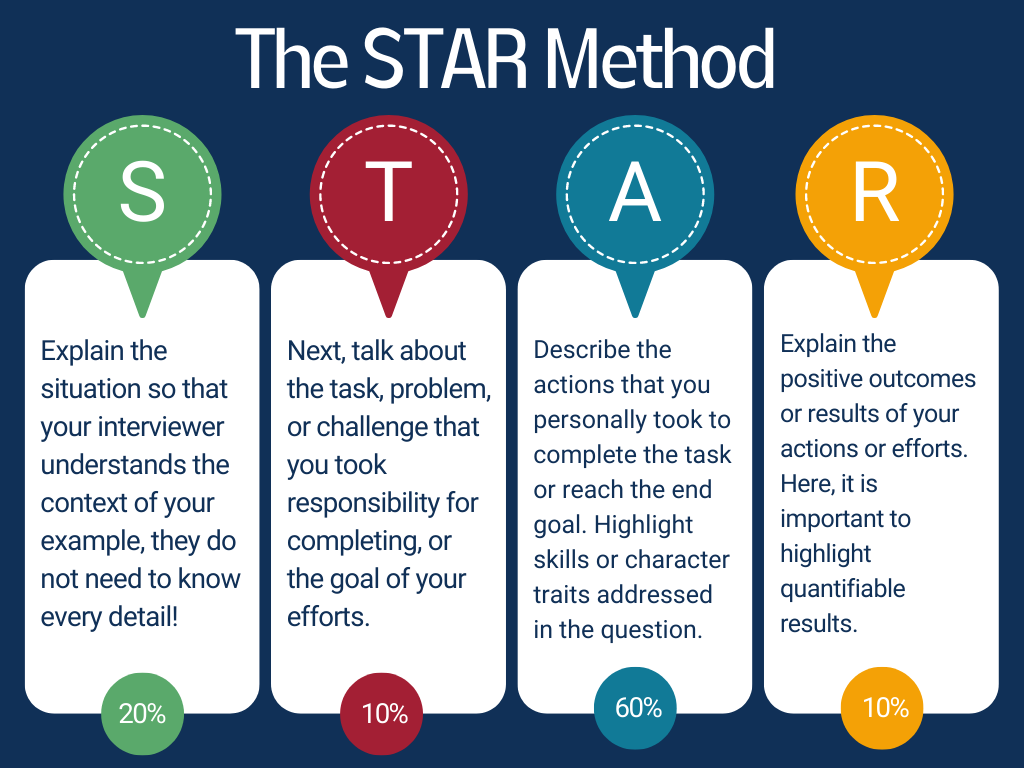
Treat STAR as a communication structure, not as a script. The image’s approximate emphasis—brief context and task, most of the time on action, then a concise result—is sensible for consulting interviews because interviewers want to understand your judgment and contribution.
A strong spoken opening might sound like this:
“I’ll describe a checkout-performance project where I led the technical diagnosis and aligned product, fraud, and security stakeholders on a phased redesign. The main challenge was improving speed without weakening fraud controls.”
This preview helps the interviewer assess whether the example fits the question. It also signals that your story has a specific challenge, personal role, and outcome.
What belongs in each part
Situation: Include only details needed to understand the stakes. Avoid explaining the whole technology stack unless it is central to the decision.
Task: State the problem and your responsibility. If the task changed during the project, explain what changed and why.
Action: This is the core. Organize your actions around meaningful decisions rather than a chronological diary. Include:
- How you analyzed the problem.
- What options you considered.
- How you made or influenced a decision.
- How you engaged stakeholders.
- How you responded to a setback, disagreement, or new information.
Result: State the outcome, its time frame, and its relevance. Add a lesson only when it strengthens the answer or the interviewer asks for reflection.
When speaking, distinguish carefully between “I” and “we.” You should acknowledge the team’s work, but the interviewer must understand your individual contribution. “We migrated the platform” is incomplete. “I owned the dependency analysis, proposed the phased rollout, and coordinated the security sign-off” is specific without denying that others contributed.
This short segment reinforces the same point: consulting recruiters look for concrete proof of skills rather than labels, and each bullet or story should make the relevant capability visible.
5 CV Fixes That Got Me Interviews Everywhere (Former Bain Consultant)
Watch “5 CV Fixes That Got Me Interviews Everywhere” by Korean Consultant for a recruiter-oriented explanation of why evidence is more persuasive than generic skill claims.
Watch consulting evidence. Focus on the distinction between naming a skill and demonstrating it through an action, team context, and outcome. Use the principle, not the presenter’s exact wording, when reviewing your own evidence map.
Avoid four common translation errors
1. Describing tools instead of decisions
“Used Python, AWS, Kubernetes, and SQL” communicates technical exposure, not consulting potential.
The important question is: what decision did your technical work enable? Perhaps you chose an architecture, prioritized a backlog, evaluated vendor options, or diagnosed a root cause.
2. Replacing evidence with consulting buzzwords
Words such as “strategic,” “transformational,” “synergistic,” and “stakeholder management” add little unless supported by specifics.
Instead of “managed stakeholders,” identify the stakeholder conflict, your communication approach, and the decision reached.
3. Claiming the team’s result as your own
A project may have generated excellent results, but your role may have been narrow. Be accurate about your contribution:
- “Led the analysis that informed the redesign” is different from “led the redesign.”
- “Contributed to a migration that reduced cost” is different from “reduced cost.”
- “Partnered with product to define rollout criteria” is different from “owned the product strategy.”
Accuracy will help you withstand probing questions such as, “What would have happened if you had not intervened?” or “Who disagreed with you, and why?”
4. Treating delivery as impact
Shipping is an output. Impact is the change after shipping.
A new dashboard is not automatically impact. It may become impact if managers use it to make faster decisions, if reporting time falls, or if its insights improve customer targeting. When post-launch data is unavailable, state the output honestly and explain the intended value without presenting it as achieved.
A practical routine for this week
Select one software-engineering project with enough substance to support a five-to-seven-minute conversation. Create a one-page evidence map using the categories in this lesson.
Then mark each item with one of four labels:
- P: strongest proof of problem solving
- L: strongest proof of leadership
- T: strongest proof of teamwork
- I: strongest proof of impact
Aim to identify at least one well-supported item in each category. If one category is weak, do not manufacture it. Instead, note the gap and choose another project later that may demonstrate that criterion more naturally.
Keep the underlying facts stable. You may eventually adapt the emphasis for different questions, but you should never change your role, the central challenge, or the result to fit a desired answer.
Key takeaways
A software-engineering project can be highly relevant to consulting when you make its evidence visible.
- Problem solving is shown through diagnosis, options, trade-offs, and decisions.
- Leadership is shown through ownership, influence, direction, and judgment—not merely seniority.
- Teamwork is shown through how you worked across differing priorities and expertise.
- Impact is shown through credible operational, customer, financial, or risk outcomes.
Use a project evidence map before writing or speaking. It prevents vague claims, helps you identify the strongest stories, and gives you defensible detail for recruiter follow-ups.
In the next lesson, you will turn this evidence into a concise, quantified consulting-style accomplishment statement suitable for a résumé.