Recommended resources
The freely available resources this lesson will direct you to.
- Experienced Hire: How to join McKinsey, BCG and Bain as an Experienced Professionalwww.youtube.com
- Transitioning to BCG and consulting as an experienced professionalwww.youtube.com
- Career Change to Consulting: Step-by-Step Guide (2026)www.hackingthecaseinterview.com
- McKinsey Digital Practice: Roles & Careers (2026)www.hackingthecaseinterview.com
Hello. In the previous lesson, you distinguished four overlapping types of MBB client-service work: broad generalist problem solving, specialist expertise, digital work, and implementation. Now we use that map for a career decision: which direct-entry route is most credible for an experienced software engineer, and when should they pursue it?
Because no personal work history has been provided, this lesson treats “experienced software engineer” as the candidate profile to evaluate. The aim is not to name one universally best route. It is to compare routes using three practical criteria:
- Role fit — what work you want to do repeatedly and what evidence you already have.
- Timing — when applications, preparation, and interviews can realistically occur.
- Eligibility — whether a specific role’s formal requirements and selection process match your profile.
Direct entry: what it means—and what it does not
A direct-entry move means applying from industry into a consulting firm without first completing a full-time MBA or another degree program. It is commonly called experienced hiring, lateral hiring, or professional hiring.
This is distinct from the MBA route. An MBA can be a valid route to consulting, but it requires a major two-year investment of time and tuition, and it is not the focus here. For an engineer with substantial delivery experience, direct entry may preserve momentum and allow the firm to hire them for capabilities it needs now.
The external guide below provides a useful orientation to common career-change paths. Treat its years-of-experience ranges as general market heuristics, not MBB rules: actual requirements differ by firm, office, practice, and live job posting.
Career Change to Consulting: Step-by-Step Guide (2026)
Read Hacking the Case Interview’s overview to distinguish the experienced-hire path from MBA and early-career routes, then connect a technology or software background to likely consulting role families.
In the section “What Are the Main Entry Paths for Career Changers?”, read the entry-path comparison. Focus on the distinction between an experienced hire and an MBA hire, rather than treating the stated timelines as guarantees. Then continue to “Which Backgrounds Transition Best Into Consulting?” and use the source-industry table to identify why technology and software experience often maps most naturally to digital, technology strategy, and implementation work.
The fundamental principle is simple:
A consulting firm hires an experienced candidate not merely for prior years of employment, but because that experience reduces risk on client work.
For a software engineer, that risk reduction might come from the ability to assess a cloud architecture, lead a complex migration, turn a vague customer need into a product roadmap, build an analytics product, or manage delivery across engineering and business stakeholders.
Four direct-entry routes for an experienced software engineer
The role types from the previous lesson now become actual recruiting choices. Titles vary widely—associate, consultant, technology architect, product manager, implementation coach, engineer, expert—but the underlying work is more stable than the titles.
| Direct-entry route | Core client value | Best evidence from a software-engineering background | Typical assessment emphasis |
|---|---|---|---|
| Generalist experienced consultant | Solves broad business problems across industries and functions | Leadership, commercial awareness, cross-functional problem solving, analytical communication | Standard consulting cases and personal-experience interviews |
| Digital or technology-strategy consultant | Connects technology decisions to business value | Product thinking, architecture trade-offs, technology roadmaps, business cases, stakeholder alignment | Consulting cases, often with technology or digital context; fit interviews |
| Technical digital specialist | Builds, architects, or deploys technical solutions for clients | Strong coding, cloud, data, AI, security, platform, or systems expertise | Technical screens or coding plus behavioral and client-communication evaluation |
| Technology implementation or transformation consultant | Converts a chosen direction into delivered, adopted, measurable change | Delivery leadership, migrations, release management, operating-model change, adoption, KPI improvement | Delivery scenarios, technical or operational depth, behavioral interviews; case format varies |
These routes are not a prestige ladder. They reflect different answers to the question: what should the firm rely on you to do on day one?
Route 1: Generalist experienced consultant
This route is for candidates who want the broadest shift away from hands-on technology work and toward business problem solving across many topics: growth, pricing, cost, market entry, operating models, M&A, and transformations.
A software engineer can be credible here, but technical competence alone is insufficient. The candidate needs evidence that they can work above the code level:
- Turn uncertain requirements into a decision and a plan.
- Quantify a commercial or operational problem.
- Influence product, operations, finance, or executive stakeholders.
- Make trade-offs under limited budget, time, or capacity.
- Explain a technical issue in terms of customer, revenue, cost, risk, or strategic impact.
For example, “rebuilt a data pipeline” is primarily an engineering accomplishment. It becomes stronger generalist evidence when framed as: “Led a cross-functional redesign of the customer-data pipeline, reducing reporting delays from three days to four hours and enabling the commercial team to target high-value customers weekly.”
Best fit: You genuinely want broad business exposure and are willing to build core consulting skills quickly, including cases, synthesis, Excel, and executive communication.
Main risk: The firm may see your most distinctive value as technical and wonder why it should hire you into a broad generalist role rather than a digital or specialist one. Your application and interview story must answer that question directly.
Route 2: Digital or technology-strategy consultant
This is often the most natural bridge for software engineers who want more business ownership without fully leaving technology behind. The work commonly involves technology strategy, digital transformation, product strategy, AI roadmaps, technology operating models, modernization priorities, or value cases for technology investment.
The key distinction from a technical specialist role is the center of gravity of your work. A technology-strategy consultant may understand architecture, cloud, platforms, and data, but their central task is often to help leaders decide:
- Which technology investments matter most?
- What business value should a digital product deliver?
- Which customer journeys should be redesigned first?
- How should an organization modernize its technology estate?
- What capabilities and operating model are needed to execute an AI strategy?
This route rewards engineers who can make technical choices legible to nontechnical leaders.
For a candidate from a product-engineering environment, strong evidence could include prioritizing a roadmap with product and business leaders, estimating expected impact, choosing between build and buy options, or designing a platform that improved speed to market.
Route 3: Technical digital specialist
A technical specialist route retains the strongest connection to engineering. In this path, you may serve clients as a software engineer, cloud engineer, data engineer, data scientist, architect, cybersecurity specialist, technical product manager, or similar expert.
The client value is concrete: assess, design, build, test, migrate, secure, deploy, or scale a solution. This does not mean you are “just coding for a consulting firm.” The role exists because clients need technical solutions linked to business outcomes.
For example, a cloud engineer might help a client migrate critical workloads while improving resilience and controlling cost. A data engineer might build the infrastructure needed for better demand forecasting. A technical product manager might guide the launch of a digital service with measurable adoption and revenue objectives.
McKinsey Digital’s role map illustrates the difference between a business-facing Digital Associate and technical roles such as software or cloud engineering. It also shows how technical specialties can map to distinct groups focused on AI, technology delivery, cloud, core technology modernization, or design.
McKinsey Digital Practice: Roles & Careers (2026)
Use this role overview from Hacking the Case Interview to separate business-facing digital consulting from technical specialist hiring. Focus on the work described, not on treating every example or organizational label as permanent.
In “What Roles Does McKinsey Digital Hire For?”, read the role-entry table and explanation. Notice that “Digital Associate” and “Software or Cloud Engineer” are different entry points with different evidence requirements. Then, in “How Is McKinsey Digital Structured?”, read the group descriptions. Map your strongest technical capability—such as software, cloud, data, AI, cybersecurity, or product delivery—to the kind of client problem it can solve.
Best fit: You want client exposure and business context while continuing to build technical depth.
Main risk: Candidates sometimes apply to a technical role hoping it will be mostly broad strategy, or apply to a digital-strategy role expecting primarily technical implementation. Read the job description’s verbs carefully:
- Build, code, architect, deploy, migrate, secure indicate a technical specialist role.
- Prioritize, assess, design a roadmap, define value, shape an operating model indicate a more consulting-oriented digital role.
Route 4: Technology implementation or transformation consultant
Implementation is a particularly credible route for engineers who have done more than individual development work. It fits candidates who have led migrations, coordinated dependencies, managed large releases, improved reliability, introduced agile ways of working, or driven adoption of a new system or process.
The implementation consultant’s question is not only “What should the client do?” It is also “How will the client actually make this work in a complex organization?”
That might involve:
- Translating a recommendation into a work plan, owners, milestones, and dependencies.
- Managing the rollout of a new technology platform.
- Helping business units adopt new tools and ways of working.
- Tracking whether promised cost, revenue, speed, or customer-experience benefits are realized.
- Resolving implementation risks across technology, operations, vendors, and leadership.
A compelling engineering example is not simply “deployed a new service.” It is “led the migration of 40 services to a new cloud environment, coordinated security and operations stakeholders, reduced incident frequency by 30 percent, and established a runbook and ownership model that sustained the result.”
Best fit: You enjoy complex delivery, organizational change, and seeing outcomes persist after launch.
Main risk: Do not assume implementation means less analytical or less strategic work. Sequencing initiatives, sizing benefits, managing trade-offs, and redesigning operating models require rigorous judgment. The distinctive feature is proximity to execution and adoption.
Role fit: choose based on your desired future work, not your current job title
A useful decision rule is to assess both proof and preference.
- Proof: What have you already done that makes a firm confident you can contribute?
- Preference: What kind of work do you want to perform repeatedly over the next several years?
A candidate can have proof for a technical specialist role yet prefer generalist work. That is not a contradiction—but it creates a larger transition story to explain.
Use this practical comparison.
| If your strongest evidence is… | And you most want to… | Most plausible initial route |
|---|---|---|
| Deep engineering, architecture, cloud, data, AI, or cybersecurity expertise | Continue technical work with greater client and business exposure | Technical digital specialist |
| Product delivery, roadmaps, stakeholder alignment, and technology investment decisions | Advise leaders on technology priorities and business value | Digital or technology strategy |
| Cross-functional delivery, transformation programs, releases, migrations, adoption, and operational KPIs | Make large-scale change work in practice | Technology implementation |
| Broad commercial leadership, business analysis, executive communication, and problem framing beyond technology | Work across many business topics and industries | Generalist experienced consultant |
| Engineering plus deep industry knowledge, such as financial services, health care, retail, or energy | Become known for a sector or functional specialty | Specialist route within digital, implementation, or an industry practice |
Your source industry can matter. An engineer who has spent years building payments infrastructure, for example, may have useful financial-services insight. A firm may value that combination of technology and sector knowledge for banking clients. This can be an advantage, but it also means the firm may initially staff you near the domain in which you are most credible.
That is not necessarily a trap. It is a trade-off: domain relevance improves immediate employability, while broad exploration may require deliberate effort after joining.
Timing: applications are rolling, preparation is not
Experienced hiring is often more rolling than campus recruiting. Open roles can appear throughout the year as firms respond to client demand, staffing gaps, and practice growth. That does not mean every role is available at every time, or that applying immediately is always wise.
The timeline below is a useful illustration of a common McKinsey-style sequence: résumé screen, online assessment, recruiter screens, two interview rounds, and offer. It estimates roughly three to four weeks through early screening and another two to four weeks through interviews. Actual processes vary by office, role, and hiring demand.
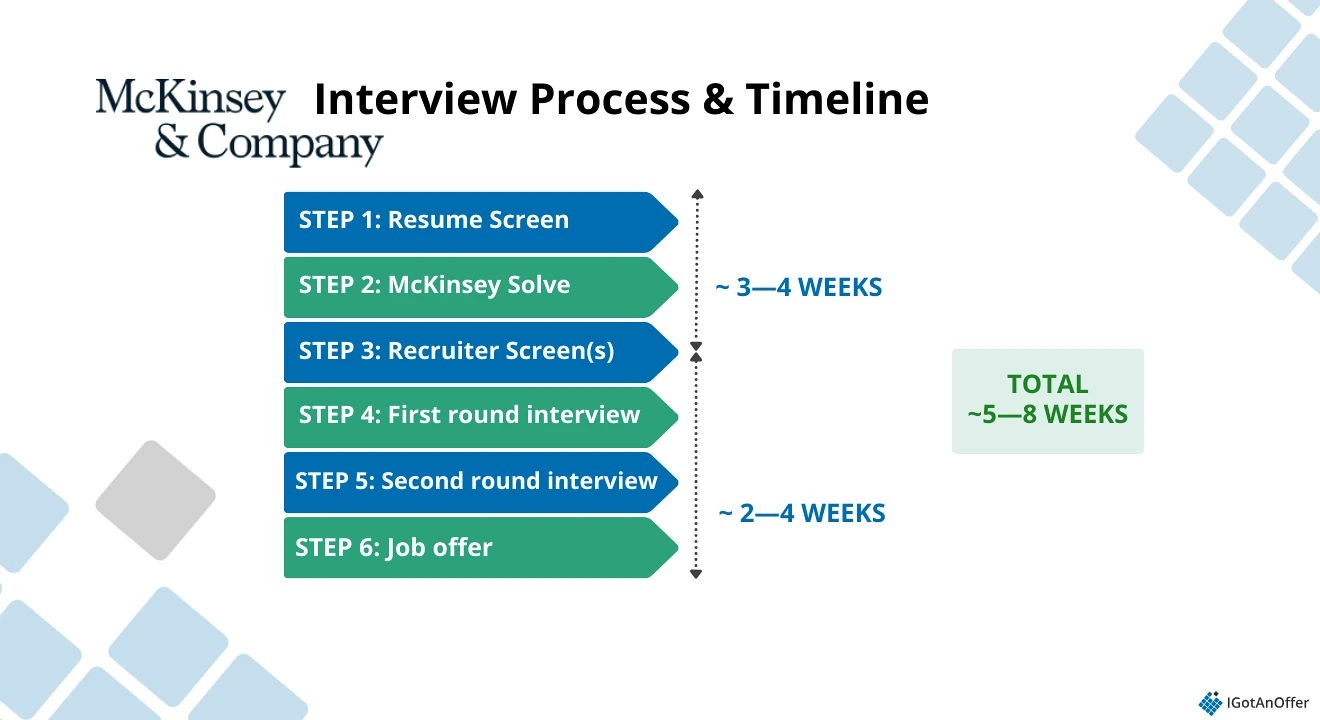
Treat the visual as a process estimate, not a promise. A technical specialist process may add coding, architecture, portfolio, data, or technical-depth assessments. A generalist or digital consultant process commonly emphasizes case interviews and personal-experience interviews.
Build your timing around three clocks
1. Your readiness clock
Most experienced candidates are employed full time. Before applying, leave enough time to prepare deliberately rather than hoping to learn cases only after a recruiter contacts you. The basic preparation requirements differ by route:
| Route | Prepare most heavily for |
|---|---|
| Generalist | Cases, mental math, business fundamentals, fit stories |
| Digital or technology strategy | Cases, technology-business trade-offs, fit stories |
| Technical specialist | Technical interviews, portfolio or architecture examples, clear business communication |
| Implementation | Delivery scenarios, transformation stories, operational and stakeholder judgment |
2. The firm’s hiring clock
Firms may recruit experienced professionals throughout the year, but specific practices and offices have fluctuating demand. Check live postings rather than assuming that a role will recur soon. Networking conversations can help you understand the nature of work and current team needs, but they do not replace applying through the stated process.
3. Your personal transition clock
Consider notice periods, visa or work-authorization needs, financial obligations, and how much interview preparation you can sustain while working. A rushed application can waste a strong opportunity. Conversely, waiting indefinitely to feel “fully ready” can become avoidance. Set an evidence-based threshold: résumé refined, key stories ready, route selected, and a baseline level of interview competence.
BCG’s own experienced-hire discussion is helpful here because it reinforces that candidates without prior consulting internships can prepare successfully, but that case interviews demand real practice.
Transitioning to BCG and consulting as an experienced professional
In “Transitioning to BCG and consulting as an experienced professional,” BCG consultants describe applying as experienced professionals and preparing for a consulting interview format that may be unfamiliar.
Watch application preparation. Focus on two points: the candidate received time to prepare for interviews after applying, and the interview evaluates business judgment and problem solving rather than whether someone attended business school.
Eligibility: separate “qualified” from “competitive”
Applicants often use “eligible” too loosely. There are two distinct questions.
Formal eligibility
These are requirements that can disqualify a candidate before interviews:
- Permission to work in the relevant location, if required.
- Location, travel, or hybrid-work expectations.
- Required degree, certification, clearance, or language capability, where listed.
- Required years or type of experience.
- Specific technical skills, such as cloud platforms, programming languages, architecture, machine learning, data engineering, or cybersecurity.
The current job posting is the authority. Do not infer eligibility from a generic career article, a role title, or another candidate’s experience.
Competitive eligibility
This is the more important question: will the firm believe you can create client value quickly enough?
For experienced software engineers, firms frequently look for evidence in four categories:
| Evidence category | What strong proof looks like |
|---|---|
| Technical depth | Designed, built, scaled, migrated, secured, or improved an important system |
| Business impact | Improved revenue, cost, speed, reliability, customer experience, risk, or productivity with quantified results |
| Leadership and collaboration | Led engineers or influenced product, operations, security, vendors, or senior stakeholders without relying only on formal authority |
| Communication and judgment | Made trade-offs clear, structured ambiguity, and explained complex technical choices to decision makers |
A strong candidate does not need every credential in a posting. But they should be able to explain why their experience is relevant to the role’s main client problems.
For instance, a backend engineer who has only worked on isolated technical tickets may be technically capable but less competitive for a technology-transformation consultant role. The same engineer might be highly competitive for a technical specialist role if they have deep platform expertise. Conversely, an engineering manager who has led a major migration, built a business case, coordinated functions, and tracked results may have credible implementation or technology-strategy options.
A disciplined route-selection method
Before sending applications, create a one-page route comparison. Use actual job descriptions, not imagined versions of roles.
For each target role, record:
- Client problem: What is the firm hiring this person to solve?
- Day-to-day verbs: Is the work primarily analyzing, advising, building, architecting, deploying, mobilizing, or tracking benefits?
- Required evidence: Which requirements can you demonstrate immediately?
- Assessment format: Cases, coding, system design, written case, fit interviews, or a mixture?
- Gaps: What must be developed before applying?
- Timing: Is the role open now, and can you prepare for its process within the likely interview window?
Then rank opportunities using a simple standard:
- Apply first where your existing evidence is strongest.
- Choose roles whose daily work you would still want after the novelty of consulting fades.
- Keep one adjacent route available, rather than applying indiscriminately to every role with “consulting” in the title.
For example, an experienced engineer interested in finance might target a digital or technology-transformation role serving financial institutions. This preserves the credibility of their technical background while building exposure to business models, operating issues, and financial-services clients. A later move toward broader strategy can be possible, but should not be assumed to be automatic.
Key takeaways
Direct entry means moving from industry into consulting without returning first for a full-time degree. For an experienced software engineer, the main routes are:
- Generalist consulting for broad business problem solving, requiring the clearest evidence of commercial judgment beyond technology.
- Digital or technology strategy for technology-enabled business decisions, product strategy, and transformation direction.
- Technical digital specialist roles for engineers who want to retain and apply deep technical expertise in client settings.
- Technology implementation roles for candidates with delivery, migration, adoption, and transformation experience.
Choose among them through role fit, timing, and eligibility. The best initial route is usually the one where your existing experience gives the firm confidence today while still moving you toward the work you want to own in the future.
In the next lesson, you will turn your engineering experience into consulting evidence by mapping one project to the criteria firms assess: problem solving, leadership, teamwork, and measurable impact.