Recommended resources
The freely available resources this lesson will direct you to.
Hello. In the previous lesson, you used the plasma membrane’s lipid bilayer and transport proteins to explain how substances enter and leave a cell. Those are two of the four major classes of biological molecules. This lesson puts them alongside carbohydrates and nucleic acids.
Your goal is to classify each class by its building units and biological roles. For exam questions, the useful habit is to connect all three: a structure or named example, what it is made from, and what it does.
Building units are a starting point, not the whole story
A monomer is a small building unit; a polymer contains many units joined together. Proteins, nucleic acids, and large carbohydrates fit this pattern. Lipids need a qualification: many contain fatty acids and glycerol, but lipids do not all consist of one repeating monomer, and they are not generally polymers.
Watch Biomolecules (Updated 2023) by Amoeba Sisters for a visual overview. As each class appears, listen for its building units and one cellular role.
Biomolecules (Updated 2023) by Amoeba Sisters introduces the four classes through their building units and functions.
Watch building units for the monomer idea; carbohydrates for sugars, storage, and structure; lipids for membranes and energy reserves; proteins for their varied jobs; and nucleic acids for nucleotides and genetic information. Keep in mind the video's qualification that glycerol and fatty acids are common lipid components, not universal lipid monomers.
The diagram below is a useful first map. Read its arrows as building-unit relationships, not as a claim that all four classes are assembled in exactly the same way.
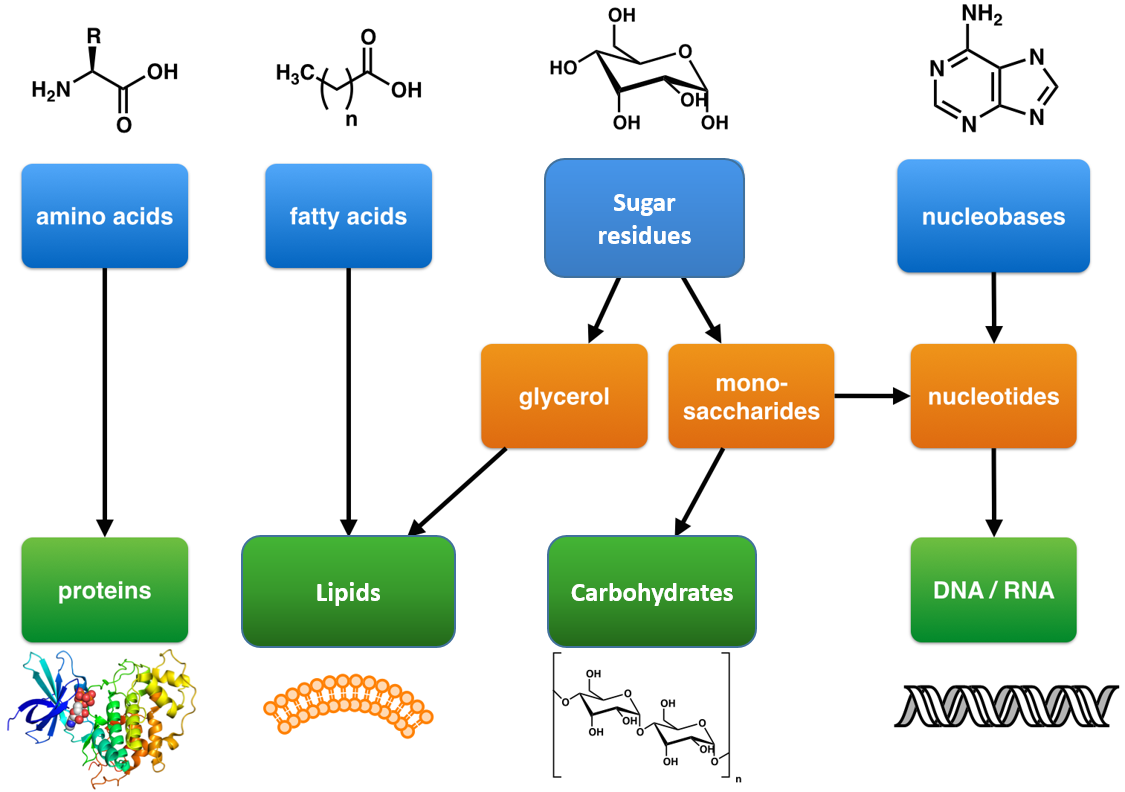
One particularly important correction to the diagram is that a nitrogenous base alone is not a nucleotide. It is only one component of one.
For the terminology likely to appear in your Biology answers, read the indicated parts of NCERT’s Biomolecules chapter. The chapter makes a useful distinction between the four commonly discussed classes and the three classes it describes as true polymeric biomacromolecules.
Read this NCERT chapter, hosted as a PDF, to connect the building-unit overview to textbook examples and wording. The selected passages span approximately pp. 144–149.
Just before Section 9.2 on pp. 144–145, find the paragraph beginning “Lipids are generally water insoluble.” Read the lipid description through the explanation of phospholipids in membranes. In Section 9.3, “Biomacromolecules” (pp. 146–147), begin at “The acid insoluble fraction, has only four types of organic compounds.” Read the distinction through the paragraph explaining why membrane lipids occur in the macromolecular fraction. In Section 9.4, “Proteins” (pp. 147–148), read the protein account through Table 9.5, “Some Proteins and their Functions”; focus on the variety of functions rather than memorising every example. In Section 9.5, “Polysaccharides” (pp. 148–149), read the storage examples beginning with the definition and ending with glycogen. Continue at “Plant cell walls are made of cellulose” through the sentence about chitin in arthropod exoskeletons to find the structural examples. Finally, in Section 9.6, “Nucleic Acids” (p. 149), read the nucleotide account from its three components through the DNA–RNA sugar distinction.
Carbohydrates: sugars used for fuel, storage, and structure
The simplest carbohydrates are monosaccharides, such as glucose. Two joined sugar units form a disaccharide; a long chain of sugar units is a polysaccharide. Thus, when asked for the building units of a carbohydrate polymer, the answer is monosaccharides. Glucose is itself a carbohydrate, but it is not a polymer.
The role depends on which carbohydrate you mean. Glucose is a readily usable fuel for cellular respiration. Starch stores carbohydrate in plants, while glycogen serves as a storage form in animals. Other polysaccharides are primarily structural: cellulose strengthens plant cell walls, and chitin occurs in fungal cell walls and arthropod exoskeletons.
This distinction matters because “carbohydrate” does not mean “quick energy” in every case. Starch and cellulose are both polysaccharides, yet one serves as a reserve and the other as a structural material. In an exam answer, name the particular carbohydrate when explaining its role.
Lipids: membrane materials and energy reserves
Lipids are a varied group that is generally insoluble in water. In many familiar lipids, including fats and oils, the principal components are fatty acids and glycerol. A triglyceride, for example, contains glycerol associated with three fatty acids. Phospholipids also contain fatty-acid portions but have an additional phosphate-containing region; they are major components of cell membranes.
You have already seen why phospholipids matter. Their organisation forms a bilayer with a water-repelling interior, creating the barrier involved in membrane transport. Lipids also serve as long-term energy reserves; some provide insulation, while certain lipids act as chemical messengers.
Do not force the monomer–polymer model onto every lipid. “Fatty acids and glycerol” describes the components of many lipids, not a single repeating unit shared by all lipids. This is why NCERT notes that lipids occur in the macromolecular fraction of its tissue analysis because of their association with insoluble membranes, although lipids are not strictly biomacromolecules in the same sense as polysaccharides, proteins, and nucleic acids.
Proteins: amino-acid chains with varied functions
A protein is built from amino acids joined into one or more polypeptide chains. Different amino acids can occur in different orders, giving proteins different structures and properties. For classification, the dependable building-unit answer is simply amino acids.
Unlike a storage polysaccharide, a protein cannot be assigned one main job across the whole class. Consider four roles:
- Catalysis: enzymes speed up biochemical reactions.
- Structure: collagen contributes to animal tissues.
- Transport: membrane transport proteins help selected substances cross membranes.
- Defence and signalling: antibodies defend against infectious agents; some hormones, including insulin, are proteins.
This brings the previous lesson into sharper focus. The membrane’s phospholipids provide much of its barrier, while particular proteins provide channels or carriers. Both are membrane components, but they belong to different molecule classes and have different characteristic building units.
Enzymes will receive their own lesson. For now, the classification point is that many enzymes are proteins made of amino acids, rather than a fifth major biomolecule class.
Nucleic acids: molecules of genetic information
DNA and RNA are nucleic acids, and their repeating building units are nucleotides. Each nucleotide contains three components: a nitrogenous base, a five-carbon sugar, and a phosphate group. The sugar is deoxyribose in DNA and ribose in RNA.
The central biological role of nucleic acids is to store and convey genetic information. DNA serves as genetic material in cells; RNA has important roles in using that information. Notice the nested classification: a nucleotide contains a sugar, but that does not make DNA a carbohydrate. Classify the whole molecule by its repeating units and role. Likewise, the nitrogenous base is a part of a nucleotide, not an alternative name for one.
Putting the four classes together
| Class | Building units or common components | Representative examples | Biological roles |
|---|---|---|---|
| Carbohydrates | Monosaccharides; polysaccharides are chains of sugar units | Glucose, starch, glycogen, cellulose | Usable fuel, energy storage, structural support |
| Lipids | Fatty acids and glycerol in many types; no universal repeating monomer | Fats, phospholipids | Long-term energy storage, membranes, some signalling |
| Proteins | Amino acids | Collagen, enzymes, antibodies, transport proteins | Structure, catalysis, defence, transport, signalling |
| Nucleic acids | Nucleotides, each containing base, sugar, and phosphate | DNA, RNA | Genetic information storage and use |
For an exam response, avoid an isolated label when the question asks for a role. “Cellulose is a carbohydrate” is classification; “cellulose is a polysaccharide built from sugar units and provides structural support in plant cell walls” connects class, building units, and function.
Key takeaways
The four classes can be distinguished by both what they are built from and what they do. Carbohydrate polymers contain sugar units; proteins contain amino acids; nucleic acids contain nucleotides. Many lipids contain fatty acids and glycerol, but lipids do not share a universal monomer. Their roles also differ: carbohydrates often supply fuel or structure, lipids form membranes and energy reserves, proteins perform diverse cellular tasks, and nucleic acids carry genetic information.
The next lesson will examine the bonds that link these building units. Keep the units clear first: the correct linkage depends on which molecules are being joined.