Recommended resources
The freely available resources this lesson will direct you to.
Hello. In the previous lesson, you saw that the plasma membrane separates the cell from its surroundings without sealing it off. Now the question is more precise: given a substance, its concentration on each side, and the membrane structures available, which way will it move—and will the cell need to supply energy?
This lesson builds a method for answering that question in exam diagrams and short-answer problems. You will compare simple diffusion, facilitated diffusion, osmosis, and ATP-driven transport, then use those distinctions to predict movement rather than merely name a process.
The membrane presents both a barrier and a route
A plasma membrane is a phospholipid bilayer. Its water-attracting heads face the watery environments inside and outside the cell, while its water-repelling tails form a nonpolar interior. Small, nonpolar molecules such as oxygen and carbon dioxide can cross that interior relatively easily. Charged ions and many polar molecules cannot readily pass through it unaided; particular membrane proteins provide routes for them.
For a first prediction, compare concentrations on the two sides. A concentration gradient is a difference in concentration. The net movement of a substance down its gradient is from higher to lower concentration. Individual particles still move in both directions, but more cross in the high-to-low direction until the difference diminishes. Moving a substance from lower to higher concentration is movement against its gradient.
Read NCERT’s account now, focusing on how membrane structure explains the transport terms you will use throughout the lesson.
Read Section 8.5.1, “Cell Membrane,” for the textbook distinction between passive and active transport. It supplies useful wording for exam answers.
In Section 8.5.1, near Figure 8.4, begin with the bilayer description and note which parts face the surrounding water. Then, in the paragraph following the discussion of the fluid mosaic model (on p. 94), read the transport passage, continuing to the sodium–potassium pump example at the paragraph’s end. Track what NCERT says about direction, proteins, and energy.
Selective permeability does not mean that a substance can cross only in one direction. It means that which substances can cross, and by what route, depends on properties such as size and polarity and on the proteins present in the membrane.
Passive transport: following a gradient
Passive transport requires no cellular energy expenditure to drive the movement. It includes more than one route across the membrane.
In simple diffusion, a substance passes directly through the lipid bilayer, down its concentration gradient. If oxygen concentration is higher outside a cell than inside it, the net movement of oxygen is inward. If carbon dioxide concentration is higher inside, its net movement is outward. In both cases, the direction follows the stated gradient; neither gas has an inherently “inward” or “outward” direction.
In facilitated diffusion, a membrane protein helps a substance cross, but the net movement is still down its gradient. A channel provides a passage for suitable substances, whereas a carrier binds a substance and changes shape to transfer it. For example, if glucose is more concentrated outside a cell, an appropriate glucose carrier can move it inward without directly using ATP. That carrier cannot, by facilitated diffusion alone, keep moving glucose inward when its concentration is higher inside.
Watch the selected explanation in Cell Transport by Amoeba Sisters. Concentrate on the distinction between needing a protein and needing energy: they are not the same thing.
In “Cell Transport,” Amoeba Sisters animate the routes taken by substances that can pass through the bilayer and those that need transport proteins.
Watch simple diffusion for the direction of gas movement, then facilitated diffusion for the roles of channels and carriers. In each case, check whether the substance moves down its gradient and whether ATP is required.
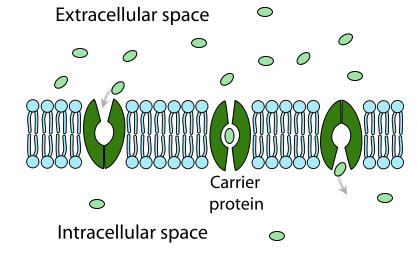
The key exam distinction is this: “uses a transport protein” does not automatically mean “active transport.” Direction relative to the gradient and energy use decide the classification.
Osmosis: predict water by comparing the two solutions
Water also crosses selectively permeable membranes. The net movement of water across such a membrane is osmosis. Water may pass through the bilayer, and water-channel proteins called aquaporins can provide a faster route. Either way, osmosis is passive.
To predict its direction, compare the solutions on each side assuming the solute in the question cannot cross the membrane. Water moves net from the side with lower solute concentration (more available water) to the side with higher solute concentration (less available water). Notice that this wording describes water’s movement; it does not mean the solute itself travels in that direction.
Suppose an animal cell is placed in a solution with a higher concentration of non-penetrating solute than its cytoplasm. The surrounding solution is hypertonic relative to the cell. Water moves out, and the cell shrinks. If the surrounding solution has a lower concentration of such solute, it is hypotonic: water moves in, and the animal cell swells. In an isotonic solution, water still crosses both ways, but there is no net movement.
The membrane remains the selectively permeable boundary in a plant cell too. Water entering a plant cell helps make it turgid; its cell wall resists excessive expansion. Water leaving reduces that firmness. Thus the same water gradient can produce a different visible result in plant and animal cells because their supporting structures differ.
When an exam question gives amounts of solute, check whether it also gives the volumes of the solutions. Concentration—not the total number of solute particles by itself—is what you need to compare. Also check whether the solute is described as able to cross: the usual tonicity prediction assumes it cannot.
Active transport: maintaining a difference
Sometimes a cell needs to move a substance against its concentration gradient, from a lower concentration to a higher one. That requires an energy source and a suitable transport protein. In the NCERT example of active transport, a pump uses energy from ATP.
The sodium–potassium pump is a particularly useful example because it prevents a common mistake: assuming that any movement of an ion must be passive. Sodium ions are generally more concentrated outside the cell, yet the pump moves three sodium ions out. Potassium ions are generally more concentrated inside, yet it moves two potassium ions in. Both movements oppose their respective concentration gradients, and the pump uses ATP to accomplish them.
Return to Cell Transport for its short transition from passive to active movement.
This part of “Cell Transport” introduces why a cell must provide energy when transport is against a gradient.
Watch active transport. Focus on the required direction of movement and ATP’s role, rather than trying to infer a mechanism from the presence of a protein alone.
Follow panels A through F in the pump image: sodium binds on the inside, ATP supplies energy as the protein changes shape, sodium is released outside, potassium binds outside, and another shape change releases potassium inside. The plus and minus signs beside the concentration bars indicate relatively high and low concentrations; they are not labels for the ions’ electrical charges. Sodium and potassium ions are both positively charged.
Not all energy-dependent movement requires ATP to be used directly by the transporting protein. For this lesson’s predictions, the essential contrast is that passive movement follows a favourable gradient without cellular energy expenditure, while active movement uses energy to achieve transport that would not occur by passive diffusion alone. Very large materials may instead enter or leave in membrane-bound vesicles; they are not carried across the bilayer by simple diffusion or a small-molecule pump.
A reliable way to read transport questions
When faced with a membrane diagram, do not begin by guessing a named process. Work through four questions in order:
- What is moving? For osmosis, follow water, not the dissolved solute.
- Which side has the higher concentration of that substance? For a basic concentration-gradient question, this establishes its passive net direction.
- Can it pass directly through the bilayer, or is a suitable protein needed? Small nonpolar gases often cross directly; ions and glucose generally need transport proteins.
- Is the proposed movement down or against the gradient? Down the gradient without ATP is passive; against it requires active transport and an energy source.
These distinctions give concise answers to common exam scenarios:
| Given situation | Predicted net movement | Classification |
|---|---|---|
| Oxygen is more concentrated outside than inside | Oxygen enters directly through the bilayer | Simple diffusion; passive |
| Glucose is more concentrated outside, and a suitable carrier is present | Glucose enters through the carrier | Facilitated diffusion; passive |
| The surrounding solution has more non-penetrating solute than the cytoplasm | Water leaves the cell | Osmosis; passive |
| A pump moves sodium from its lower concentration inside to its higher concentration outside using ATP | Sodium leaves through the pump | Active transport |
For ions, real cell membranes also have electrical differences that influence movement. When a basic exam problem specifies only concentrations, use the stated concentration gradient; if it supplies an electrical condition as well, do not assume concentration alone tells the whole story. Above all, do not predict that a substance will cross merely because a gradient exists: the membrane must provide a route for it.
Key takeaways
To predict movement across a plasma membrane, identify the substance, compare its concentration on each side, check its route, and decide whether movement follows or opposes its gradient. Simple diffusion and facilitated diffusion are passive; the latter uses a protein but no ATP to drive movement. Osmosis is passive water movement across a selectively permeable membrane. ATP-driven pumps, such as the sodium–potassium pump, can maintain concentration differences by moving substances against their gradients.
In the next lesson, you will turn to carbohydrates, lipids, proteins, and nucleic acids. The membrane you have just studied provides a first example of why their structures matter: its lipid bilayer creates the barrier, while its proteins give the cell selective ways to cross it.