Recommended resources
The freely available resources this lesson will direct you to.
Introduction
Hello! In our last lesson, we focused on interleaving—the practice of mixing different but related topics within a study session. We established that its power lies in training your brain to discriminate between concepts, helping you learn when to apply a specific skill.
Today, we'll drill down into a related but distinct idea: variation within a single topic. Our goal is to learn how to use varied examples and contexts during practice to improve concept generalization. This means taking a principle you've learned and becoming adept at applying it across a wide range of situations, not just the one you first learned it in.
For you as a UX designer, this is a crucial skill. It's the ability to take a design principle learned from an e-commerce project and apply it correctly to a healthcare app, a productivity tool, or an educational platform. This lesson directly addresses your goal of improving the practical application of your knowledge.
Let's start with a simple visual.
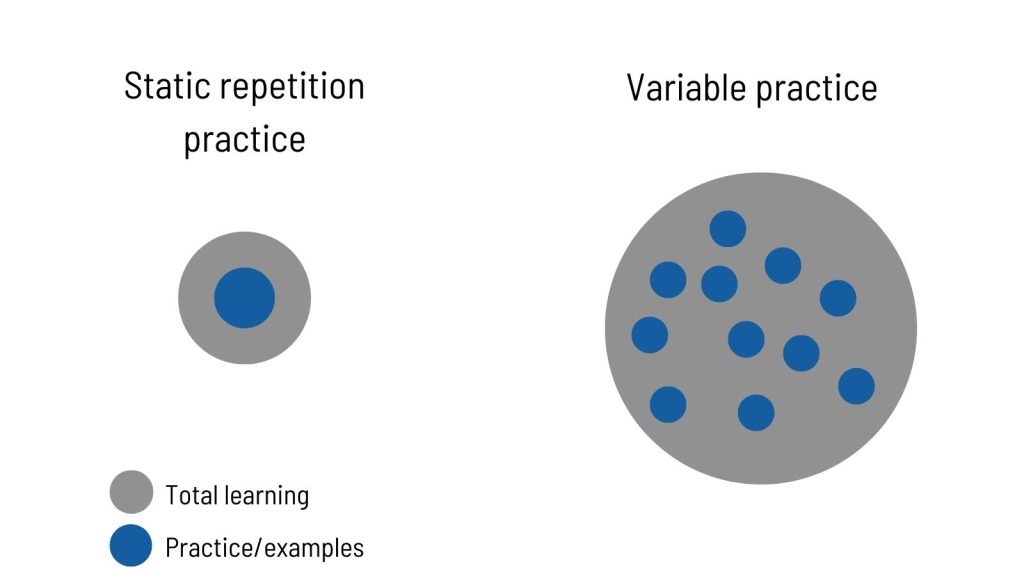
From Brittle to Robust: The "Why" of Variation
Learning a new concept from a single, clear example feels efficient. You grasp it quickly, and performance on similar problems is high. However, this knowledge is often "brittle"—it breaks when the context changes. Introducing variability during practice—even though it can feel slower and more difficult initially—forges more robust and flexible knowledge.
The core mechanism behind this is about turning difficult guesswork into confident pattern-matching.
- When you learn from a narrow set of examples, you have to extrapolate when you face a new, different problem. You're making a guess based on the limited data you have.
- When you learn from a wide, varied set of examples, a new problem is more likely to fall within the range of what you've already seen. You can interpolate, confidently applying a pattern you already understand.
A key theory that underpins this is called Variation Theory. Its central idea is that we learn by discerning what is different and what stays the same across multiple examples. This process is essential for what's known as "transfer"—applying knowledge to new situations.
Learning through the Variation Theory: A Case Study
The academic paper 'Learning through the Variation Theory' discusses how this applies to the transfer of learning. It distinguishes between applying knowledge to similar situations ('near transfer') and adapting it to different ones ('far transfer').
Please read the short subsection titled 'Transfer of Learning'. It begins after the main discussion on Variation Theory. Focus on the distinction between 'near transfer' and 'far transfer', and the conclusion it draws about presenting learners with more situations.
As the paper notes, varied practice is what enables far transfer. By seeing a concept in many forms, you learn to separate its core essence from the superficial details of any single example.
The "What" of Variation: A Framework for Practice
"Variability" is a broad term. To make it more actionable, we can break it down into different types. Understanding these types will help you be more intentional when designing your practice sessions.
How variability shapes learning and generalization
The review paper 'How variability shapes learning and generalization' provides an excellent framework by identifying four distinct kinds of variability. We will focus on the first three.
Please read the section titled 'Four kinds of variability'. Pay close attention to the definitions and examples for: Numerosity (set size) Heterogeneity (differences between examples) Situational (contextual) diversity (The fourth, Scheduling, relates to our previous lessons on spacing and interleaving).
Let's summarize these with examples relevant to your UX work:
-
Numerosity (More Examples): Instead of learning about the "accordion" UI pattern from one article, you review five different examples of accordions. This is the simplest form of variation.
-
Heterogeneity (More Different Examples): This is often more powerful than just numerosity. Instead of looking at five accordions on e-commerce FAQ pages (low heterogeneity), you look at one on an FAQ page, one in a design system's component library, one in a complex settings menu on an OS, and one used for navigation on a mobile site (high heterogeneity). The number of examples is the same, but their diversity is much greater.
-
Situational/Contextual Diversity (Different Environments): You practice your user interview skills. In a low-variability scenario, you always use a quiet meeting room. In a high-variability scenario, you conduct interviews in the office, over a video call with a bad connection, and in a coffee shop. You learn to adapt your technique to the environment itself.
While more examples (numerosity) are good, the key takeaway is that the diversity of those examples (heterogeneity) is often what drives generalization the most.
Test your understanding!
You are learning about the UX principle of "progressive disclosure." Which of the following practice activities primarily leverages heterogeneity?
A. Reading three different blog posts that all explain the definition of progressive disclosure.
B. Finding ten examples of progressive disclosure used in mobile app onboarding flows.
C. Analyzing how progressive disclosure is used in a complex software (like Figma), a video game tutorial, and a government tax form.
Show answer
C is the best answer. While B uses numerosity (many examples), its context is narrow (onboarding flows). C uses fewer examples but they come from highly diverse contexts (pro software, gaming, bureaucracy), forcing you to generalize the core principle across very different use cases. This is a classic example of using heterogeneity.
The "How" of Variation: Designing a Varied Practice Session
Let's put this into practice using a model from the Variation Theory paper you looked at earlier. In their case study, they improved student learning by using varied contexts in a structured way.
Learning through the Variation Theory: A Case Study
The case study in 'Learning through the Variation Theory' provides a fantastic blueprint for applying this principle. Students were asked to apply the same abstract concepts within different, concrete organizational contexts.
Skim through the following sections to understand the structure of the exercise: The Pedagogical Setting: Note how students were divided into groups, each assigned a different context (bank, supermarket, university). Teaching the Two Theories Separately Using Examples: See how students were prompted to generate their own examples within their assigned context. Illustrating the Difference... & Table 1: Observe how examples from the different contexts were compared to highlight the core principles. Conclusions: Read the first paragraph of the conclusion to see how this process improved students' ability to generalize.
The key insight from this study is the two-step process:
- Generate examples within a specific context.
- Compare examples across different contexts.
Let's translate this into a concrete exercise for you.
Your Turn: A Varied Practice Exercise on "Feedback"
Goal: Deepen your understanding of the UX principle of "System Feedback" (one of Nielsen's 10 Usability Heuristics).
Step 1: Choose Your Contexts
Select 3-4 different digital environments. For instance:
- A mobile banking application.
- A collaborative design tool (like Figma or Miro).
- A smart TV interface (like Netflix or Disney+).
- An e-commerce checkout process.
Step 2: Generate Examples Within Each Context
For each context, find or describe at least two examples of system feedback: one good, one bad (or missing).
- Mobile Banking App:
- Good: After a fund transfer, an animated checkmark and a confirmation message "Transfer Successful" appears immediately.
- Bad: Tapping "Pay Bill" grays out the button for 5 seconds with no spinner or loading message, leaving you wondering if it worked.
- Design Tool (Figma):
- Good: When you save a file, a small toast notification appears saying "Saved to cloud."
- Bad: You apply a complex filter to an image, and the whole interface freezes for a few seconds with no progress bar.
- Smart TV Interface:
- ... (your turn to find examples)
- E-commerce Checkout:
- ... (your turn to find examples)
Step 3: Compare and Synthesize
Now, look at all your examples together. Answer these questions:
- What is the invariant core of "good feedback" across all contexts? (e.g., It's immediate, clear, and tells the user the current state).
- How do the specifics of the implementation vary? (e.g., On a TV, feedback needs to be visually large and simple due to viewing distance. In a pro tool, feedback can be more subtle to avoid disrupting workflow. On mobile, it might include haptics).
By doing this, you're not just memorizing the definition of "feedback." You are building a rich, flexible mental model of how the principle operates in the real world.
When Is Variation Most Helpful?
It's important to note that high variability isn't always the best approach, especially for complete beginners.
How variability shapes learning and generalization
The paper 'How variability shapes learning' also discusses when variation is most effective. It highlights that the learner's experience level matters.
Please read the first two paragraphs of the section 'When is variability most helpful?'. Focus on the finding that high variability can overwhelm novices, who may benefit from low variability at the very beginning of learning.
If a concept is brand new and complex, starting with a few similar examples (low variability) can help you get your bearings. Once you have a basic grasp, you should quickly introduce more varied examples to build that robust, generalizable understanding.
Conclusion
Today we've added a powerful tool to your learning toolkit. By moving beyond static repetition and embracing varied practice, you actively train yourself to build flexible, transferable knowledge—a hallmark of true expertise.
Key Takeaways:
- Generalization is a skill: To apply knowledge in new situations ("far transfer"), you need to practice with varied examples and contexts.
- From extrapolation to interpolation: Varied practice expands your mental database of examples, making it more likely that new problems will resemble something you've already seen.
- Leverage heterogeneity: When practicing, focus not just on the number of examples, but on their diversity. Choose examples from different domains and contexts.
- Use the "Generate & Compare" method: For any new principle, practice by finding examples within several distinct contexts and then comparing them to understand the core idea versus its specific application.
What's Next?
We've seen that both interleaving and variation can feel more difficult than simple, blocked practice. This raises a crucial question: when, if ever, is that simpler "blocked" practice the right choice? In our next lesson, we will distinguish between situations where blocked practice is appropriate versus interleaved practice, helping you develop the metacognitive skill of choosing the right learning strategy for the right task.