Recommended resources
The freely available resources this lesson will direct you to.
Introduction
Hello again! In our last few lessons, we've explored powerful but challenging learning strategies like interleaving and variation. We've seen how mixing related topics and using diverse examples forces your brain to work harder, leading to more robust, flexible knowledge. This is a core part of what are known as 'desirable difficulties'.
However, these advanced techniques aren't always the best starting point. Just as in design, where you choose a tool based on the specific task, effective learning requires choosing the right practice method for your current stage of understanding.
Today, our goal is to distinguish between situations where blocked practice is appropriate versus interleaved practice. We will move from simply knowing what these techniques are to knowing when and why to use each one. Mastering this will give you a crucial metacognitive skill to "debug" your own learning, ensuring you're not making things unnecessarily difficult or deceptively easy.
Blocked vs. Interleaved Practice: A Quick Refresher
Let's start by visually cementing the difference between these two approaches.
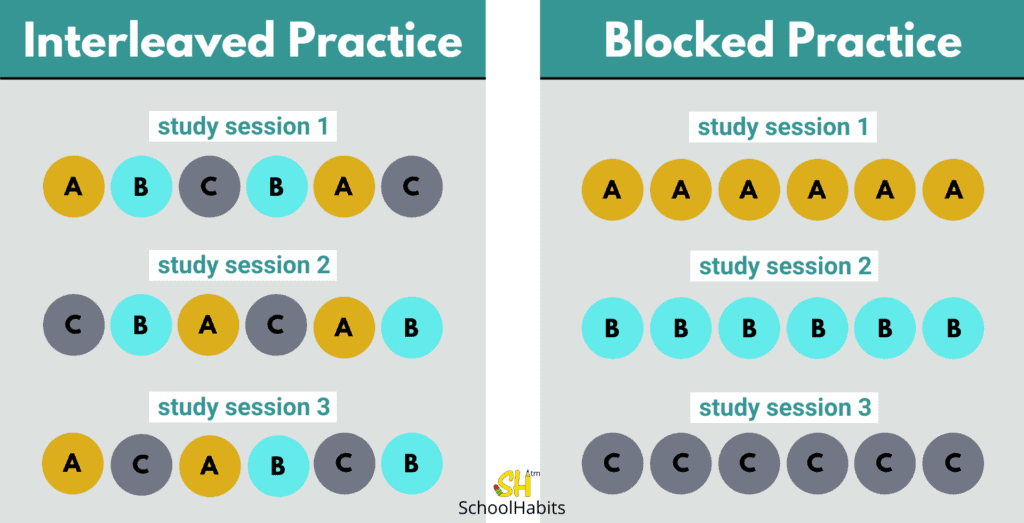
In blocked practice, you know what kind of problem you're solving before you even start. In interleaved practice, the first step is to figure out what kind of problem you're facing. This distinction is at the heart of why they serve different purposes.
To hear this explained with a few analogies, watch the first part of this video.
Secrets of Interleaved Practice | How Learning Works
Benjamin Keep's video 'Secrets of Interleaved Practice' offers a concise definition of both blocked and interleaved practice using an algebra example.
Watch the segment from 00:14 to 01:33. Focus on how he visually and conceptually defines the two practice styles.
Now, let's break down when to use each method.
The Case for Blocked Practice: Building the Foundation
While our previous lessons have championed interleaving, its simpler counterpart, blocked practice (also called targeted training), is essential. It's most effective when you are at the very beginning of learning something new.
Interleaving vs. Targeted training: What's more effective for learning?
The article 'Interleaving vs. Targeted training' from eFront Learning provides a clear breakdown of the benefits and ideal scenarios for blocked practice.
Please read the sections 'The case for targeted training' and 'When to use targeted training'. Pay attention to the scenarios where this focused approach is most beneficial.
Based on that reading and other research, here are the key situations where you should use blocked practice:
- Initial Skill Acquisition: When a concept or skill is brand new, you need to build a basic understanding without the cognitive load of switching between different problem types. For example, if you're learning to code and have never seen a
forloop, you should practice writing severalforloops in a row before mixing them withwhileloops orif-elsestatements. - Building Confidence: The initial stages of learning can be intimidating. Blocked practice allows for repeated success in a focused area, which boosts confidence and motivation. This can be especially important when tackling a subject that feels difficult, helping you overcome the initial friction to get started.
- Mastering Fundamentals: Some skills are foundational building blocks. For instance, in UX design, you must first master the mechanics of creating a wireframe in Figma before you can effectively interleave practice between wireframing, prototyping, and user flow diagramming. Blocked practice helps automate these fundamental mechanics.
- Targeting a Specific Weakness: If you've identified a very precise gap in your knowledge (e.g., "I'm not good at writing alternative text for complex images"), it's efficient to use blocked practice to drill that one skill until you're proficient.
Blocked practice helps you learn the how of a single skill. But once you know how, you need to learn when. That's where interleaving comes in.
The Case for Interleaved Practice: Building Connections and Judgment
Once you have a basic grasp of several related concepts, it's time to switch to interleaved practice. Interleaving is what builds durable, flexible knowledge that you can apply in the real world.
The real challenge in any complex field, including UX design, isn't just executing a known procedure but first identifying which procedure to use.
The Benefits of Interleaved Practice, Dr. Doug Rohrer
In this video, Dr. Doug Rohrer explains that the primary benefit of interleaving is that it forces you to practice choosing the correct strategy, not just executing it.
Watch the segment from 01:22 to 03:32. Notice his emphasis on the difference between 'choosing the strategy' and 'executing the strategy.'
This is the core purpose of interleaving. Here are the situations where you should use interleaved practice:
- Developing Discrimination Skills: When you're learning concepts that can be easily confused, interleaving is crucial. For you, this could be distinguishing between when to create a User Journey Map, an Experience Map, or a Service Blueprint. Practicing them in an interleaved fashion forces you to focus on their distinct features and use cases.
- Long-Term Retention: As we've discussed, interleaving is a form of spaced practice. By cycling through topics, you are forced to retrieve information you haven't seen for a little while, which strengthens the memory trace far more than repeated, immediate review.
- Simulating Real-World Challenges: Your work doesn't present problems in neat, pre-sorted blocks. A project might require you to think about information architecture, accessibility, and interaction design all at once. Interleaved practice prepares you for this messy reality by training you to pull the right tool from your mental toolkit at the right time.
- Improving Transfer: The ability to take what you've learned and apply it to a new problem is the ultimate goal. Interleaving promotes this "transfer" by forcing you to generalize principles rather than memorizing solutions to specific problem types.
Test your understanding!
You are learning three new Figma plugins: one for creating data tables, one for managing accessibility contrast ratios, and one for generating placeholder content. Which of the following describes the best learning sequence?
A. Spend three hours mixing tasks: create a table, check its contrast, add content, create another table, etc.
B. Spend one hour learning the table plugin, the next hour learning the accessibility plugin, and the third hour learning the content plugin.
C. Spend about 30-45 minutes on each plugin separately (blocked practice) to learn its basic functions. Then, start a practice project where you have to use all three plugins together as needed (interleaved practice).
Show answer
C is the best answer. It correctly sequences the two types of practice. You start with blocked practice (B) to get a handle on each new tool individually, avoiding overwhelm. Then you transition to interleaved practice (closer to A, but after the initial learning) to learn how to use them together in a realistic context. Option A is pure interleaving from the start, which would be very difficult for brand new tools. Option B is pure blocked practice, which won't help you learn how to integrate the skills.
The Novice-to-Expert Transition: A Simple Heuristic
So, how do you put this all together? The most effective path generally follows a "Blocked-to-Interleaved" sequence.
| Aspect | Blocked Practice | Interleaved Practice |
|---|---|---|
| Structure | Practice one skill repeatedly (AAABBBCCC) | Mix different skills in one session (ABCABCABC) |
| Best For | Initial skill acquisition, complete beginners | Consolidation, application, exam preparation |
| Cognitive Load | Lower during practice | Higher (desirable difficulty) |
| Student Perception | Often preferred (feels more productive) | Often resisted initially (feels harder) |
| Long-Term Goal | Building foundational competence | Building discrimination and transfer |
This table, adapted from the 'Interleaving: A Teacher's Guide' (Resource ID LINK), summarizes the key differences and ideal uses.
Think of it as a two-phase process:
- Phase 1: Build the Bricks (Blocked Practice). When you encounter new, related concepts (e.g., three different UX research methods), learn each one in isolation first. Your goal is to understand the basic "what, why, and how" of each individual concept.
- Phase 2: Build the Wall (Interleaved Practice). Once you have a basic familiarity with each concept, create practice sessions that mix them together. Give yourself a problem and force yourself to first identify which concept is the right tool, and then apply it.
A Critical Warning: Interleaving is NOT Multitasking
It's vital to understand what interleaving is not. It is not rapidly switching between unrelated tasks.
Secrets of Interleaved Practice | How Learning Works
Let's return to the 'Secrets of Interleaved Practice' video for a crucial clarification. The author clearly distinguishes effective interleaving from ineffective task-switching.
Watch the final segment from 06:59 to 08:39. Pay close attention to the distinction made between interleaving related concepts and task-switching between different subjects.
- Interleaving (Good): Mixing practice of related skills within the same domain.
- Example: A practice session mixing problems on user journey maps, service blueprints, and experience maps.
- Task-Switching (Bad): Switching between unrelated subjects.
- Example: Studying UX heuristics for 15 minutes, then switching to a coding tutorial for 15 minutes, then back to UX.
Task-switching incurs a "cognitive cost" every time you switch, hindering deep focus and learning. Interleaving works because the concepts are related, forcing your brain to make connections and draw distinctions within a domain.
Conclusion
You now have a framework for choosing the right type of practice for the right time. This strategic decision-making is a cornerstone of effective, self-directed learning. By knowing when to focus narrowly with blocked practice and when to broaden your scope with interleaved practice, you can tailor your efforts for maximum efficiency and long-term retention.
Key Takeaways:
- Blocked practice is for beginners. Use it when you're learning a new concept from scratch to build foundational knowledge and confidence.
- Interleaved practice is for consolidation. Use it after you have a basic grasp of several related concepts to build discrimination skills, improve long-term retention, and simulate real-world problem-solving.
- Follow the "Blocked-to-Interleaved" path. Start with focused practice on individual components, then move to mixed practice to learn how they fit together.
- Interleaving is not multitasking. Effective interleaving involves mixing related concepts, not switching between entirely different domains.
What's Next?
In our next lesson, we'll put this all into action. You've learned about interleaving, variation, and when to use blocked versus mixed practice. Now it's time to combine these ideas. The next lesson will guide you to design a practice session that mixes different types of problems or concepts, giving you a concrete template for your own learning projects.