Recommended resources
The freely available resources this lesson will direct you to.
- Impact of Exchange Rate Appreciations and Depreciations with Evaluationwww.youtube.com
- Macro 6.5 - Changes in the Foreign Exchange Market and Net Exportswww.youtube.com
- How Do Exchange Rates Impact Net Exports?www.reviewecon.com
- 5.14 Monetary policy and the exchange rate - The Economy 2.0books.core-econ.org
Introduction
Welcome to our new lesson! In our last session, we built the supply and demand model for the foreign exchange market. You learned that in a floating exchange rate system, the value of a currency is a price determined by the constant interplay of global demand and supply. We identified the key factors that cause a currency to appreciate (strengthen) or depreciate (weaken), such as changes in relative interest rates, inflation, and income.
Today, we will address the logical follow-up question: "So what?" What are the economic consequences of these currency fluctuations? Your learning outcome for this lesson is to describe the effects of currency appreciation and depreciation on net exports.
Since net exports () are a key component of a country's Aggregate Demand (), you will see that changes in the exchange rate can have significant ripple effects on a nation's output, employment, and price level.
1. The Core Relationship: Exchange Rates and Trade
The link between exchange rates and net exports works through relative prices. A change in the exchange rate alters the price of domestic goods for foreigners and the price of foreign goods for domestic residents.
Let's break this down for both scenarios.
Currency Appreciation
When a country's currency appreciates, it becomes "stronger." This means one unit of the home currency can buy more units of a foreign currency.
Let's say the US Dollar (USD) appreciates against the Mexican Peso (MXN).
- Effect on Imports: For an American consumer, a product from Mexico priced at 200 pesos becomes cheaper in dollar terms. Imports from Mexico become more attractive.
- Effect on Exports: For a Mexican consumer, a product from the US priced at $10 becomes more expensive in peso terms. Exports from the US become less attractive.
The result is straightforward:
- Exports decrease ().
- Imports increase ().
- Since Net Exports = Exports - Imports (), net exports will decrease.
Currency Depreciation
When a country's currency depreciates, it becomes "weaker." This means one unit of the home currency can buy fewer units of a foreign currency.
Now, let's say the US Dollar depreciates against the Mexican Peso.
- Effect on Imports: For an American consumer, that same 200-peso product from Mexico now costs more in dollar terms. Imports become less attractive.
- Effect on Exports: For a Mexican consumer, the $10 US product now costs fewer pesos. US exports become more attractive.
The result is the opposite:
- Exports increase ().
- Imports decrease ().
- Therefore, net exports will increase.
The following video provides a very clear, numerical example that walks through this exact logic.
Macro 6.5 - Changes in the Foreign Exchange Market and Net Exports
This video from ReviewEcon uses a simple example of US and Mexican sodas to demonstrate precisely how appreciation and depreciation affect the prices of imports and exports, and consequently, net exports.
Watch the entire video (from 00:25 to 04:04). The first part covers appreciation, and the second part covers depreciation. Notice how the change in the exchange rate directly impacts the cost of the sodas for the foreign consumer and the domestic consumer.
2. Visualizing the Impact and Adding Nuance
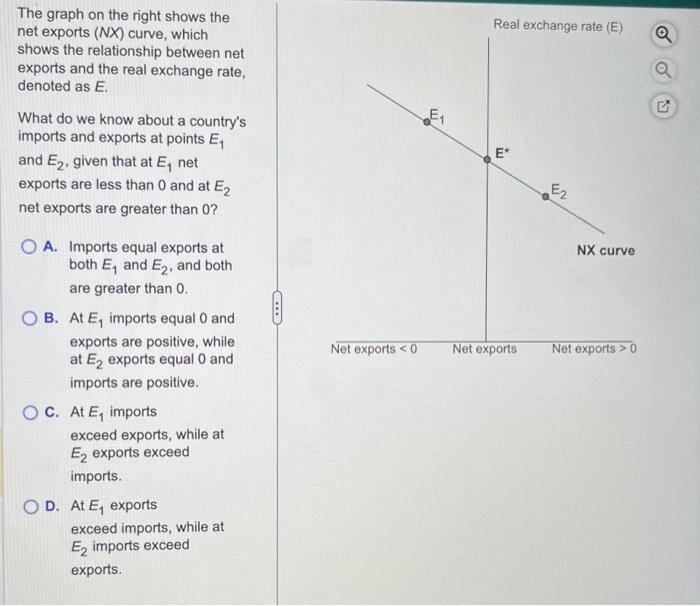
We can summarize the relationship you just saw in a graph called the Net Exports (NX) Curve. This curve shows the inverse relationship between the real exchange rate and the quantity of net exports.
A useful mnemonic to remember the core effect on trade is:
- SPICED: Strong Pound, Imports Cheap, Exports Dear. (Appreciation)
- WPIDEC: Weak Pound, Imports Dear, Exports Cheap. (Depreciation)
While the primary effect of an exchange rate change is on net exports (shifting Aggregate Demand), there can also be a secondary effect on the Short-Run Aggregate Supply (SRAS) curve. This happens because many firms use imported raw materials and components in their production processes.
- Appreciation: A stronger currency makes imported inputs cheaper. This lowers production costs for firms, shifting the SRAS curve to the right.
- Depreciation: A weaker currency makes imported inputs more expensive. This raises production costs, shifting the SRAS curve to the left.
The next video explains both the AD and SRAS effects.
Impact of Exchange Rate Appreciations and Depreciations with Evaluation
The channel EconplusDal provides a concise summary using the SPICED/WPIDEC mnemonics and also introduces the important secondary effect on a firm's costs of production.
Watch from the beginning to 04:53. The first part (up to 02:46) covers appreciation, and the second part covers depreciation. Pay attention to how the analysis includes shifts in both the AD curve (via net exports) and the SRAS curve (via input costs).
3. Deeper Analysis: Elasticity and Timing
The real world is a bit more complex than our simple model suggests. The degree to which net exports change depends on how responsive consumers and firms are to the changes in prices. This brings us back to a concept from Module 2: price elasticity of demand (PED).
The Marshall-Lerner Condition
For a currency depreciation to successfully increase net exports, the demand for both exports and imports must be sufficiently elastic. The Marshall-Lerner condition states that a depreciation will improve the current account balance only if the sum of the absolute values of the price elasticities of demand for exports and imports is greater than 1.
Intuition: If demand for a country's exports is very inelastic, making them cheaper (through depreciation) won't cause a large increase in the quantity sold. The fall in price might be larger than the rise in quantity, causing total export revenue to fall, working against the desired effect.
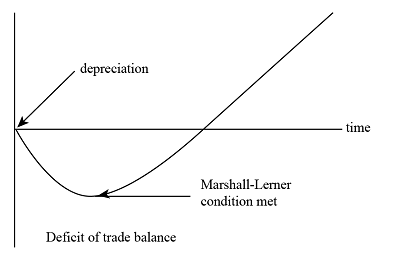
The J-Curve Effect
This elasticity issue often plays out over time. In the short run, demand for imports and exports tends to be inelastic. Contracts are in place, and it takes time for consumers and firms to find new suppliers and change their purchasing habits.
This leads to the J-Curve effect:
- Immediately following a currency depreciation, the trade balance may worsen. The price of imports rises instantly, but the quantity of imports purchased doesn't fall much, leading to a higher total import bill.
- Over time, as consumers and firms adjust to the new relative prices (i.e., as demand becomes more elastic), the quantity of exports rises and the quantity of imports falls.
- The trade balance then improves, tracing the shape of the letter 'J'.
This final video clip summarizes these important evaluative points.
Impact of Exchange Rate Appreciations and Depreciations with Evaluation
Let's return to the EconplusDal video to hear a summary of these important caveats that determine the ultimate impact of an exchange rate change.
Watch the final part of the video, from 04:53 to the end. Note the key factors mentioned: the size of the exchange rate change and the price elasticity of demand for exports and imports (the Marshall-Lerner condition).
Conclusion
Today we have established a critical link in open-economy macroeconomics. You've learned that exchange rate movements are not just numbers on a screen; they have tangible effects on a country's international trade by altering the relative prices of its goods and services on the world stage.
Key Takeaways:
- A currency appreciation makes a country's exports more expensive and its imports cheaper, causing net exports to decrease.
- A currency depreciation makes a country's exports cheaper and its imports more expensive, causing net exports to increase.
- This inverse relationship can be represented by the downward-sloping Net Exports (NX) curve.
- Exchange rate changes can also affect SRAS if firms rely on imported raw materials.
- The ultimate effect on net exports is not guaranteed. It depends on the price elasticity of demand for imports and exports (the Marshall-Lerner condition) and the timing of adjustments (the J-Curve effect).
Preview of the Next Lesson:
We've now seen how floating exchange rates adjust based on market forces and how those adjustments, in turn, affect a country's trade balance. This leads to a crucial policy question: Is this automatic adjustment mechanism a good thing? Or would it be better for a government to intervene and manage its currency's value? In our next lesson, we will tackle this by comparing the advantages and disadvantages of fixed versus floating exchange rate regimes.