Recommended resources
The freely available resources this lesson will direct you to.
Introduction
Welcome back! In our previous lesson, we established the Balance of Payments as the accounting system for all of a country's international transactions. We saw that a deficit in the current account (e.g., importing more than exporting) must be balanced by a surplus in the financial account (e.g., selling assets to foreigners).
Every one of those transactions—an American buying a Japanese car, a European investor buying a U.S. government bond, or a Brazilian firm paying dividends to an American shareholder—has a crucial step in common: one currency must be exchanged for another. These millions of daily exchanges create a global marketplace for currencies.
Today, your learning outcome is to explain how supply and demand for currencies determine exchange rates in a floating system. We will build the standard supply and demand model for the foreign exchange market and use it to understand what makes a currency's value rise or fall. This is the mechanism that connects the international trade and financial flows we discussed last time to the prices we see quoted daily for the dollar, euro, yen, and other world currencies.
1. The Foreign Exchange Market
The foreign exchange market (often called the "Forex" or "FX" market) is the market where currencies are traded. It's not a single physical location but a global, decentralized network of banks, corporations, and individuals buying and selling currencies.
In a floating exchange rate system, like the one used by most major economies (USA, Eurozone, Japan, UK), the value of a currency is determined by the interaction of supply and demand, with no direct government intervention to target a specific rate.
The price determined in this market is the exchange rate, which is simply the price of one currency in terms of another. For example, an exchange rate of €0.92/US$ means that one U.S. dollar costs 0.92 euros.
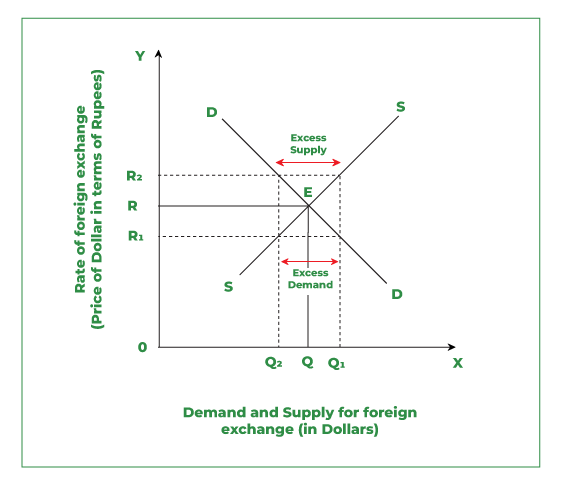
Like any other market, we can model this using supply and demand curves.
The reading below from the Reserve Bank of Australia provides a formal confirmation of this core principle.
Understanding Exchange Rates And Why They Are Important
This document from Australia's central bank authoritatively describes different exchange rate systems. We will focus on the one relevant for today's lesson.
Read the section titled 'Floating' under the main heading 'Exchange Rate Regimes'. Focus on the very first sentence, which states the central idea of our lesson.
2. Who Demands and Who Supplies?
This is the most critical and often trickiest part of understanding the Forex market. Let's use the market for U.S. dollars (USD) as our example.
-
Demand for USD: The demand for U.S. dollars comes from foreigners (e.g., Europeans, Japanese) who need dollars to buy American goods, services, or assets.
- A French company wants to buy software from Microsoft. It needs to buy USD.
- A Japanese investor wants to buy a U.S. Treasury bond. They need to buy USD.
- A Canadian tourist is visiting New York. They need to buy USD.
-
Supply of USD: The supply of U.S. dollars comes from Americans who want to sell their dollars to buy foreign currencies. They do this to purchase foreign goods, services, or assets.
- An American consumer wants to buy a German car. They must supply USD to buy euros.
- An American investment fund wants to buy stock in a Brazilian company. It must supply USD to buy Brazilian reais.
- An American student is backpacking through Thailand. They must supply USD to buy Thai baht.
The following short video provides an excellent, clear explanation of this fundamental point.
Foreign Exchange Practice- Macro Topic 6.4 and 6.5
This clip from an ACDC Econ video by Jacob Clifford clearly answers the 'who demands/who supplies' question. This is a crucial foundation for everything that follows.
Watch the first minute of the video (00:00 to 01:03). Pay close attention to his explanation of who is on the demand side and who is on the supply side in the market for U.S. dollars.
3. The Supply and Demand Curves
Now let's examine why the curves have their characteristic shapes. We'll stick with the market for the U.S. dollar, with the exchange rate expressed as Euros per Dollar (€/USD).
-
The Demand Curve is downward-sloping:
- If the exchange rate falls (e.g., from €1.00/$ to €0.90/$), the dollar has depreciated. It is now "cheaper" for Europeans.
- This means American goods, services, and assets are now less expensive for them. That Microsoft software that cost $100 now costs €90 instead of €100.
- Because U.S. items are cheaper, foreigners will want to buy more of them, so the quantity of dollars they demand will increase.
-
The Supply Curve is upward-sloping:
- If the exchange rate rises (e.g., from €1.00/$ to €1.10/$), the dollar has appreciated. It is now "stronger."
- This means one dollar can buy more euros. For Americans, European goods, services, and assets are now cheaper. That German car that costs €40,000 now costs an American buyer $36,363 instead of $40,000.
- Because foreign items are cheaper, Americans will want to buy more of them. To do so, they will be willing to supply a greater quantity of dollars to the market.
The video below walks through the logic for both curves and then goes on to explain the factors that shift them, which is our next topic.
Macro: Unit 5.2 -- The Foreign Exchange Market
This video from 'You Will Love Economics' provides a detailed look at the entire Forex market model. We'll watch it in two parts.
First, watch from the beginning to 10:11. This will introduce the market, define appreciation and depreciation, and explain the logic behind the downward-sloping demand curve and upward-sloping supply curve.
4. What Shifts the Curves? Determinants of Exchange Rates
The equilibrium exchange rate changes when either the supply or the demand curve shifts. These shifts are caused by changes in the underlying economic factors that motivate people to buy and sell currencies. Here are the main determinants:
A. Changes in Tastes and Preferences
If foreign consumers' taste for a country's goods increases, the demand for that country's currency will increase.
- Example: A popular new Hollywood movie series increases the desire for American cultural exports and tourism to the US.
- Effect: Europeans and others demand more USD to watch the movies and visit the U.S. The demand curve for USD shifts right, causing the dollar to appreciate.
B. Changes in Relative Income
If income in one country rises, its citizens will buy more goods, including imports.
- Example: The U.S. economy experiences strong growth, and American incomes rise.
- Effect: Americans will buy more of everything, including imported goods like French wine and Japanese electronics. To do so, they must supply more USD to buy euros and yen. The supply curve for USD shifts right, causing the dollar to depreciate.
C. Changes in Relative Price Level (Inflation)
Money flows to where it has higher purchasing power.
- Example: Inflation in the U.S. is significantly higher than in the Eurozone.
- Effect: U.S. goods become relatively more expensive. Europeans will buy fewer U.S. goods, decreasing the demand for USD (demand shifts left). At the same time, European goods become relatively cheaper for Americans, who will increase their imports, increasing the supply of USD (supply shifts right). Both effects cause the dollar to depreciate.
D. Changes in Relative Interest Rates
Capital flows to where it can earn the highest return. This is one of the most powerful shifters of exchange rates in the short run.
- Example: The U.S. central bank raises interest rates, making U.S. bonds offer a higher return than European bonds.
- Effect: European investors will want to buy these higher-yielding U.S. bonds. To do this, they need to buy dollars. The demand for USD shifts right, causing the dollar to appreciate.
The video below explains each of these four determinants with clear graphical examples.
Macro: Unit 5.2 -- The Foreign Exchange Market
Now, let's continue with the same video to see how these shifters work in practice.
Watch from 10:11 to 18:37. The video will explain how a change in tastes, trade prices (our relative price level), income, and capital flow (our relative interest rates) will shift the supply and demand curves and change the equilibrium exchange rate.
5. Seeing Both Sides of the Market
It's crucial to remember that every foreign exchange transaction has two sides. When someone is demanding USD, they are simultaneously supplying another currency (e.g., EUR). Therefore, a shift in the market for one currency implies a corresponding shift in the market for the other.

This dual effect is why, as you saw in the videos, a factor like higher U.S. interest rates can be shown as either an increase in demand for dollars OR a decrease in the supply of dollars (as Americans keep their money at home). Both perspectives lead to the same outcome: the dollar appreciates.
Conclusion
You have now built the fundamental model used to analyze foreign exchange rates. You can see that a currency's value is not arbitrary; it is a price determined by the millions of decisions made by importers, exporters, tourists, and investors around the world.
Key Takeaways:
- In a floating exchange rate system, the value of a currency is determined by the forces of supply and demand.
- The demand for a currency comes from foreigners who want to buy that country's goods, services, or assets. The demand curve is downward-sloping.
- The supply of a currency comes from domestic residents who want to buy foreign goods, services, or assets. The supply curve is upward-sloping.
- The equilibrium exchange rate changes when the curves shift. The main shifters are changes in relative tastes, incomes, price levels (inflation), and interest rates.
- An increase in demand or a decrease in supply will cause a currency to appreciate (strengthen).
- A decrease in demand or an increase in supply will cause a currency to depreciate (weaken).
Preview of the Next Lesson:
We've just spent this lesson understanding why a currency might appreciate or depreciate. The logical next question is, what are the consequences? In the next lesson, we will explore exactly that, as we describe the effects of currency appreciation and depreciation on net exports and, by extension, on the broader economy.