Recommended resources
The freely available resources this lesson will direct you to.
Introduction
Welcome to your twelfth module. In the previous two lessons, we explored international trade from a microeconomic viewpoint, analyzing the gains from trade based on comparative advantage and the welfare effects of protectionist policies like tariffs and quotas. We focused on the flow of goods and services between nations.
Now, we will zoom out to a macroeconomic perspective. A country's economic relationship with the rest of the world involves more than just exporting and importing goods. It also includes international investment, cross-border income payments, and financial transfers. To keep track of all these transactions, economists and policymakers use an accounting system called the Balance of Payments.
Your learning outcome for this lesson is to define the balance of payments and distinguish between the current account and the capital (financial) account. Understanding this framework is essential for analyzing major macroeconomic issues like trade deficits, international capital flows, and exchange rates.
1. The Balance of Payments: A Country's Global Ledger
The Balance of Payments (BoP) is a systematic record of all economic transactions between the residents of a country and the rest of the world during a specific period, typically a quarter or a year. Think of it as a nation's comprehensive financial statement detailing its interactions with other countries.
Every transaction that involves money flowing into the country is recorded as a credit (a positive entry). Every transaction that involves money flowing out of the country is recorded as a debit (a negative entry).
The BoP is broadly divided into two main components:
- The Current Account: Tracks the flow of goods, services, and income.
- The Financial Account: Tracks the flow of financial assets, like stocks, bonds, and real estate. (There is also a much smaller Capital Account, which we will clarify shortly).
Balance of Payments (BOP) Accounts- Macro 6.1
Let's start with a high-level overview. This video introduces the Balance of Payments and its two main accounts in a very straightforward way, using the example of trade between the US and China.
Watch the video from the beginning up to 02:34. Focus on the core distinction he makes: the current account tracks trade in goods and services, while the financial account tracks the buying and selling of assets like stocks and bonds.
The key insight from the video is that these two accounts are two sides of the same coin. A country that buys more goods and services from the world than it sells (a current account deficit) must pay for them. It does so by selling assets to the world or by borrowing (a financial account surplus).
2. A Closer Look at the Current Account
The current account measures the international trade in goods, services, and income that are generally consumed in the present period. It has three main sub-components.
The Balance of Payments | Explainer | RBA
The current account is a bit more detailed than just goods and services. The Reserve Bank of Australia provides a very clear breakdown of its formal components.
Read the section titled 'The Current Account'. Pay close attention to the table that lists and defines the 'Trade balance', 'Primary income balance', and 'Secondary income balance'. This gives you the full, formal structure.
As the reading explains, the components are:
- Trade Balance: This is the most well-known part. It is the value of a country's exports of goods and services minus the value of its imports of goods and services. A positive balance is a trade surplus; a negative balance is a trade deficit.
- Primary Income (or Net Investment Income): This records income earned by residents from their foreign investments (e.g., dividends from foreign stocks, interest on foreign bonds) and income paid to foreigners on their domestic investments.
- Secondary Income (or Net Transfers): These are one-way transfers where nothing is received in return. Examples include foreign aid sent by the government or personal remittances sent by migrant workers to their families back home.
The Current Account Balance is the sum of these three components.
3. The Financial and Capital Accounts: The Modern Distinction
This is where terminology can be confusing. Historically, and in some simplified models, the term "Capital Account" was used to describe all asset transactions. However, under current international standards (set by the IMF), these transactions are split into two distinct accounts: a very large Financial Account and a much smaller Capital Account.
Balance of Payments (Current Account, Financial Account and Capital Account)
This next video does an excellent job of explaining the modern, precise distinction between the 'Financial Account' and the much smaller 'Capital Account'.
Watch from 00:50 to 06:05. First, he'll describe the minor Capital Account (e.g., debt forgiveness). Then, he'll detail the much more significant Financial Account, breaking it down into portfolio investment, foreign direct investment (FDI), and changes in reserves. Focus on the examples he gives for each.
To summarize the modern distinction:
-
The Financial Account is the main event. It records the buying and selling of financial assets.
- Foreign Direct Investment (FDI): Long-term, significant investments where the investor has a degree of control, such as building a factory abroad or acquiring more than 10% of a foreign company.
- Portfolio Investment: The purchase of stocks and bonds where the investor has no control (less than 10% ownership). These are generally more liquid and short-term than FDI.
- Other Investment: A catch-all category including loans, currency deposits, and trade credits.
- Reserve Assets: Transactions involving the central bank's holdings of foreign currencies.
-
The Capital Account is a minor account that records specific types of transactions.
- Capital Transfers: Such as debt forgiveness or certain government grants for infrastructure projects.
- Sale/Purchase of Non-produced, Non-financial Assets: Such as patents, copyrights, trademarks, or rights to natural resources.
The image below provides a useful table for comparing these accounts side-by-side.
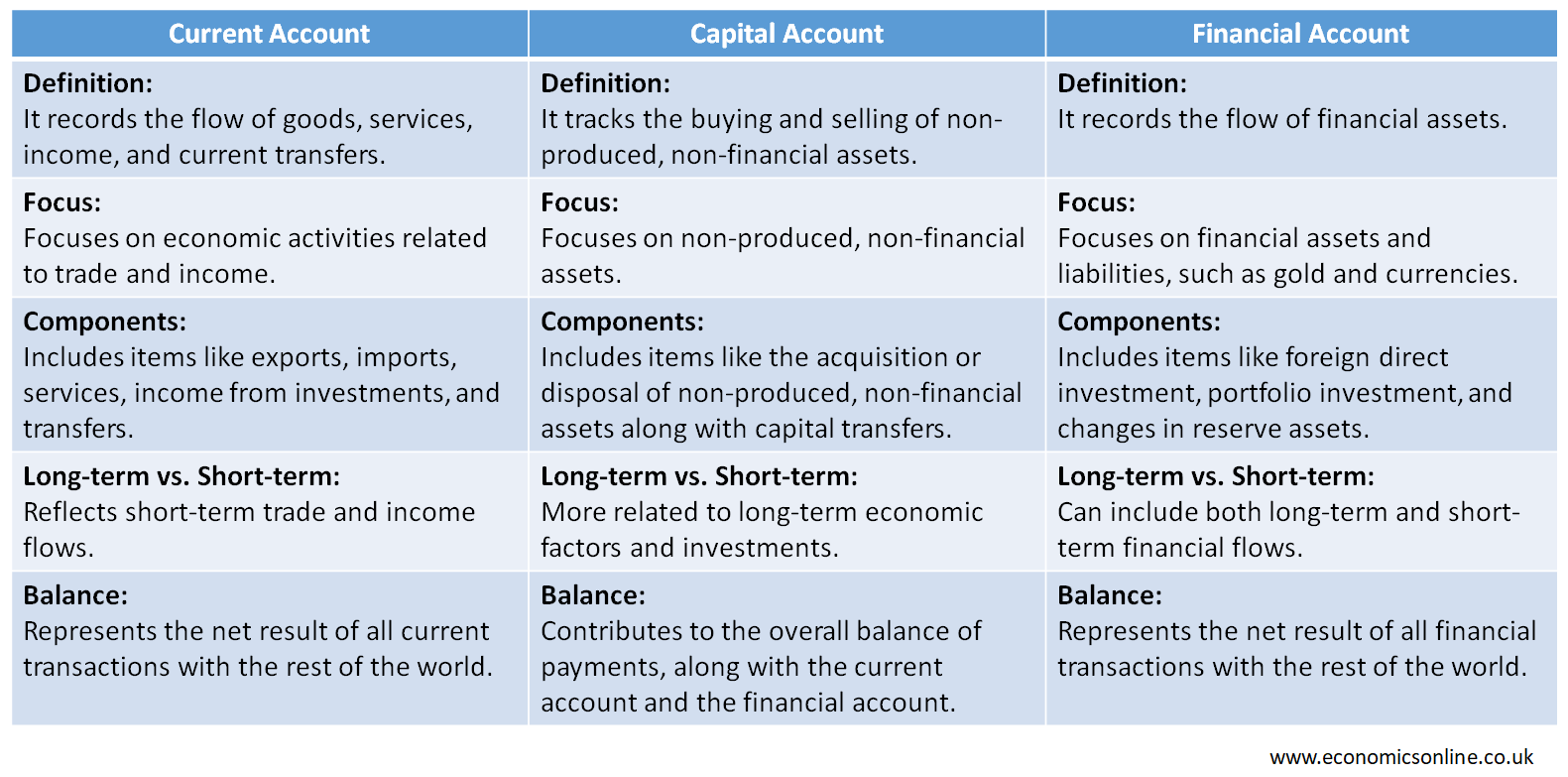
For the rest of this course, when we discuss international asset flows balancing the current account, we are primarily referring to the Financial Account.
4. The Fundamental Rule: It Must Balance
The Balance of Payments is built on the principle of double-entry bookkeeping. Every single international transaction is recorded twice: once as a credit (+) and once as a debit (-). Therefore, the sum of all entries in the BoP must, by definition, be zero.
Current Account + Capital Account + Financial Account = 0
Since the Capital Account is very small, this simplifies to a crucial relationship:
Current Account ≈ - Financial Account
This means a country with a current account deficit must have a financial account surplus of a similar magnitude, and vice versa.
- A current account deficit means a country is spending more abroad (on imports, etc.) than it is earning from abroad (from exports, etc.). It must finance this shortfall by either selling assets to foreigners or borrowing from them. This net selling of assets or borrowing is a financial account surplus (a net inflow of capital).
- A current account surplus means a country is earning more from abroad than it is spending. It can use this excess income to buy foreign assets or lend to other countries. This net purchasing of assets or lending is a financial account deficit (a net outflow of capital).
This balancing act is the most important concept in the Balance of Payments.
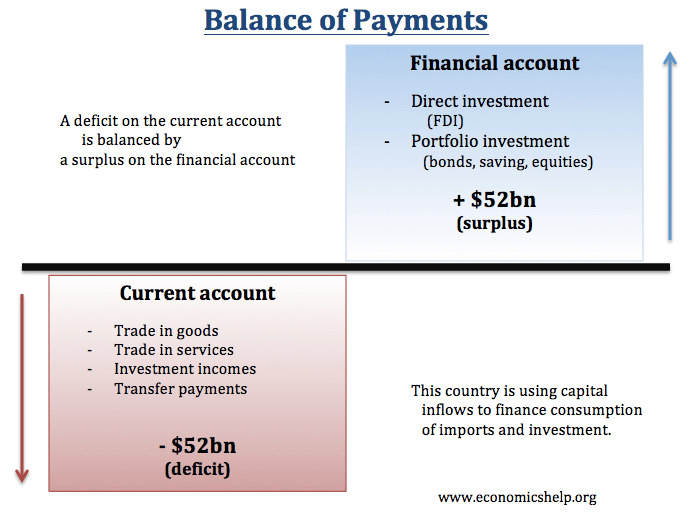
To see how the double-entry system works in practice, let's trace a few transactions.
The Balance of Payments | Explainer | RBA
To see how this works in practice, let's trace a few transactions through the accounting system. The RBA explainer provides some excellent examples and shows how they are recorded in a sample Balance of Payments table.
First, read the brief section 'Accounting Framework' to understand the 'Double Entry' principle. Then, carefully study the 'Box: Some Examples of Credits and Debits'. Trace how each of the three example transactions results in both a credit and a debit entry in the final table. This really clarifies how the accounts are interconnected.
Conclusion
In this lesson, you have learned the accounting framework that underpins all of international macroeconomics. You are now equipped to interpret headlines about trade deficits and understand what they imply about a country's financial relationship with the world.
Key Takeaways:
- The Balance of Payments (BoP) is a record of all economic transactions between a country and the rest of the world.
- The BoP is composed of the Current Account, the Financial Account, and the smaller Capital Account.
- The Current Account tracks trade in goods and services, as well as primary income (from investments) and secondary income (transfers).
- The Financial Account tracks trade in assets, such as stocks, bonds, and direct investments like factories.
- Due to double-entry bookkeeping, the BoP must always balance. A deficit in the Current Account must be financed by a surplus in the Financial Account, meaning the country is a net borrower from or a net seller of assets to the rest of the world.
Preview of the Next Lesson:
Every transaction we discussed today—whether buying a German car, receiving a dividend from a Japanese company, or a US firm building a factory in India—requires an exchange of currencies. These countless transactions create the supply and demand for currencies in the global market. In our next lesson, we will explore exactly this: how the supply and demand for currencies determine exchange rates in a floating system.