Recommended resources
The freely available resources this lesson will direct you to.
Introduction
Welcome to our final lesson in the course! In the previous lesson, we established that in a floating exchange rate system, market forces cause currencies to appreciate or depreciate, which in turn affects a country's net exports. This automatic adjustment raises a fundamental question for policymakers: is it better to allow exchange rates to float freely, or should a government actively manage its currency's value?
Today, we will delve into this classic debate. Your learning outcome is to compare the advantages and disadvantages of fixed versus floating exchange rate regimes. There is no single correct answer; the choice involves a series of critical trade-offs between stability, flexibility, and economic independence. By the end of this lesson, you will understand the core arguments that economists and policymakers weigh when deciding on an exchange rate system.
1. Defining the Exchange Rate Regimes
Before we compare them, let's quickly clarify the two main systems:
- Floating (or Flexible) Exchange Rate: The value of the currency is determined purely by the forces of supply and demand in the foreign exchange market. Most major economies, including the United States, the UK, and Japan, use a form of this system.
- Fixed (or Pegged) Exchange Rate: The government or central bank sets a target value for its currency, often against a major currency like the U.S. dollar or the euro. It must then actively intervene in the market to maintain this target price.
To maintain a fixed rate, the central bank must be ready to counteract market pressures. If the market wants to push the currency's value down, the central bank must buy its own currency (using its foreign reserves). If the market pushes the value up, the central bank must sell its own currency. This creates the imbalances shown below, which the central bank must manage.

Now, let's explore the pros and cons of each approach.
2. The Case for Floating Exchange Rates
A floating exchange rate system offers two major advantages: policy autonomy and automatic stabilization. The following video provides an excellent overview of these points.
Fixed vs Floating Exchange Rates (Arguments For and Against)
To begin, watch this segment from the EconplusDal video, which clearly lays out the primary benefits of allowing a currency to float.
Watch from 00:33 to 03:59. As you watch, focus on understanding these four key advantages: (1) Reduced need for currency reserves, (2) Freedom for domestic monetary policy, (3) Automatic correction of trade deficits, and (4) Lower risk of currency over/undervaluation.
Let's unpack the two most important advantages you just saw:
Advantages of Floating Rates:
- Independent Monetary Policy: This is arguably the most significant benefit. The central bank is free to use its main policy tool—interest rates—to manage the domestic economy. It can lower rates to fight a recession or raise them to combat inflation, without worrying that these actions will violate a currency peg.
- Automatic Adjustment: As we saw in the last lesson, exchange rate movements can act as an automatic stabilizer.
- If a country enters a recession, its currency tends to depreciate. This makes its exports cheaper, boosting net exports and providing a stimulus to aggregate demand.
- If an economy is overheating, its currency tends to appreciate. This cools down the export sector and reduces inflationary pressure.
- No Need for Large Reserves: The central bank doesn't need to hold vast, costly reserves of foreign currency, as it is not obligated to intervene in the market.
- Reduced Risk of Speculative Crises: Since the exchange rate is determined by the market, there isn't a fixed "target" for speculators to bet against, which reduces the likelihood of a currency crisis (a topic we will explore in more detail later).
Disadvantages of Floating Rates:
Of course, this flexibility comes at a cost.
- Volatility and Uncertainty: Exchange rates can be volatile. This uncertainty can discourage international trade and investment, as firms cannot be sure of the future value of their revenues and costs.
- Inflationary Risk: A sharp depreciation, while boosting exports, also makes imports more expensive. If the country relies heavily on imported consumer goods or raw materials, this can lead to significant cost-push inflation.
3. The Case for Fixed Exchange Rates
The main argument for a fixed exchange rate is the inverse of the argument against a floating one: stability. By removing exchange rate uncertainty, a fixed regime aims to provide a more predictable environment for international business.
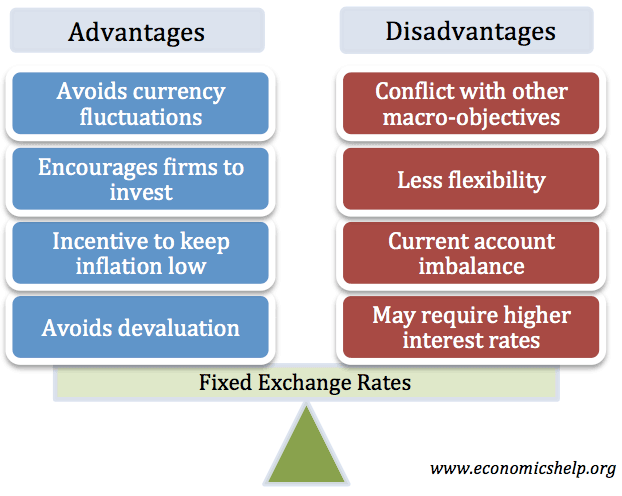
To get a more detailed breakdown, let's turn to a reading that lays out the arguments clearly.
IB Economics - Evaluation of Different Exchange Rate Systems
The article 'IB Economics - Evaluation of Different Exchange Rate Systems' from Tutor2u provides a concise, structured list of the pros and cons for both systems. It's a great way to consolidate your understanding.
Please read the sections titled 'Fixed Exchange Rate System' and 'Comparative Analysis'. Pay close attention to the lists of advantages and disadvantages for the fixed system.
Synthesizing from the reading and the image, here are the key points:
Advantages of Fixed Rates:
- Certainty for Trade and Investment: Eliminating exchange rate risk encourages international trade and foreign direct investment (FDI). Businesses can make long-term plans and investments without the risk of currency fluctuations eroding their profits.
- Discipline and Credibility: A fixed rate can act as a credibility anchor for monetary policy. It forces the government to maintain policies consistent with low inflation to defend the peg. This can be particularly valuable for developing countries with a history of high inflation.
- Reduced Transaction Costs: Firms do not need to engage in costly hedging activities (e.g., buying forward contracts) to protect themselves from currency risk.
Disadvantages of Fixed Rates:
- Loss of Monetary Policy Autonomy: This is the most significant drawback. The central bank must use interest rates to defend the peg, not to manage domestic unemployment or inflation. If it needs to raise interest rates to prevent depreciation, it could push a weak domestic economy into a full-blown recession.
- Vulnerability to Crises: This is the most dangerous aspect of a fixed regime in the modern global economy. If investors believe a currency is overvalued and the government might be forced to devalue it, they have a massive incentive to sell that currency immediately. This can lead to a speculative attack, where a flood of selling exhausts the central bank's foreign reserves and forces a sudden, chaotic devaluation, often triggering a deep financial crisis.
4. A Deeper Dive: Fixed Rates and Currency Crises
The risk of speculative attacks is so significant that it has led many economists to argue against fixed exchange rates for most countries. The experience of the 1990s, with major crises in Mexico, East Asia, and Russia, provides a powerful lesson.
Fixed Exchange Rates and Floating Exchange Rates: What Have We Learned?
For a deeper understanding of this risk, we will turn to a report from the U.S. Congressional Research Service. This reading is more advanced, but it offers crucial insight into why fixed rates are so fragile in a world with high capital mobility.
Read the section titled 'What Have Recent Crises Taught Us About Exchange Rates?' (starting on page 11). Focus on the 'fire in a crowded theater' analogy and the explanation for why fixed rates are prone to crisis while floating rates are not.
As the report explains, a fixed peg creates a one-way bet for speculators. If they are wrong and the currency is not devalued, they lose little. But if they are right, they stand to make enormous profits. This asymmetric risk profile makes fixed regimes inherently unstable when capital can flow freely across borders.
5. The Real World: Managed Floats
Given the severe trade-offs, most countries today do not choose a pure float or a pure fix. Instead, they opt for a middle ground.
- Managed Float (or Dirty Float): An exchange rate system where the currency is generally allowed to float according to market forces, but the central bank intervenes to prevent excessive volatility or to nudge the currency in a desired direction.
This hybrid system attempts to capture the "best of both worlds": the automatic adjustment and policy autonomy of a float, with some of the stability of a fix. However, it also means that policymakers are constantly managing a delicate balancing act.
Conclusion
You have now reached the end of your foundational journey into economics. Today, we analyzed one of the most important policy choices in open-economy macroeconomics: the selection of an exchange rate regime.
Key Takeaways:
- Floating exchange rates offer monetary policy independence and act as automatic stabilizers, but they can introduce volatility and uncertainty that may hinder trade.
- Fixed exchange rates provide stability and certainty, promoting trade and investment, and can enforce policy discipline. However, they require sacrificing monetary policy autonomy and, most critically, are vulnerable to devastating speculative attacks and currency crises in an era of globalized finance.
- The fundamental trade-off is flexibility vs. stability.
- Most countries adopt a managed float, seeking a pragmatic compromise between the two extremes.
Course Wrap-Up:
Congratulations on completing this course! We began with the core principles of individual choice and scarcity, built models of supply and demand, and analyzed how firms and consumers interact in different market structures. We then scaled up to the macroeconomic level, learning how we measure national output, unemployment, and inflation. We explored how fiscal and monetary policies are used to manage the business cycle, and finally, we placed the economy in a global context by studying international trade and finance.
You now possess a powerful analytical toolkit to understand the economic forces that shape our world—from your personal financial decisions to national policy debates and global economic trends. The goal was to provide a rigorous foundation, and I hope you feel equipped and motivated to continue exploring the vast and fascinating field of economics.