Recommended resources
The freely available resources this lesson will direct you to.
- Ultimate Guide to Film Composition & Framing — Key Elements Explained [Shot List Ep. 11]www.youtube.com
- Composition In Storytellingwww.youtube.com
- The Psychology of Cinematography: The Emotional Impact of Visual ...www.robertcmorton.com
- Rules of Shot Composition in Film: A Definitive Guidewww.studiobinder.com
Hello and welcome.
In our last lesson, we explored mise-en-scène—the art of filling the frame with meaningful elements like sets, props, costumes, and lighting. We focused on what the audience sees. Now, we shift our attention to how the audience sees it.
This lesson is about framing and composition. We will examine how the deliberate arrangement of elements within the boundaries of the shot—the frame—is one of a director's most powerful tools. You'll learn how these choices guide the viewer's eye, establish power dynamics, and ultimately direct the emotional interpretation of a scene.
For a director like you, aiming to create artistic and emotionally resonant films, mastering composition is what elevates a simple recording of events into a piece of visual poetry. It's the key to unlocking the psychological depth you admire in the works of Bergman and the sublime, metaphysical feel of Herzog's landscapes.
The Purpose of Composition: More Than a Pretty Picture
Before we dive into specific rules and techniques, it's crucial to understand that composition is not merely about creating a visually pleasing image. It is an act of storytelling. Every compositional choice you make—where to place a character, what to leave in or out of the frame, how to use lines and shapes—infuses the shot with meaning and emotion.
Let's begin with a video that frames this concept perfectly, moving beyond technical rules to discuss composition as a fundamental expressive decision.
The video 'Composition In Storytelling' by The House of Tabula provides an excellent conceptual foundation, arguing that composition's primary roles are to guide attention and display power dynamics.
First, watch from 00:48 to 01:54 to understand why composition is considered an expressive, not just technical, act.
As the video argues, composition brings focus and structure to what would otherwise be a "sensory overload." It's the art of knowing what to show, what not to show, and how to show it.
Guiding the Eye, Creating Subtext
One of composition's primary jobs is to guide the audience's attention to the most important elements in the scene. But great directors use these same techniques to create a deeper layer of meaning, or subtext.
Let's watch two more clips from the same video that demonstrate how this is done.
These sections illustrate how standard compositional techniques can be used for sophisticated emotional and thematic storytelling.
Watch the segment on the 'frame within a frame' (05:03 - 07:21), and notice how it can symbolize everything from isolation to the pursuit of a new life. Then, watch the following segment on 'lines of perspective' (07:21 - 08:28) and how they can be used to emotionally trap a character or, conversely, show them a new path.
This idea of using visual structure to imply an emotional or psychological state is central to the work of directors you admire. Think of how often characters in Bergman's films are framed by doorways or windows, visually separating them and externalizing their inner isolation.
The Power Dynamics of the Frame
Perhaps the most potent use of composition is in establishing and shifting power dynamics. The video you've been watching introduces a powerful concept for analyzing this: Artificial Control vs. Primal Control.
- Artificial Control: This is about visual dominance. Which element in the frame commands the viewer's attention due to its size, focus, or placement? This is about where we look.
- Primal Control: This is about narrative dominance. Which character or object holds the most power within the story at that moment? This is about who (or what) is in charge.
Great composition often plays with the relationship between these two forms of control. Let's see how.
This final clip from 'Composition In Storytelling' is crucial. It explains how you can visually represent a character's power—or lack thereof—in a scene.
Watch from 08:38 to 11:39. Pay close attention to how size, scale, and a character's position in the frame (e.g., in the background vs. towering in the foreground) are used to manipulate both artificial and primal control.
The example from Citizen Kane is a masterclass in this principle. Young Kane has our attention (artificial control) because he is the subject, but the adults who are deciding his fate are large and in the foreground, holding all the narrative power (primal control). This creates a feeling of oppressive helplessness.
The Director's Toolkit: Key Compositional Elements
Now that we have a strong conceptual framework, let's explore the specific tools directors use to compose their shots. Given your background in visual design, many of these principles—like balance, line, and shape—will be familiar. Here, we'll see them applied to the four-dimensional canvas of film.
The following video is a comprehensive visual guide. We'll watch it in sections to break down the core elements.
Ultimate Guide to Film Composition & Framing — Key Elements Explained [Shot List Ep. 11]
The 'Ultimate Guide to Film Composition & Framing' from StudioBinder serves as a great visual glossary of the essential techniques.
Watch the following sections, focusing on how each element can be used to create a specific feeling: Guiding the Eye: Watch 'Points & Lines' (02:07 - 04:25). Organizing Space: Watch 'Shapes,' 'Space,' and 'Depth' (04:25 - 05:11 and 06:57 - 09:49). Notice the connection to the 'deep space composition' we discussed in the last lesson. Creating Balance & Perspective: Watch 'Balance' and 'Angle' (09:49 - 11:55 and 11:55 - 12:56). Pay attention to how both balance and imbalance can be used to create harmony or unease.
These "rules"—like the Rule of Thirds or the Golden Ratio—are not rigid laws. They are time-tested principles for creating compositions that feel balanced and direct attention effectively. Knowing them is essential, but as we'll see, knowing when to break them is just as important.
The Psychology of Framing and Composition
Every compositional choice triggers a psychological response in the viewer. A low-angle shot makes a character feel powerful; a Dutch angle creates unease; a symmetrical frame can feel orderly or oppressive.
This infographic provides a clear and concise summary of the emotional language of different camera angles and shot sizes.

To see these principles in action, let's examine a case study. The film Nightcrawler (2014) is an excellent example of a director using composition to carefully manage the audience's relationship with a difficult, amoral protagonist.
Rules of Shot Composition in Film: A Definitive Guide
This article, 'Rules of Shot Composition in Film' from StudioBinder, uses the film Nightcrawler to demonstrate how compositional rules can be used and broken to manipulate audience emotion.
Please read the following sections to see how specific techniques create character and feeling: 'The Rule of Thirds': See how placing the character off-center is used to isolate him and make him seem untrustworthy. 'Balance and symmetry': Notice how breaking the Rule of Thirds to center the character creates tension. 'Eye-level framing': Understand how this simple choice creates empathy, even for an anti-hero. 'Depth of field' (specifically the subsection on Bokeh): See how shallow focus and blurring the background are used to visually represent the character's alienation from society.
Application Exercise
Let's apply these ideas. Look at the image below, which contains four stills from different films.
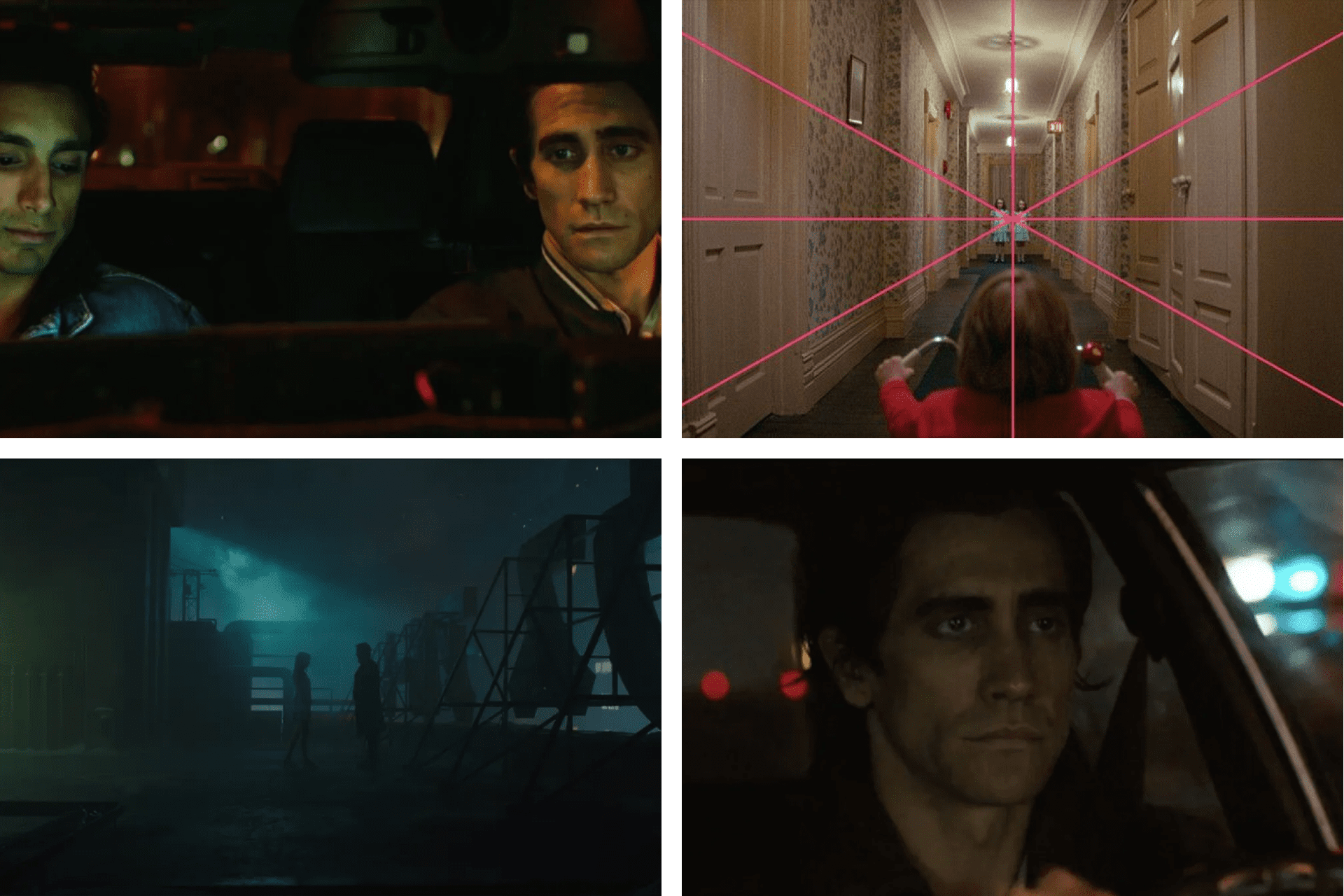
Focus on the top-right image, the iconic shot from Stanley Kubrick's The Shining.
- How does the use of one-point perspective (where all parallel lines converge on a single point) affect you as a viewer? What emotion does it evoke?
- How does the strict symmetry of the shot contribute to this feeling?
- Where does this composition place the primal control in the scene? Does the boy or the hotel itself feel more powerful?
Now, consider the top-left image of the man in the car.
- How does this tight close-up framing affect your connection to the character?
- What does the use of negative space (the dark, empty area to the right) suggest about his emotional state or situation?
Take a moment to write down your thoughts. This is the process of "reading" a film's visual language—a skill you will continually develop as a director.
Key Takeaways
- Framing and composition are not just for aesthetics; they are primary tools for emotional and psychological storytelling.
- Composition works by guiding the viewer's eye and establishing power dynamics (primal vs. artificial control).
- Core techniques include the use of lines, shapes, space, depth, balance, and camera angle to create feelings of harmony, tension, power, or vulnerability.
- Understanding the "rules" of composition is vital, but intentionally breaking them can be an even more powerful expressive choice.
Looking Ahead
In this lesson and the last, we've covered how to build and frame a single, powerful shot. But films are made of many shots joined together. In our next lesson, we will explore the art of editing, distinguishing between continuity editing (which creates a seamless flow) and non-continuity approaches (which can disrupt time and space for artistic effect). This will be our first step into assembling shots into a coherent and impactful sequence.