Recommended resources
The freely available resources this lesson will direct you to.

Hello!
In our last lesson, we focused on how to compose a single, meaningful shot through framing and composition. We looked at how you, as a director, can guide the viewer's eye and establish emotional and power dynamics within the frame. Now, we move from the individual shot to the relationship between shots.
This lesson explores editing, the art of joining shots together to create a sequence. Specifically, we'll address the fundamental distinction between continuity editing and non-continuity approaches. This is one of the most significant choices a director makes, as it defines the very texture of the film's reality.
For a filmmaker like you, drawn to the experimental and surreal, understanding non-continuity isn't just an academic exercise—it's about discovering a cinematic language that can break free from literal reality to express inner states, metaphors, and poetic ideas, much like your inspirations Rebecca Horn and the surrealist masters.
The "Invisible" Rules: Understanding Continuity Editing
Most mainstream narrative films use a set of conventions designed to make the editing feel seamless and invisible. This is continuity editing. Its primary goal is to create a coherent sense of space and time, so the audience can easily follow the story without being distracted by the cuts.
To begin, let's get a clear, concise overview of the core principles of this "invisible" style.
Introduction to Film: Lesson 5.2 - Continuity and Discontinuity
This short video, 'Introduction to Film: Lesson 5.2 - Continuity and Discontinuity,' provides a straightforward breakdown of the 'rules' that create seamless continuity.
Please watch from the beginning until 04:00. Focus on understanding these key techniques: Establishing Shot: Orienting the viewer. Shot-Reverse-Shot: The standard for conversations. Match on Action: Cutting during a movement to hide the edit. 180-Degree Rule: Maintaining consistent screen direction. Eyeline Match: Following a character's gaze.
These rules work together to construct a stable and logical story world, or diegesis. Breaking them can be jarring and confusing... or it can be a powerful artistic choice.
Beyond the Rules: Emotion Over "Mistakes"
What happens when a great film has a "continuity error," like a disappearing prop? Is it a mistake, or is something more important at play? Often, expert editors will knowingly sacrifice perfect physical continuity to prioritize a stronger performance or a more potent emotional moment.
This next video explores this very idea, reframing how we think about editing choices.
Why They Just Don't Care About Continuity
The video 'Why They Just Don't Care About Continuity' by Thomas Flight offers a sophisticated perspective, arguing that for many great filmmakers, emotion is far more important than flawless continuity.
Watch the section from 01:30 to 05:20. Pay close attention to the discussion of editor Thelma Schoonmaker's work with Martin Scorsese and Walter Murch's 'Rule of Six,' which ranks emotion at the top of editing priorities and physical continuity at the bottom.
This concept is crucial for your goals. If your aim is to express complex human feelings, you may find that the most emotionally "correct" take is not the one that perfectly matches the previous shot. This philosophy liberates you to edit for feeling, not just for flawless logic.
A Different Language: The Art of Non-Continuity
While some filmmakers bend the rules of continuity for emotional impact, others abandon them entirely, using a completely different cinematic language. Non-continuity editing doesn't try to hide the cuts. Instead, it uses them to create new meanings, disrupt expectations, and explore psychological or conceptual territory.
This approach has a rich history in artistic movements that you're drawn to.
Discontinuity Editing – Different Ways of Making Cinema
This blog post, 'Discontinuity Editing – Different Ways of Making Cinema,' connects this editing style directly to key avant-garde movements. It will provide an artistic context for the techniques we're about to explore.
Please read the first three sections of the article, starting from the beginning and ending just before the section on 'Soviet Montage Theory.' Notice how it links non-continuity to the French New Wave and experimental filmmakers like Maya Deren, who used it to explore the subconscious and 'the wilderness of the human mind.'
As the article highlights, non-continuity editing is the language of dreams, inner struggles, and poetic expression. It's less about showing what is happening and more about evoking what is being felt or thought.
The Techniques of Non-Continuity
There are several distinct approaches within non-continuity editing. Let's look at some key techniques.
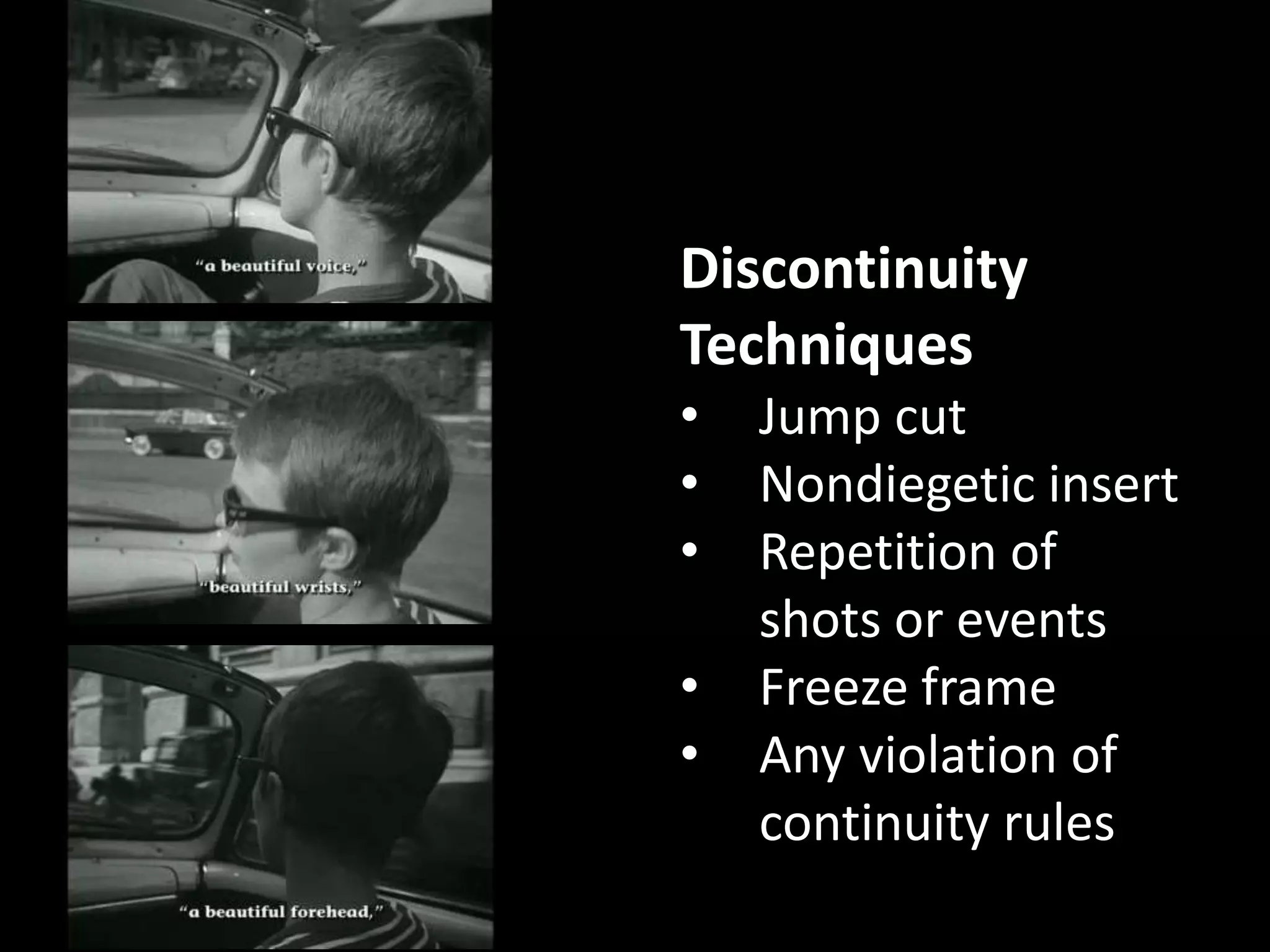
The jump cut shown above is one of the most famous examples. Instead of creating a smooth flow of time, it creates a jarring leap forward, making the viewer aware of the edit. But there are other, more subtle and conceptual approaches.
The following text provides detailed definitions for the main types of non-continuity editing.
Editing – Introduction to Film & TV
The textbook chapter 'Editing – Introduction to Film & TV' offers clear definitions and excellent examples for different non-continuity approaches. This will build your technical vocabulary.
Please read the sections titled 'Discontinuity Editing' and 'Associative editing.' Focus on understanding the following concepts: False Match on Action: An action starts in one location and appears to finish in a completely different one. Jump Cut: An abrupt 'jump' in time or position within the same shot framing. Graphic Match: Connecting two different shots through a similar shape or color. Associative Editing (and the Kuleshov Effect): Creating a new idea or emotion by juxtaposing two unrelated images.
Associative editing, in particular, is a cornerstone of experimental film. It relies on the mind's tendency to create connections. By placing two images next to each other—a person's face and a bowl of soup, a politician and a sheep—a director can create a third meaning that exists only in the space between the shots. This is a powerful way to build metaphors visually.
Let's see these ideas in motion.
Why They Just Don't Care About Continuity
Returning to the Thomas Flight video, we'll see how these non-continuity techniques are used in practice, from the narrative jump cuts of 'The Irishman' to the surrealism of 'Meshes of the Afternoon' and the impressionistic style of Terrence Malick.
Watch from 06:33 to 09:20. Notice how these different filmmakers use breaks in continuity for very different effects—sometimes for narrative punctuation, and other times to create a dreamlike or memory-like state.
Two Styles, Two Goals
We can now see that continuity and non-continuity aren't just sets of techniques; they are two fundamentally different philosophies of editing.
- Continuity Editing: Asks, "How can I make the audience forget they're watching a film and immerse them in a believable story world?"
- Non-Continuity Editing: Asks, "How can I use the relationship between images to create a symbolic, emotional, or intellectual meaning that transcends the literal story?"
The video below concludes by explicitly contrasting these two philosophies, using historical examples from Soviet montage.
Why They Just Don't Care About Continuity
This final clip from Thomas Flight's video clearly defines non-continuity editing as a style that creates meaning through symbolic, thematic, or rhythmic relationships between shots, rather than spatial and temporal ones.
Watch from 09:20 to 13:02. Pay attention to the analysis of Sergei Eisenstein's work, where the meaning comes from the 'collision' of images (soldiers looking up + a cannon wheel descending = being crushed by war).
Application Exercise
Consider your interest in Rebecca Horn's work. Her films often feature her body sculptures in slow, deliberate performances, blurring the line between object, body, and environment.
- If you were to film one of her performance pieces, like Unicorn, why might continuity editing fail to capture the essence of the work? What would you lose?
- Now, think about using non-continuity. How could you use graphic matches to connect the shape of the sculpture to shapes in nature?
- How could you use associative editing? For example, what could you juxtapose with a shot of the performer walking through a field to evoke a feeling of isolation, freedom, or pain?
Jot down a few ideas. This exercise will help you connect these editing theories to the kind of artistic work you want to create.
Key Takeaways
- Continuity editing uses a set of rules (180-degree rule, match-on-action) to create a seamless and invisible flow, prioritizing narrative clarity and immersion.
- Non-continuity editing deliberately breaks these rules or uses a different logic entirely, such as association or rhythm. Its goal is to create artistic, emotional, or intellectual effects.
- Techniques like jump cuts, false matches, graphic matches, and associative editing are not "mistakes" but powerful tools in the language of experimental, poetic, and art-house cinema.
- The choice between these two approaches is a fundamental decision about what kind of reality you want to create for your audience.
Looking Ahead
In this lesson, we explored how joining images together shapes our perception of cinematic reality. In our next lesson, we will move on to the final topic in this foundational module: sound. We will distinguish between diegetic sound (originating from within the film's world) and non-diegetic sound (imposed from outside, like a musical score). Like editing, the use of sound is another crucial layer in constructing—or deconstructing—the world of your film.