Recommended resources
The freely available resources this lesson will direct you to.
Hello!
In our last lesson, we explored how editing constructs cinematic time and space, distinguishing between the invisible "rules" of continuity and the expressive freedom of non-continuity. We briefly mentioned the concept of the diegesis—the story's world. Today, we delve deeper into that world through its soundscape.
This lesson completes our first module, "Foundations of Cinematic Language," by focusing on the crucial role of sound. You will learn to distinguish between diegetic sound (sounds originating from within the film's world) and non-diegetic sound (sounds imposed from outside it). Understanding this distinction and its narrative functions is fundamental. More importantly for your artistic goals, we will explore how filmmakers creatively blur this line to express psychological states, create metaphors, and build the surreal and poetic worlds you're inspired to create.
The World of the Film: Diegetic vs. Non-Diegetic Sound
The term diegesis comes from the ancient Greeks and simply means the world in which the story's events occur. Therefore, any sound that the characters in the film can logically hear is considered diegetic. Anything they can't hear, which is added for the audience's benefit, is non-diegetic.
Let's start with a clear and concise introduction to these core concepts.
Ultimate Guide to Diegetic vs Non-Diegetic Sound — Definitions, Examples, & How to Break the Rules
This video, 'Ultimate Guide to Diegetic vs Non-Diegetic Sound,' from StudioBinder provides an excellent foundation. It clearly defines the terms and connects them back to the concept of the film's world.
Please watch from 00:32 to 02:09. Focus on the core distinction: if the characters can hear it, it's diegetic; if only the audience can hear it, it's non-diegetic.
To visualize this structure, consider the following diagram. It maps out the main categories of film sound. Your experience in visual communication and design will make this kind of conceptual mapping intuitive.
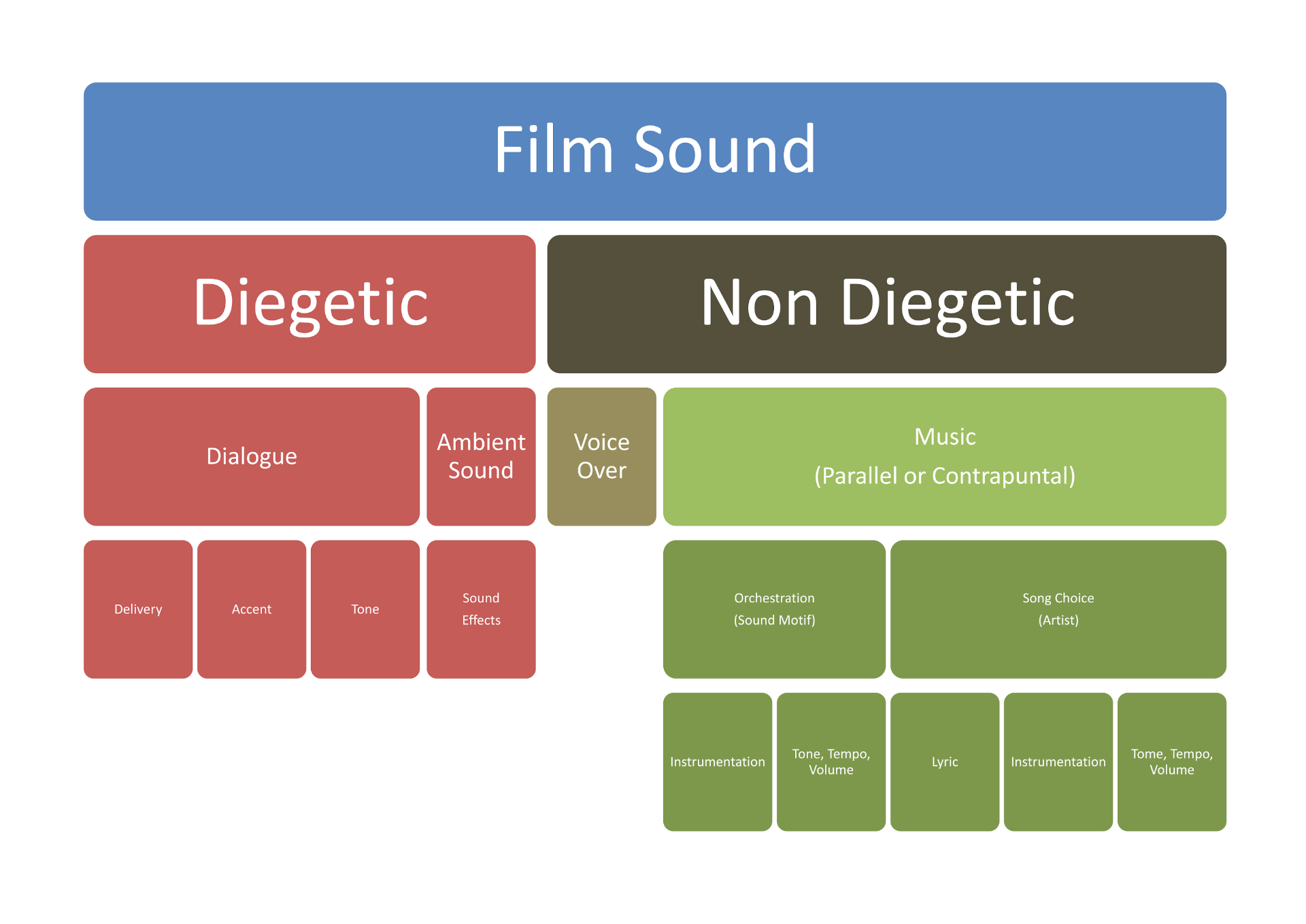
The Narrative Functions of Sound
Now that we have the basic definitions, let's explore why directors use each type of sound.
Diegetic Sound Vs. Non-diegetic Sound. What is it? - Artlist
This article from Artlist, 'Diegetic Sound Vs. Non-diegetic Sound,' offers straightforward explanations and examples of the functions of each sound category.
Please read the sections 'What is diegetic sound?', 'What is non-diegetic sound?', and the concluding section 'Storytelling with sound'. This will clarify the primary roles of each: diegetic sound enhances realism and immersion, while non-diegetic sound shapes mood, emotion, and provides information directly to the audience.
As the article notes, diegetic sound grounds your film in a believable reality. The crunch of footsteps, the hum of a refrigerator, or distant traffic all contribute to building a tangible world.
Non-diegetic sound, most commonly the musical score or a narrator's voice, is a direct line of communication with your audience. It's one of your most powerful tools for guiding emotion.
Let's see some examples of how these sounds function in practice.
Ultimate Guide to Diegetic vs Non-Diegetic Sound — Definitions, Examples, & How to Break the Rules
We'll return to the StudioBinder video to see how both sound types are applied creatively.
Please watch the following two segments: Diegetic Sound (02:57 - 04:30): Notice how diegetic sound isn't just for realism. Off-screen sounds can expand the world, and manipulating what a character hears (or doesn't hear) can build suspense or reflect their point of view. Non-Diegetic Sound (06:17 - 09:30): Pay attention to the role of the musical score. Think about how scenes from Interstellar or Up would feel without the music telling you how to feel.
Blurring the Lines: The Artistic Potential of Sound
For a filmmaker interested in surrealism and experimental cinema, the real creative power lies in bending and breaking these rules. The line between what is "real" in the film and what is an external flourish can be a fascinating space to explore.
Trans-diegetic Sound
This is sound that crosses the boundary, moving from non-diegetic to diegetic, or vice versa. This often has a self-aware, sometimes comedic effect, but it can also be used to seamlessly transition between a character's internal and external reality.
Diegetic vs Nondiegetic Sound, Part 1
The video 'Diegetic vs Nondiegetic Sound, Part 1' uses a classic comedy scene to perfectly illustrate a sound transitioning from non-diegetic to diegetic.
Watch the clip from Mel Brooks's Blazing Saddles (00:52 - 03:06). The sequence starts with what we assume is a typical non-diegetic score, until the camera reveals its source within the scene.
This reveal plays with our expectations. The StudioBinder video also shows how this technique can be used to link scenes or blur the lines of reality, as in Shaun of the Dead or Birdman.
Meta-diegetic and Oneiric Sound: The Sound of the Mind
Going deeper, we can find terms to describe sound that represents a character's subjective inner world. This is highly relevant to your interest in expressing human emotion and mystical states.
THE FILM SOUND ANALYSIS FRAMEWORK
The academic paper 'THE FILM SOUND ANALYSIS FRAMEWORK' provides precise terminology for these advanced concepts. This will give you a sophisticated vocabulary for analyzing and designing sound for experimental work.
Please read the two short sections: 2.2.3 Meta-Diegetic Sound: Understand this as sound filtered through a character's mind—a subjective perception, memory, or hallucination. The example from Hitchcock's Blackmail is key. 2.2.3 Oneiric Sound: This is a specific type of meta-diegetic sound that represents a dream-like state. Notice the description of diegetic sounds fading away as pensive music takes over.
These concepts—meta-diegetic and oneiric sound—are the language of filmmakers like Bergman, who sought to portray inner turmoil, or surrealists who explored the logic of dreams. They allow you to make the invisible world of a character's thoughts and feelings audible.
Application Exercise
Let's connect these ideas to your artistic vision. Imagine a short film inspired by your interest in nature, metaphor, and human emotion.
Scene: A character stands alone at the edge of a vast, desolate landscape (perhaps inspired by a Werner Herzog film). They are grappling with a profound sense of loss.
Describe how you would use sound to build this scene:
- Diegetic Sounds: What sounds from the environment would you use to establish the scene's physical reality and the character's presence? (e.g., wind, the character's breathing, the crunch of gravel underfoot).
- Non-Diegetic Sound: What kind of musical score or sound design would you add to convey the feeling of loss and desolation to the audience?
- Meta-Diegetic Sound: How could you represent the character's inner state? Could the diegetic sound of the wind morph into something else, like a distorted whisper of a memory?
- Trans-diegetic Moment: Can you devise a way for a sound to cross the boundary? For instance, perhaps the character begins to hum a sad melody, which then swells to become the full, non-diegetic orchestral score, showing us that the music is an expression of their inner feeling.
Take a few minutes to jot down your ideas. This will help solidify your understanding of how these different sound categories can work together as storytelling tools.
Key Takeaways
- Diegetic sound originates from within the film's world and is heard by the characters. It builds realism and immersion.
- Non-diegetic sound is external to the film's world and heard only by the audience. It's a powerful tool for shaping mood, emotion, and providing narrative information.
- The lines between these categories can be creatively blurred. Trans-diegetic sound crosses the boundary, while meta-diegetic and oneiric sounds allow you to represent a character's subjective, internal world.
- Sound is not merely an accompaniment to the image; it is an active and essential layer of cinematic storytelling.
Looking Ahead
This lesson concludes our first module, "Foundations of Cinematic Language." You now have the essential vocabulary to discuss and analyze shots, camera movement, mise-en-scène, editing, and sound.
In our next module, "Developing an Artistic Vision," we will put this entire toolkit to use. We'll begin by analyzing how one of your key inspirations, Ingmar Bergman, masterfully combines these elements—particularly his iconic close-ups and intense soundscapes—to explore the psychological depths of his characters.