Recommended resources
The freely available resources this lesson will direct you to.
Hello! Welcome back.
In our last lesson, we explored the power of sound to create a film's inner world, focusing on how meta-diegetic and oneiric sound can make a character's psychological state audible. Today, we transition from the landscape of the mind heard through sound to the landscape of the mind seen on the human face.
This lesson marks the beginning of our second module, "Developing an Artistic Vision." We will move from defining the tools of cinematic language to analyzing how master filmmakers—and your own key inspirations—use them. Our focus is on Ingmar Bergman, a director you've cited as a major influence. Specifically, we will analyze how Bergman uses the close-up with unparalleled psychological intensity to explore and convey his characters' complex inner states. This is a crucial step in understanding how to translate the abstract world of emotion into concrete, powerful cinema.
The Face as the Primary Landscape
Many directors use landscapes to create mood, but for much of his career, Bergman's primary landscape was the human face. He gradually moved away from a reliance on dialogue and external action to a more ascetic, visually-focused style where the subtlest facial expression could carry the weight of an entire scene.
To understand this fundamental shift in his approach, let's start with a short reading that includes a powerful quote from the director himself.
Images and Words In Ingmar Bergman's Films
This article, 'Images and Words In Ingmar Bergman's Films,' traces his evolution from a more literary, dialogue-driven style to one centered on visual asceticism. It perfectly explains why the face became so central to his work.
Please read the section titled 'ASCETIC CLOSE-UPS'. Pay close attention to Bergman's own words about his goal to 'come closer and closer to the people in the story.' This section establishes the core philosophy behind his famous technique.
Bergman believed the human face was the "hallmark and distinguishing feature of the film medium." He treated it not just as a subject, but as a terrain to be explored.
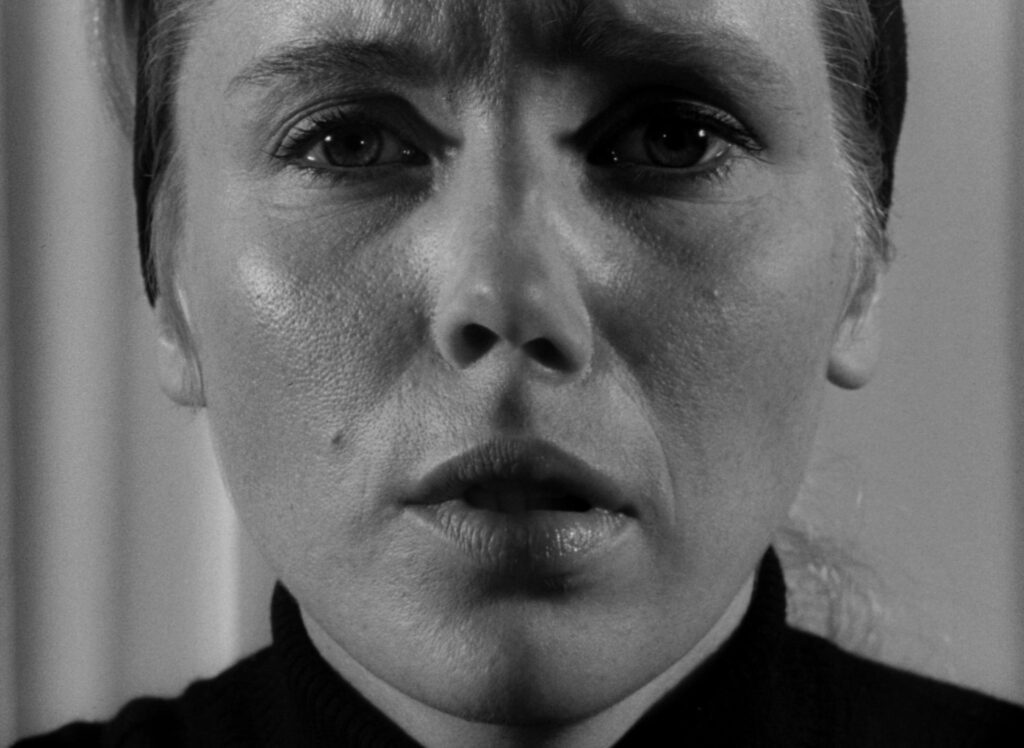
Composing with Faces: A Visual Grammar
If the face is a landscape, Bergman developed a sophisticated visual grammar for exploring it. His techniques went far beyond simply placing the camera close to an actor. He used lighting, angle, composition, and obstruction to shape our perception of a character's inner world.
The following video essay is an excellent visual analysis of Bergman's "art of filming faces."
The Director Who Mastered The Art of Filming Faces
The video 'The Director Who Mastered The Art of Filming Faces' by Thomas Flight provides a brilliant catalogue of Bergman's specific techniques. It will give you a clear, visual understanding of his methods.
Please watch the following three segments: Manipulating the Face (01:28 - 02:51): Notice how he uses rotation, objects, and especially light to radically change the texture and meaning of a face. Costume, Shadow, and Subtle Expression (02:51 - 03:58): Your background in design will make the use of costume and shadow here particularly interesting. Focus on the analysis of Liv Ullman's subtle expressions in Cries and Whispers. The Power of Obscuring (05:33 - 06:24): Pay attention to the psychological effect of hiding part of a face. Bergman understood that what we can't see can be as powerful as what we can.
Staging for Psychological Intimacy
Bergman's focus on the face fundamentally changed how he staged entire scenes. He often rejected the conventional shot/reverse-shot method used for dialogue, which tends to create a back-and-forth rhythm. Instead, he developed a unique staging technique that creates intense psychological intimacy and allows characters to deliver lines like private confessions, or soliloquies, even when another person is present.
This next reading breaks down the mechanics of this technique. As a director, understanding these staging principles is invaluable.
Notes on Ingmar Bergman’s Stylistic Development
The article 'Notes on Ingmar Bergman’s Stylistic Development' provides a superb analysis of Bergman's innovative staging. It explains how he creates the space for his actors to express deep, internal monologues.
Please read the section that begins with the discussion of 'Nära Livet' (Brink of Life) and continues through the analysis of figures 2-8. Focus on the concept of 'frontal staging'—where characters often look towards the camera rather than at each other. The author argues this avoids a 'naturalist battle' and creates an 'introverted tone'.
This staging, combined with his compositions of multiple faces within a single frame, turns dialogue scenes into complex psychological portraits. Let's revisit the Thomas Flight video to see this in action.
The Director Who Mastered The Art of Filming Faces
This segment of the video visually demonstrates the principles discussed in the article.
Please watch these two final clips: Arranging Multiple Faces (03:58 - 05:33): See how he stacks and arranges faces to create symbolic meaning and contrast emotions within a single shot. Staging and Movement (07:59 - 09:12): This section explicitly discusses the absence of shot/reverse-shot and the precision required from actors. It shows how the turn of a head becomes a major dramatic event.
Case Study: Persona and the Psychology of the Self
Nowhere are these techniques more central than in Bergman's 1966 masterpiece, Persona. The film, which you might find resonates with your interest in surrealism and Rebecca Horn's explorations of identity, is a profound investigation into the nature of the self. Bergman uses the face to explore psychological theories, particularly Carl Jung's concepts of the persona (the social mask we wear) and the shadow (the repressed, hidden parts of our identity).
This final video provides the psychological context to understand why Bergman's visuals in Persona are so powerful.
The film that drove its director mad
The video 'The film that drove its director mad' offers a deep dive into Persona, linking its visual strategies directly to Jungian psychology and Bergman's own mental state during its creation.
Please watch two key sections that break down the film's core themes: Persona and Shadow (00:18:57 - 00:23:59): This part explains the Jungian concepts and how the two main characters, Elizabeth and Alma, can be seen as representing the ego and the shadow self. This is the theoretical key to the film's psychological intensity. The Monologue Analysis (00:30:26 - 00:33:47): This is a brilliant shot-by-shot analysis of a famous monologue that is repeated twice. Pay close attention to how the changes in camera framing, lighting, and performance visually represent the shifting dynamics between the characters' inner selves.
In Persona, the close-up isn't just a shot; it's an act of psychological inquiry. The famous composite faces and shots of characters seemingly merging are the ultimate visual expression of the film's themes of dissolving identity.

Application Exercise
Let's put these concepts into practice. For your own work, which aims to express abstract emotions and explore human feeling, Bergman's techniques offer a powerful model.
Scenario: Plan a short, dialogue-free scene for an experimental film. The scene must convey a character's internal struggle between their public, composed self (their persona) and a hidden, chaotic part of their identity (their shadow).
Instructions: In a few sentences for each point, describe how you would use Bergman's techniques to visualize this conflict:
- Close-Up Composition: How would you light the character's face to suggest this duality? Would you use stark, split lighting? Would you use shadows cast by an object? Would you partially obscure the face?
- Performance and Movement: What subtle expressions or precise movements (like a slow turn of the head) would you ask of the performer to convey the inner turmoil shifting beneath a calm surface?
- Staging with Another Element: If a second person (or even an object, like a mirror or a sculpture you designed) acts as the catalyst for this internal conflict, how would you compose them in the frame with your main character? Would you use the frontal, non-confrontational staging? Could you create a composition where their faces merge or overlap to create a single, symbolic image?
This exercise will help you begin to translate abstract psychological ideas into a concrete visual plan, just as Bergman did.
Key Takeaways
- Bergman elevated the close-up to his primary storytelling tool, treating the human face as a landscape for psychological drama.
- He used a rich visual grammar—including specific lighting, camera angles, and partial obstruction—to reveal or conceal his characters' inner states.
- He developed an innovative staging technique, often avoiding shot/reverse-shot in favor of frontal compositions that create psychological intimacy and allow for introverted expression.
- In films like Persona, these cinematic techniques are fused with deep psychological concepts (like Jung's persona/shadow) to explore the very nature of identity.
Looking Ahead
In this lesson, we saw how Ingmar Bergman looked inward, finding metaphysical drama in the microscopic landscape of the human face. In our next lesson, we will turn our gaze outward. We'll analyze another of your key inspirations, Werner Herzog, who finds his drama in the vast, indifferent, and often terrifying landscapes of the natural world, using them as powerful narrative and metaphysical forces.