Recommended resources
The freely available resources this lesson will direct you to.
- Nature and Suffering with Werner Herzog | The MeatEater Podcastwww.youtube.com
- The Inner Chronicle of What We Are – Werner Herzog Documentarywww.youtube.com
- [PDF] Dwelling in active serenity: Nature in Werner Herzog's cinemawww.repository.cam.ac.uk
- Gazing Into Werner Herzog's Landscapes of the Soulwww.brightwalldarkroom.com
Hello! Welcome to our new lesson.
In our last session, we delved into the world of Ingmar Bergman, analyzing how he masterfully used the human face as an "inner landscape" to explore the depths of psychological turmoil. We saw how a close-up could become the entire world of the film.
Today, we pivot from the microscopic to the macroscopic. We turn our gaze from the landscape of the face to the vast, imposing landscapes of the natural world, as seen through the eyes of another of your key inspirations: Werner Herzog. This lesson directly addresses the learning outcome of describing Herzog's use of landscape and nature as narrative and metaphysical forces. We will explore how, for Herzog, a mountain, a river, or a jungle is never just a setting, but a powerful entity that shapes the story and embodies his profound, and often bleak, philosophy.
Herzog's Philosophy: The Indifference of Nature
Before we analyze his films, it's essential to understand Herzog's core philosophy. Many describe his films with the shorthand "Man vs. Nature," but Herzog himself finds this description lacking.

Herzog argues that for nature to be "against" man, it would have to be aware of man's existence. He believes it is not.
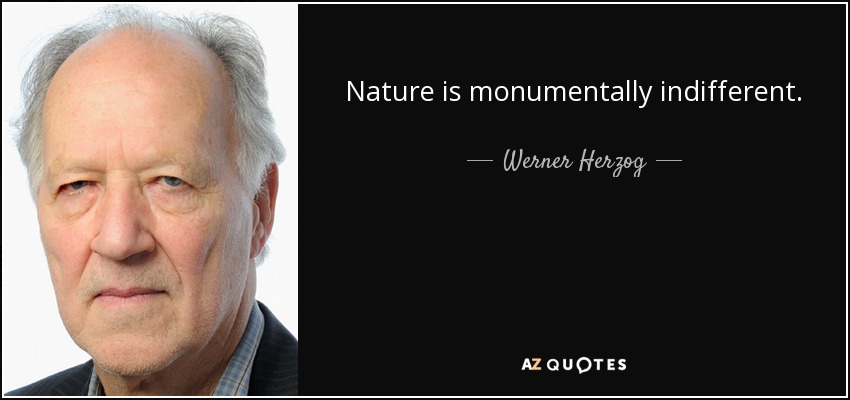
Let's hear this directly from the director.
Nature and Suffering with Werner Herzog | The MeatEater Podcast
In this excerpt from 'The MeatEater Podcast,' Werner Herzog immediately clarifies his stance on nature. Listening to him articulate this idea is the best way to grasp his unique perspective.
Please watch the segment from 01:07 to 02:46. Pay close attention as Herzog corrects the 'man versus nature' cliché, instead describing the universe as 'monstrously indifferent' and its common denominator as 'chaos, hostility, and murder.'
This idea of a chaotic, indifferent universe is the philosophical bedrock of his work. His characters are not fighting a malevolent opponent; they are struggling to assert their dreams, obsessions, and very existence in a cosmos that simply does not care.
Ecstatic Truth and Adequate Images
Given this worldview, Herzog is not interested in capturing a simple, factual reality. He is on a quest for what he calls "ecstatic truth"—a deeper, poetic truth that can only be reached through invention, imagination, and stylization. This concept is vital for your own goal of creating artistic and experimental films.
To find this ecstatic truth, he seeks out "adequate images"—powerful, pure images that reflect our inner state and can be found in the world's most extreme and mysterious landscapes.
The Inner Chronicle of What We Are – Werner Herzog Documentary
This video essay, 'The Inner Chronicle of What We Are,' provides a clear explanation of these two crucial concepts in Herzog's filmmaking philosophy.
Please watch two segments from this video: In Search for Adequate Images (10:26 - 12:05): Focus on Herzog's disdain for 'worn out images' and his search for fresh, powerful ones in unknown places. Ecstatic Truth (24:25 - 27:01): This is the most important part. Grasp the distinction he makes between the 'accountant's truth' (facts) and the 'ecstatic truth' (a deeper, poetic truth reached through fabrication and stylization).
So, when Herzog points his camera at a landscape, he's not just showing us a place. He's using that place to find an "adequate image" that can reveal an "ecstatic truth" about the human condition.
Case Study 1: Nature as Antagonist in Aguirre, the Wrath of God (1972)
Herzog's breakthrough film, Aguirre, the Wrath of God, is perhaps the most visceral depiction of nature as a narrative force. The story follows a Spanish conquistador's mad search for El Dorado in the Amazon. Here, the jungle and the river are not backdrops; they are lead characters.
Gazing Into Werner Herzog's Landscapes of the Soul
The article 'Gazing Into Werner Herzog's Landscapes of the Soul' offers a brilliant analysis of how the Amazonian landscape functions in Aguirre.
Please read the section that begins with 'When it comes to jungles on screen, there is before Aguirre and after Aguirre.' Focus on how the author describes the river as a 'centrifugal force' and the jungle as 'omniscient,' shaping the narrative and reflecting Aguirre's descent into madness.
In Aguirre, the landscape is an active antagonist. The rapids destroy the rafts, the dense vegetation hides unseen enemies, and the sheer, unending green expanse drives the characters insane. The jungle's indifference and chaos don't create Aguirre's madness, but they provide the perfect environment for his pre-existing megalomania to fester and consume him. The landscape becomes a mirror for the chaos within.
Case Study 2: Nature as Metaphor in Fitzcarraldo (1982)
Ten years later, Herzog returned to the Amazon for Fitzcarraldo, a film about a man obsessed with building an opera house in the jungle. This required hauling a 320-ton steamship over a mountain. Herzog famously performed this feat for real, rejecting special effects. This decision gets to the heart of how he uses nature as a metaphysical force.
The struggle is not just about moving a ship; it's a grand metaphor for the scale of human dreams against the crushing indifference of reality.
Let's hear Herzog explain the project's meaning himself.
Nature and Suffering with Werner Herzog | The MeatEater Podcast
In this return to 'The MeatEater Podcast,' Herzog discusses the filming of Fitzcarraldo and pushes back against the idea that moving the ship was 'insane.'
Please watch these two clips: The Jungle Experience (43:16 - 46:03): Listen to his description of the jungle—'I love the jungle yet against my better knowledge'—and the immense challenges of the shoot. This highlights the palpable, antagonistic presence of the environment. A Big Metaphor (46:03 - 48:44): This is key. Focus on his explanation that the ship being pulled over a mountain is not insanity but a 'big metaphor' for human aspiration, something dormant inside all of us.
Where Aguirre is consumed by the jungle, Fitzcarraldo engages in a monumental struggle with it. The rapids ultimately defeat his specific plan, but he emerges not destroyed, but transformed. The physical battle with the landscape serves a metaphysical purpose: it tests the limits of a dream.
The following reading provides a final, clarifying contrast between the landscapes of Aguirre and Fitzcarraldo.
Gazing Into Werner Herzog's Landscapes of the Soul
We'll now read the next section from 'Gazing Into Werner Herzog's Landscapes of the Soul,' which beautifully contrasts the two films.
Please read the section titled with the quote, 'I’m planning something geographical.' Pay attention to the distinction between Aguirre’s obsession and Fitzcarraldo’s dream, and how the jungle acts as the 'ultimate undoing' of the plan, but not the spirit.
Application Exercise
Think about your own artistic goal to tell stories through nature and metaphors. Consider a character possessed by a single, powerful emotion—grief, obsession, or transcendent joy.
Now, instead of showing that emotion through a Bergman-esque close-up on their face, how would you use a Herzog-ian landscape to express it?
- Choose a Landscape: Pick a natural environment (a desert, an ice field, a volcanic crater, a dense forest).
- Describe the "Adequate Image": What specific, powerful image from this landscape would represent your character's inner state? (e.g., a lone, dead tree in a salt flat for grief; a relentlessly advancing glacier for obsession).
- Narrative vs. Metaphysical: Briefly describe how this landscape could function in your story. Does it act as a narrative force (a physical obstacle the character must overcome)? Or is it a purely metaphysical one (a grand metaphor for their internal struggle, like the ship over the mountain)?
Take a few minutes to jot down your ideas. This exercise will help you bridge the gap between abstract emotion and tangible, cinematic imagery, using the natural world as your canvas.
Key Takeaways
- Indifferent Nature: Herzog's central philosophy is that nature is not evil, but "monumentally indifferent" to human existence, characterized by chaos and struggle.
- Ecstatic Truth: He uses landscapes to search for "ecstatic truth," a poetic reality that transcends mere facts and is achieved through stylization and imagination.
- Nature as Narrative Force: In films like Aguirre, the landscape acts as a character and antagonist, a physical force that drives the plot and mirrors the protagonist's inner chaos.
- Nature as Metaphysical Force: In films like Fitzcarraldo, the physical struggle with nature becomes a grand metaphor for human dreams, aspirations, and the sheer force of will required to pursue them.
Looking Ahead
In this lesson, we saw how Werner Herzog finds metaphysical drama in the vast, external world. In our next lesson, we will explore the work of Rebecca Horn, an artist who masterfully bridges the internal and external. We will analyze how she integrates the body, wearable sculpture, and performance in her films, creating a unique language where the physical form itself becomes a moving, expressive landscape. This will connect the psychological focus of Bergman with the environmental focus of Herzog, bringing us even closer to your goal of creating interdisciplinary, experimental cinema.