Recommended resources
The freely available resources this lesson will direct you to.
Hello! Welcome back to our study of topological matter.
In the previous lesson, we analyzed the Kane-Mele model and saw how strong spin-orbit coupling can drive a trivial insulator into a Quantum Spin Hall (QSH) insulator, a state characterized by a non-trivial topological invariant. The most striking consequence of this, as we demonstrated numerically, is the mandatory appearance of gapless states at the material's edge.
Today, we're going to take a closer look at these remarkable edge states. Our goal is to describe the spin-momentum locking of helical edge states in a QSH insulator. We will uncover the unique relationship between an electron's spin and its direction of motion along the edge, and understand why this property makes these states so robust against disruptions.
1. The Helical Nature of Edge States
The edge states of a QSH insulator are often called "helical" edge states. This term refers to a property known as spin-momentum locking: an electron's spin orientation is rigidly tied to its momentum vector. Specifically, for a given edge, electrons moving in one direction will have one spin polarization (e.g., spin-up), while electrons moving in the opposite direction are forced to have the opposite spin polarization (spin-down).
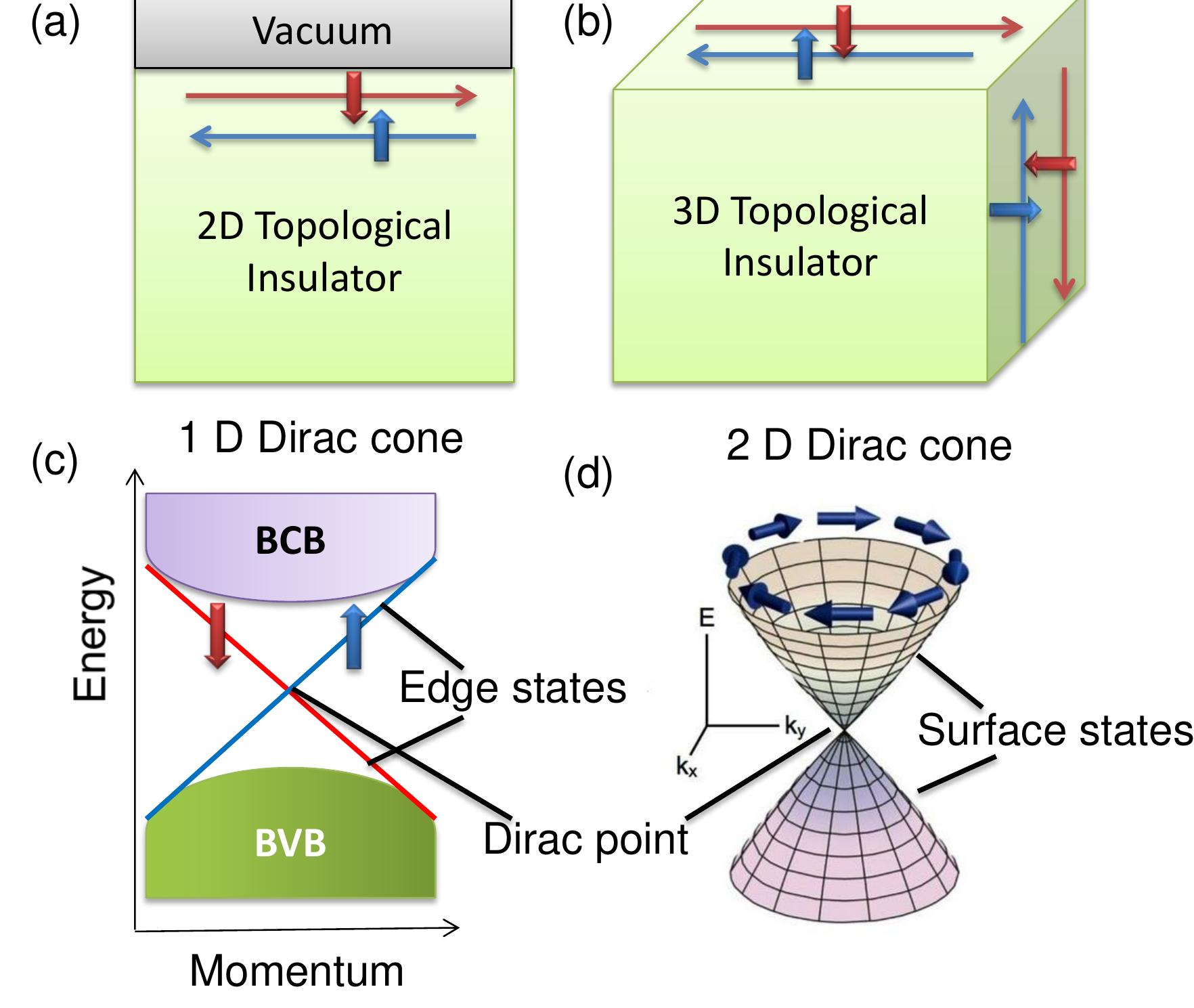
To understand the origin of this behavior, it's helpful to return to the intuitive picture of the QSH effect as two independent copies of the integer quantum Hall (IQH) effect, one for each spin, glued together in a time-reversal symmetric way.
Let's hear this idea explained by Charles Kane, one of the pioneers of the field.
Quantum spin Hall effect intro (by Charles Kane)
In this short video, Charles Kane provides the foundational concept of the QSH effect. He explains how two time-reversed copies of the IQH effect lead to counter-propagating, spin-polarized edge states.
Watch from 0:34 to 2:29. Focus on how the model is constructed and how this directly leads to the emergence of what he terms 'helical edge states', where spin-up and spin-down electrons have opposite group velocities.
As Kane explains, the intrinsic spin-orbit coupling effectively acts like a magnetic field that points up for spin-up electrons and down for spin-down electrons.
- The spin-up electrons experience an IQH effect, leading to a chiral edge state that propagates in one direction (e.g., clockwise).
- The spin-down electrons experience an IQH effect from the opposite effective magnetic field, leading to a chiral edge state that propagates in the opposite direction (counter-clockwise).
When you look at a single edge, you see a spin-up state moving one way and a spin-down state moving the other. This is precisely spin-momentum locking. There is no net charge current (the Hall conductance is zero), but there is a net flow of spin, giving the effect its name: the Quantum Spin Hall effect.
2. Visualizing Helical Edge States
We can visualize this by examining the band structure and wavefunctions of a QSH insulator in a finite strip geometry, which we simulated in the last lesson. The band structure reveals two linear bands that cross the bulk energy gap. These are the edge states. One band has a positive slope (positive group velocity, ), and the other has a negative slope (negative group velocity).
The key is that these two bands are spin-polarized. The state with positive velocity is, for example, predominantly spin-up, while the state with negative velocity is predominantly spin-down.
Energy spectrum, edge state wave functions and finite size effects
This section from a Bachelor's thesis provides an excellent visualization of the helical edge states in the HgTe/CdTe quantum well system, a realistic material platform for the QSH effect.
Please read the section 'Energy spectrum, edge state wave functions and finite size effects' on pages 15-16 of the PDF. Pay close attention to Figure 3.5. It shows the calculated probability density of the spin-up and spin-down wavefunctions, confirming that they are localized at opposite edges and counter-propagating.
The analysis in the reading makes the abstract concept of spin-momentum locking concrete. By plotting for the different spin components, you can directly "see" that:
- The wavefunctions are localized at the edges of the sample ().
- A state with momentum (e.g., spin-up) is localized at one edge, while the state with momentum (also spin-up) is localized at the other edge.
- On a single edge, the right-moving state () is spin-up, and the left-moving state () is spin-down. This is the hallmark of a helical liquid.
3. Protection by Time-Reversal Symmetry
The most profound consequence of spin-momentum locking is the exceptional stability of these edge states. In a normal one-dimensional wire, any small amount of disorder or impurity can cause an electron to scatter backwards, leading to resistance and eventually Anderson localization. In a helical edge state, this is forbidden.
The argument is remarkably simple:
- Consider an electron moving to the right. Due to spin-momentum locking, it must have spin-up.
- To backscatter, it would need to reverse its momentum and travel to the left.
- The only available left-moving states have spin-down.
- Therefore, backscattering requires the electron to flip its spin.
A standard, non-magnetic impurity scatters electrons via an electric potential, which does not couple to spin. Such an impurity respects time-reversal symmetry and cannot induce the required spin-flip. Consequently, elastic backscattering is forbidden.
Let's hear Charles Kane explain this protection and its surprising strength.
Quantum spin Hall effect intro (by Charles Kane)
In this follow-up clip, Kane discusses the puzzle of why these edge states are so robust. He explains their protection using both the concept of Kramers' degeneracy and a powerful thought experiment.
Watch from 2:29 to 6:11. First, focus on how time-reversal symmetry and Kramers' theorem protect the band crossing point. Then, pay close attention to his thought experiment about transmission through a disordered region, which leads to the conclusion of perfect transmission.
The protection can be understood more formally through two related concepts:
1. Kramers' Theorem: As Kane mentioned, and as we've discussed before, time-reversal symmetry guarantees that for a system with half-integer spin, every energy eigenstate is at least twofold degenerate (a "Kramers pair"). The crossing point of the two helical edge state bands at a time-reversal invariant momentum (TRIM) like is precisely such a Kramers degenerate point. No time-reversal symmetric perturbation (like non-magnetic disorder) can lift this degeneracy and open a gap. The metallic nature of the edge is topologically protected.
2. Scattering Matrix (S-matrix) Formalism: We can analyze the scattering process more rigorously. It can be shown that for particles with (fermions), time-reversal symmetry imposes a strict constraint on the reflection matrix: it must be antisymmetric. For an odd number of channels (like the single Kramers pair on one edge), an antisymmetric matrix must have a determinant of zero, which forbids perfect reflection. This guarantees some transmission, and in the single-channel case, it guarantees perfect transmission.
Test your understanding!
Imagine you introduce magnetic impurities (e.g., a few randomly oriented magnetic atoms) into the edge of a QSH insulator. These impurities do not respect time-reversal symmetry. What do you expect to happen to the edge state transport?
Show answer
Magnetic impurities break time-reversal symmetry. The interaction between the electron's spin and the impurity's local magnetic moment can induce a spin-flip. This provides a mechanism for an electron to go from a right-moving, spin-up state to a left-moving, spin-down state. Backscattering is now allowed, which will open a gap in the edge state spectrum, destroy the perfect conductance, and lead to resistance.
4. Experimental Signatures
This unique physics leads to clear experimental fingerprints.
Quantized Conductance
The prohibition of backscattering means the edge channels act as perfect ballistic conductors. For a typical two-terminal measurement on a sample of length , the conductance is predicted to be quantized at a universal value, independent of the sample's length or the amount of non-magnetic disorder.
The factor of 2 arises because in a two-terminal setup, there are two edges conducting in parallel. This exact value was measured in HgTe/CdTe quantum wells by Molenkamp's group in 2007, providing the first experimental confirmation of the QSH effect. The resource below discusses this seminal experiment.
Quantum Spin Hall Effect - Universidad de Salamanca
This document outlines the Landauer-Büttiker formalism applied to a QSH insulator and presents the experimental results that confirmed the theory.
Skim through the slides starting from 'Molenkamp’s group (2007); HgTe/CdTe QW Experiments' to the end (slides 139-153). Focus on the final result for a multi-terminal Hall bar (slide 151) which predicts a quantized longitudinal resistance and zero Hall resistance, and the experimental data on slide 152 that confirms this quantization for samples of appropriate size.
Direct Imaging with ARPES
While transport measurements provide compelling evidence, Angle-Resolved Photoemission Spectroscopy (ARPES) can directly "see" the spin-momentum locking. By using circularly polarized light, which carries angular momentum, photoemission becomes sensitive to the electron's spin. This allows experimentalists to map the spin texture of the electronic bands.
Colloquium, November 12th, 2015 -- Shining Light on Topological Insulators
This colloquium clip shows how ARPES with polarized light is used to visualize the spin texture of topological surface states. While it focuses on a 3D TI, the principle is identical for the 2D edge states.
Watch the segment from 24:40 to 27:22. The key idea is how taking the difference between spectra measured with left- and right-circularly polarized light reveals the underlying spin polarization of the bands.
This technique provides direct, visual confirmation of the helical nature of the edge and surface states, beautifully connecting the abstract topological theory to a measurable quantity. Your background in spectroscopy should make the logic of this differential measurement technique particularly clear.
Conclusion
Today, we have delved into the physics of the edge states that define a Quantum Spin Hall insulator. We moved beyond simply knowing they exist to understanding their fundamental properties.
Key Takeaways:
- The edge states of a QSH insulator are helical, exhibiting spin-momentum locking: an electron's spin is locked perpendicular to its momentum.
- This property arises because the QSH state can be viewed as two opposite integer quantum Hall states, one for each spin, combined in a time-reversal symmetric manner. This results in counter-propagating, spin-polarized channels at the edge.
- Spin-momentum locking, protected by time-reversal symmetry, forbids backscattering from non-magnetic impurities. This makes the edge a perfect one-dimensional conductor.
- This perfect conduction manifests experimentally as a quantized conductance of , and the spin texture can be directly imaged using spin-resolved ARPES.
Preview of the Next Lesson
We have now thoroughly explored the bulk and boundary of 2D topological insulators. The next logical step is to extend these ideas to three dimensions. In the next lesson, we will discuss the bulk-boundary correspondence for both 2D and 3D topological insulators, exploring the fascinating properties of the 2D surface states that emerge on the boundary of a 3D TI.