Recommended resources
The freely available resources this lesson will direct you to.
- TMS21 Lecture 2. Jennifer Cano. Introduction to Topological Insulators, part 1www.youtube.com
- Charles Kane - Symmetry, Topology and Electronic Phases of Matter (February 14, 2018)www.youtube.com
- Colloquium: Topological insulatorsfizyka.umk.pl
- A Study of Topological Insulators in Two and Three Dimensionscentral.bac-lac.gc.ca
Hello! Welcome back to our final lesson on topological insulators.
In our last session, we dissected the helical edge states of a 2D Quantum Spin Hall (QSH) insulator, establishing their key property of spin-momentum locking and its origin in time-reversal symmetry. We saw that this protection leads to a perfectly conducting 1D channel at the system's boundary.
Today, we will generalize this powerful idea into a unifying principle known as the bulk-boundary correspondence. Our learning outcome is to explain the bulk-boundary correspondence for 2D and 3D topological insulators. We will see how a non-trivial topological invariant calculated from the bulk properties of a material makes the existence of robust, metallic states at its boundary with a trivial insulator (like vacuum) an absolute necessity.
1. The Bulk-Boundary Correspondence: A Fundamental Principle
The bulk-boundary correspondence is one of the most profound and central concepts in the study of topological phases. In essence, it states:
The topological invariant of a gapped bulk material dictates the number and character of gapless states that must exist at its boundary.
This means you can predict the exotic physics happening at the edge of a material just by calculating a property of its infinite, periodic bulk crystal structure.
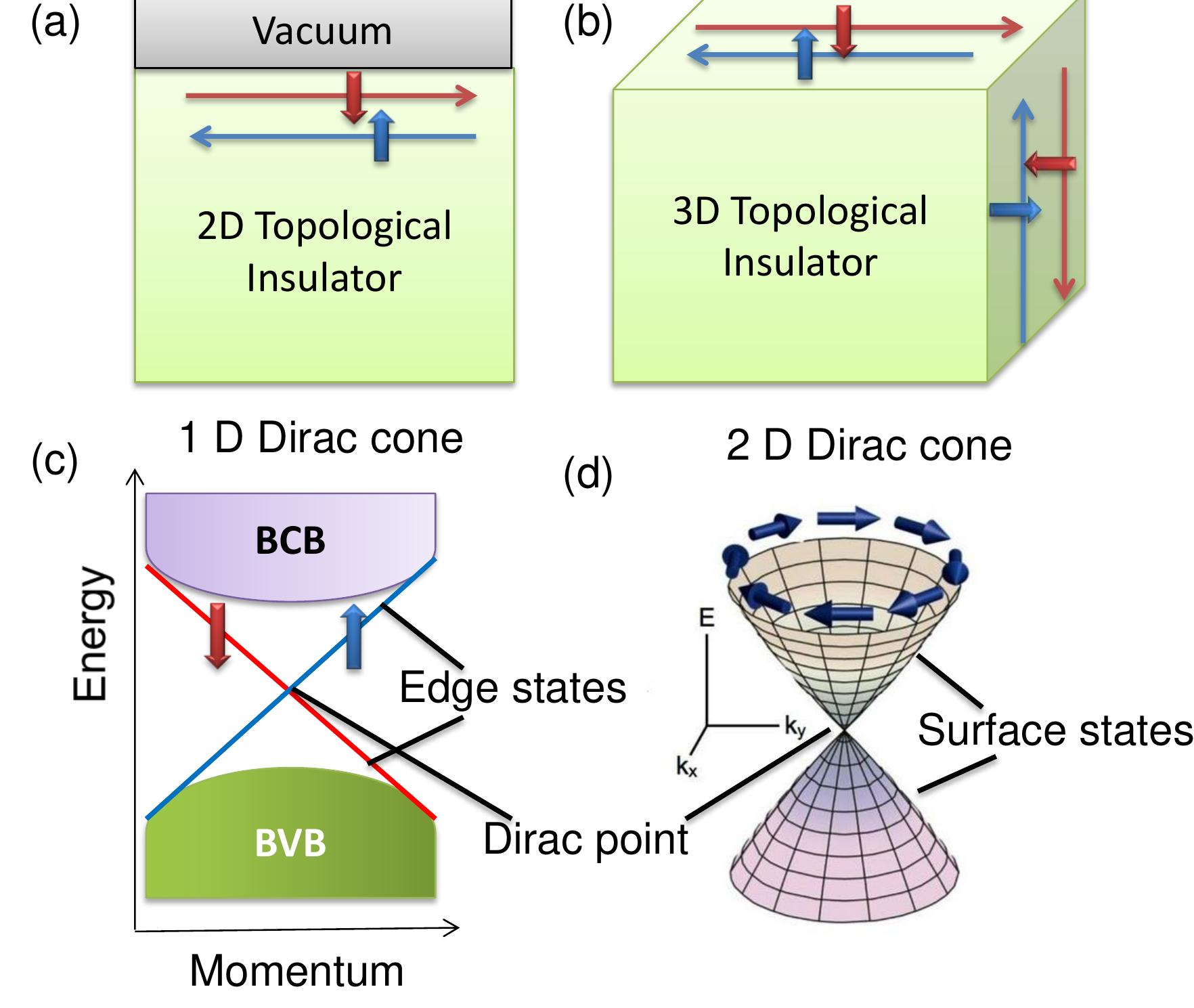
Let's begin by developing an intuition for this principle using the Integer Quantum Hall (IQH) effect, the first discovered topological phase.
Charles Kane - Symmetry, Topology and Electronic Phases of Matter (February 14, 2018)
In this classic explanation, Charles Kane uses a simple, semi-classical picture of 'skipping orbits' to provide a highly intuitive reason for why a gapped quantum Hall bulk must have conducting edge states. He introduces the idea of the edge as a robust, 'one-way street' for electrons.
Watch the segment from 27:53 to 33:05. Focus on the skipping orbit picture and the resulting one-way (chiral) nature of the edge current. Note his emphasis on the robustness of these states against disorder.
Kane's explanation provides a great physical picture. The core theoretical argument is that if you have an interface between two insulators with different topological invariants, the energy gap must close somewhere at that interface. Why? Because the topological invariant is an integer (or a value); it cannot change smoothly from one value to another. It can only change abruptly, which requires passing through a phase transition where the bulk gap closes. At the boundary, this gap-closing manifests as a permanent, gapless metallic state.
For a more formal and general treatment, let's turn to the canonical review on topological insulators by Hasan and Kane.
Colloquium: Topological insulators
This section of the review formally establishes the bulk-boundary correspondence. It introduces the general argument for the existence of edge states at a topological boundary and provides the explicit formula for Chern insulators.
Please read the subsection '3. Edge states and the bulk-boundary correspondence' on pages 3047-3048. Pay special attention to the introductory paragraphs and the final equation, Eq. (7).
As the paper states, the correspondence for a Chern insulator (like the IQH state) is given by:
Here, is the bulk Chern number, and and are the number of right-moving and left-moving modes at the edge, respectively. For an IQH state with at a boundary with vacuum (), we must have a net of one chiral mode (). This is the "one-way street" Kane described.
2. The Correspondence in 2D Topological Insulators
Now, let's apply this principle to the QSH insulators we've been studying. These are protected by time-reversal symmetry, so their bulk invariant is not the Chern number (which must be zero), but the index, .
In the last lesson, we saw that a non-trivial bulk () gives rise to a pair of counter-propagating helical edge states. This is the bulk-boundary correspondence for 2D TIs. We can now state it more formally.
Colloquium: Topological insulators
Let's return to the Hasan and Kane review to see the formal statement of the bulk-boundary correspondence for Z2 topological insulators.
Read the subsection 'C. Z2 topological insulator' on pages 3048-3049. Focus on Figure 3, which illustrates the two possible connectivities of edge states, and Eq. (9), which formalizes the correspondence.
The key formula here is Eq. (9):
where is the number of Kramers pairs of edge states that cross the Fermi energy between two time-reversal invariant momenta (TRIMs) in the edge Brillouin zone.
- If the bulk is trivial (), there must be an even number of crossings. This allows for zero crossings, meaning the edge can be gapped.
- If the bulk is non-trivial (), there must be an odd number of crossings. This guarantees at least one crossing that cannot be removed by any time-reversal symmetric perturbation. This is the origin of the topologically protected metallic edge.
Let's watch a short video that provides a different, but very practical, way to visualize this connection.
TMS21 Lecture 2. Jennifer Cano. Introduction to Topological Insulators, part 1
In this video, Dr. Jennifer Cano explains how the Z2 invariant can be practically computed and how its value directly relates to the presence of surface states. She connects the bulk calculation to the edge-state band structure.
Watch from 42:10 to 47:18. Observe how she explains that a time-reversal symmetric system can't have a net Chern number, but you can define a Z2 invariant based on the winding of states over half the Brillouin zone. The crucial part is the connection she makes between this bulk property and whether an odd or even number of bands cross a line in the surface state spectrum.
3. The Correspondence in 3D Topological Insulators
The true power and richness of topology become apparent when we move to three dimensions. A 3D topological insulator is a material that is insulating in its bulk but is guaranteed to have conducting surfaces.
Strong and Weak 3D TIs
The classification in 3D is more complex. Instead of one invariant, there are four: .
- The three indices characterize weak topological insulators (WTIs). These can be understood as 3D stacks of 2D QSH layers. They have conducting surface states, but their protection relies on translation symmetry and they are not robust against all forms of disorder.
- The "strong" index characterizes strong topological insulators (STIs). If , the material is an STI, a phase that is intrinsically 3D and cannot be viewed as a simple stack of 2D systems. Its surface states are exceptionally robust.
We will focus on the strong topological insulator, as it represents a truly new phase of matter.
Surface States of a Strong 3D TI
The bulk-boundary correspondence dictates that an STI must have gapless states on any surface. What do these look like? Instead of 1D helical modes, the surface hosts a 2D metallic state with a peculiar band structure: a Dirac cone. This is similar to the band structure of graphene, but with a crucial difference: an STI surface has an odd number of Dirac cones (the simplest case being a single cone), whereas graphene has an even number (four, when accounting for spin and valley degeneracy).
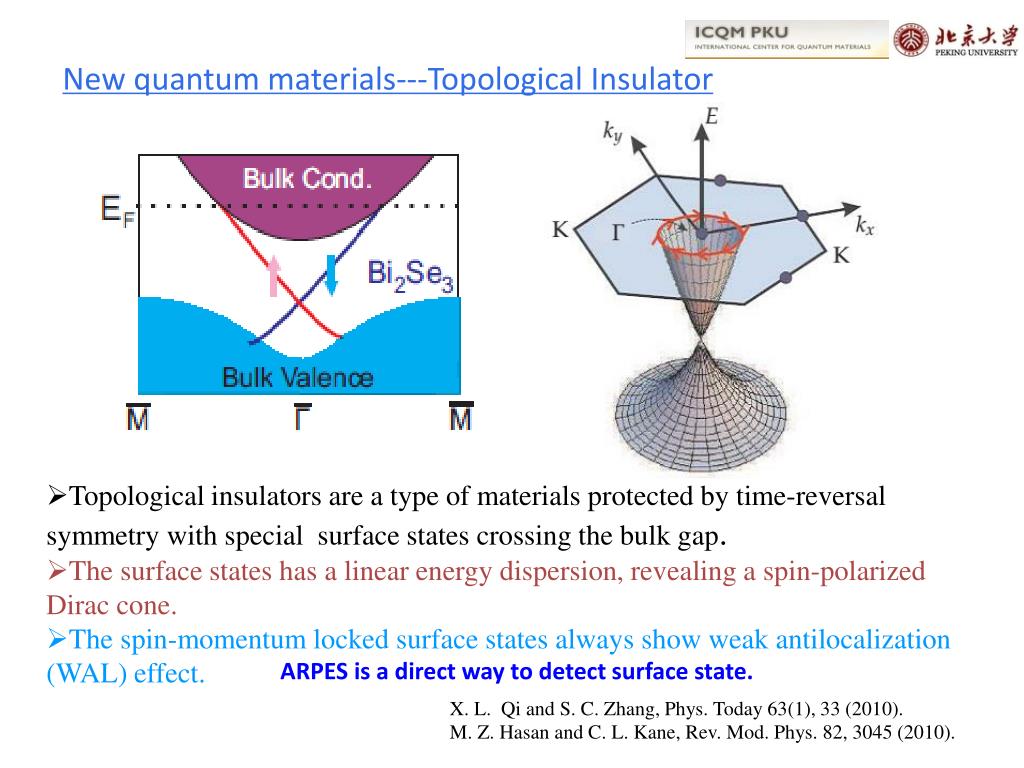
Let's read the final section from Hasan and Kane to formalize these ideas.
Colloquium: Topological insulators
This section introduces 3D topological insulators, defines the strong and weak indices, and describes the unique single-Dirac-cone surface state that is the hallmark of the strong phase.
Please read the subsection 'A. Strong and weak topological insulators' on page 3054. This is a dense but crucial section. Focus on understanding the distinction between weak and strong TIs and the description of the surface state of an STI: a single Dirac cone with a non-trivial Berry phase.
The correspondence for a 3D TI is thus:
- A bulk with a strong topological index implies that any surface will host an odd number of gapless 2D Dirac cones.
The existence of a single Dirac cone on the surface is remarkable. A single spinful Dirac fermion cannot exist in a purely 2D, time-reversal symmetric lattice (a consequence of the "fermion doubling theorem"). A topological insulator elegantly circumvents this theorem by splitting the would-be pair of Dirac cones: one lives on the top surface of the crystal, and its partner lives on the bottom surface. You can't get rid of one without getting rid of the other, but they are spatially separated by the entire bulk!
Test your understanding!
A "weak" 3D topological insulator can be viewed as layers of 2D QSH insulators stacked along a certain direction (say, ). While the side surfaces (e.g., the and faces) have protected states, the top/bottom () surfaces are not as robust. Why might the surface states of a weak TI be more susceptible to being gapped by disorder than the surface states of a strong TI?
Show answer
The surface states of a weak TI consist of an even number of Dirac cones. For example, stacking 2D TIs gives a pair of Dirac cones on the top surface. While these are protected by time-reversal and lattice translation symmetry, strong disorder that breaks translation symmetry can mix the states from the two different cones. This coupling between the pair of cones can open up an energy gap, destroying the metallic surface.
In contrast, a strong TI has an odd number of Dirac cones (simplest case: one). A single Dirac cone has no "partner" to couple with. As long as time-reversal symmetry is preserved, it is impossible to open a gap in its spectrum, making it robust even to strong disorder.
Conclusion
Today we have formalized one of the most aesthetically pleasing and physically powerful concepts in modern condensed matter physics: the bulk-boundary correspondence.
Key Takeaways:
- The Principle: The topological classification of a material's bulk electronic structure dictates the mandatory existence and character of conducting states at its boundaries.
- 2D Chern Insulators: The bulk Chern number equals the net number of chiral (one-way) edge modes: .
- 2D Insulators (QSHI): A non-trivial bulk () guarantees an odd number of pairs of helical edge states crossing the Fermi energy, making the edge a protected 1D metal.
- 3D Insulators: These are classified as strong or weak. A strong topological insulator () is a true 3D phase whose surfaces host an odd number of robust, 2D Dirac cones, creating a protected 2D topological metal.
This lesson completes our journey through the essential physics of topological insulators. We have progressed from the mathematical foundations of Berry curvature to the concrete physical reality of protected conducting channels on the boundaries of these exotic materials.
Preview of the Next Lesson
Having explored insulators with topological properties, we will next turn our attention to topological semimetals. In our next lesson, we will describe the bulk band structure and surface Fermi arcs characteristic of a Weyl semimetal. Unlike topological insulators, where the interesting physics is in the gapped bulk leading to boundary states, Weyl semimetals have topologically protected points where the bulk bands touch, leading to even more exotic phenomena in both the bulk and on the surface.