Recommended resources
The freely available resources this lesson will direct you to.
Welcome back.
In our last lesson, we quantified the inputs and outputs of the Kroll reduction reactor. Our mass balance calculations revealed a critical reality of the process: the reactor's output isn't pure titanium. It's a crude, porous mass called "sponge," which is a heterogeneous mixture of the desired titanium metal, unreacted magnesium, and the magnesium chloride byproduct. For this sponge to become a valuable industrial material, these impurities must be meticulously removed.
This lesson examines the crucial post-reduction purification steps that accomplish this. We will explore the two primary methods used in the industry: vacuum distillation and acid leaching. You will learn the fundamental principles of each technique, their operational characteristics, and the critical trade-offs they present in terms of cost, efficiency, and final product quality. Understanding these purification strategies is essential for evaluating the operational efficiency and cost structure of a titanium production facility.
1. Vacuum Distillation: The High-Purity Standard
The dominant method for purifying titanium sponge, especially for high-performance applications like aerospace, is vacuum distillation. The principle is elegant and relies on a fundamental physical property: differences in volatility.
Magnesium and magnesium chloride have much lower boiling points (and thus higher vapor pressures at a given temperature) than titanium.
- Titanium (Ti): Boiling Point ≈ 3287 °C
- Magnesium (Mg): Boiling Point ≈ 1090 °C
- Magnesium Chloride (MgCl₂): Boiling Point ≈ 1412 °C
By heating the crude sponge to a temperature around 1000 °C under a high vacuum, the Mg and MgCl₂ can be selectively vaporized, leaving the solid, purified titanium sponge behind.

The following reading describes how this is implemented in a large-scale industrial setting.
Titanium Sponge Production Method by Kroll Process at OTC - J-Stage
The paper 'Titanium Sponge Production Method by Kroll Process at OTC' from Osaka Titanium technologies describes their industrial-scale process. This section specifically covers the vacuum separation step.
Please read the short section titled '2.2 Reduction and vacuum separation'. Focus on the paragraph that begins 'After the reduction reaction is completed, vacuum separation is begun.' This details the heating, application of vacuum, and the final outcome.
As the resource describes, the entire reduction vessel containing the titanium cake is placed into a furnace and heated externally. A vacuum is pulled, causing the residual magnesium and MgCl₂ to turn into gas. This vapor is drawn out and collected on a cooler surface (the condenser), solidifying for later recycling. The MgCl₂ can be sent back to an electrolysis cell to recover the magnesium, closing the loop on a key raw material.
Operational Analysis of Vacuum Distillation:
-
Advantages:
- High Purity: This method is extremely effective at removing chlorides and magnesium, capable of producing titanium sponge with the very low impurity levels required for demanding applications. Crucially, it avoids contact with water or air, minimizing the pickup of oxygen and hydrogen, which are detrimental to titanium's mechanical properties.
- Efficient Recycling: It recovers the MgCl₂ byproduct and excess Mg in a relatively clean, anhydrous form, which is ideal for direct recycling into the electrolysis and reduction stages, respectively.
-
Disadvantages:
- Energy Intensive: Heating a large, multi-ton steel vessel to ~1000 °C and maintaining a high vacuum for many hours is extremely energy-consuming. This is a major operating cost.
- Slow Batch Process: The heating and cooling cycles are long, making it a bottleneck in the overall production chain and limiting throughput.
- High Capital Cost: Large-scale vacuum furnaces and powerful vacuum pumping systems represent a significant capital investment.
- Chloride Inclusions: As noted in some literature, if the process temperature is too high, the titanium particles can begin to sinter (fuse together), trapping pockets of MgCl₂ within the sponge that the vacuum cannot remove.
2. Acid Leaching: A Lower-Cost Alternative
An alternative purification route is acid leaching. Instead of exploiting differences in volatility, this method uses differences in chemical solubility. Magnesium and magnesium chloride are readily soluble in water and dilute acids, while metallic titanium is comparatively resistant, especially under controlled conditions.
The process, in simple terms, involves crushing the crude sponge and washing it with an aqueous solution to dissolve away the impurities.
[PDF] Purification of crude titanium powder produced by metallothermic ...
This paper, 'Purification of crude titanium powder by acid leaching', directly compares vacuum distillation with leaching and investigates the key challenges of the latter. It offers a clear rationale for why a company might choose this path.
Please read the section 'Purification methods' (starts on page 351). Pay close attention to the paragraph starting 'The fundamental difference between vacuum distillation and acid leaching...'. This paragraph explicitly lays out the pros and cons of each method from an operational and cost perspective.
As the paper highlights, the business case for leaching is compelling: it consumes less energy, uses simpler (and cheaper) equipment, and can be faster than distillation. However, it introduces significant process control challenges, primarily revolving around contamination.
The Challenge of Oxygen and pH Control
The main drawback of leaching is the risk of contaminating the titanium with oxygen. Given your background in chemistry, you'll recognize that titanium is a highly reactive metal. This contamination happens in two primary ways:
- Direct Oxidation: Unreacted magnesium is highly reactive with water and acid, an exothermic reaction that releases significant heat. If the temperature gets too high, the titanium itself will begin to oxidize by reacting with water.
- Hydrolysis of Subchlorides: The crude sponge may contain titanium subchlorides (e.g., TiCl₂, TiCl₃) from incomplete reduction. In neutral water, these compounds hydrolyze to form insoluble titanium hydroxides and oxychlorides, which precipitate onto the surface of the titanium powder, increasing its oxygen content.
The solution to these problems lies in careful process control, particularly temperature and pH.
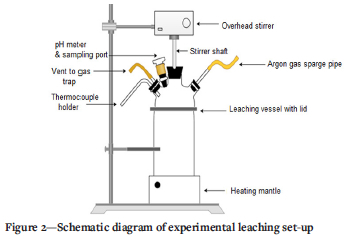
Let's look at how the authors of the paper address the contamination issue.
[PDF] Purification of crude titanium powder produced by metallothermic ...
The same paper demonstrates how controlling the leaching conditions, specifically the acidity, is crucial for producing high-quality titanium.
Please read the section 'Results and discussion', focusing on the subsection 'Effect of leaching medium on the leaching system and product quality'. Notice the difference in oxygen content for products leached in pure water versus 1 M HCl (Figure 2). The text explains that maintaining a low pH (by using acid) prevents the formation of insoluble hydrolysis products.
The key finding is that leaching in plain water is counterproductive due to hydrolysis, leading to high oxygen content. By using a sufficiently concentrated acid (1 M HCl in this case), the pH of the solution is kept low (pH < 2). In this acidic, reducing environment, the problematic titanium subchlorides remain dissolved in the solution as ions (e.g., ) and can be washed away, rather than precipitating as oxides on the final product.
This turns the purification process into a delicate optimization problem: the acid must be strong enough to prevent hydrolysis but not so aggressive that it attacks the titanium metal itself. It's a classic example of a cost-performance trade-off, directly relevant to your goal of understanding industrial operations.
3. Comparison: Distillation vs. Leaching
As a potential executive or investor, the choice between these two processes (or a hybrid approach) is a major strategic decision. It dictates capital expenditure, operating costs, product quality, and target markets.
| Feature | Vacuum Distillation | Acid Leaching |
|---|---|---|
| Principle | Separation by volatility (boiling points) | Separation by solubility in an aqueous solution |
| Energy Cost | Very High (heating to ~1000 °C, high vacuum) | Low (primarily for stirring, pumping; exothermic reaction) |
| Capital Cost | High (large vacuum furnaces, pumps) | Low (tanks, stirrers, pumps) |
| Final Purity (Oxygen) | Excellent (very low oxygen pickup) | Fair to Good (high risk of oxygen pickup without tight control) |
| Throughput | Slow (long batch cycles for heating/cooling) | Potentially fast, can be designed as a continuous process |
| Byproduct Recycling | Efficient (recovers clean, anhydrous Mg/MgCl₂) | Complex (recovering anhydrous MgCl₂ from a brine solution is costly) |
| Key Challenge | Energy cost, cycle time | Process control (temperature, pH) to ensure product quality |
| Typical Use | Aerospace-grade sponge, high-value applications | Lower-cost powders, potential pre-purification step |
Conclusion
You have now examined the critical final steps in producing titanium sponge. The crude mass from the Kroll reactor is transformed into a commercially useful material through one of two distinct routes, each with a clear operational and economic profile.
Key Takeaways:
- Vacuum distillation is the industry standard for high-purity titanium. It leverages the high volatility of Mg and MgCl₂ impurities to separate them from titanium under heat and vacuum. It is energy-intensive and slow but produces the highest quality product.
- Acid leaching is a lower-cost alternative that dissolves impurities in an acidic solution. While it has lower capital and energy costs, it presents a significant process control challenge to prevent oxygen contamination of the final product.
- The choice between these methods represents a core techno-economic trade-off. Vacuum distillation prioritizes ultimate quality for a high cost, while leaching aims for "good enough" quality at a lower cost, a classic dilemma in manufacturing strategy.
The crude sponge, after purification, is still not a final product. It is a porous, irregular mass. In our next lesson, we will briefly discuss the final step in primary metal production: consolidating the sponge into a solid, usable ingot through advanced melting technologies. However, we will first build on today's lesson by analyzing the trade-offs between final sponge purity, recovery yield, and processing costs, a topic that directly ties into the choice of purification method.